Consider the following statements in respect of election to the President of India: 1. The members nominated to either House of the Parliament or the Legislative Assemblies of States are also eligible to be included in the Electoral College. 2. Higher the number of elective Assembly seats, higher is the value of vote of each MLA of that State. 3. The value of vote of each MLA of Madhya Pradesh is greater than that of Kerala. 4. The value of vote of each MLA of Puducherry is higher than that of Arunachal Pradesh because the ratio of total population to total number of elective seats in Puducherry is greater as compared to Arunachal Pradesh. How many of the above statements are correct?

- AOnly oneCorrect
- BOnly two
- COnly three
- DAll four
Explanation
-
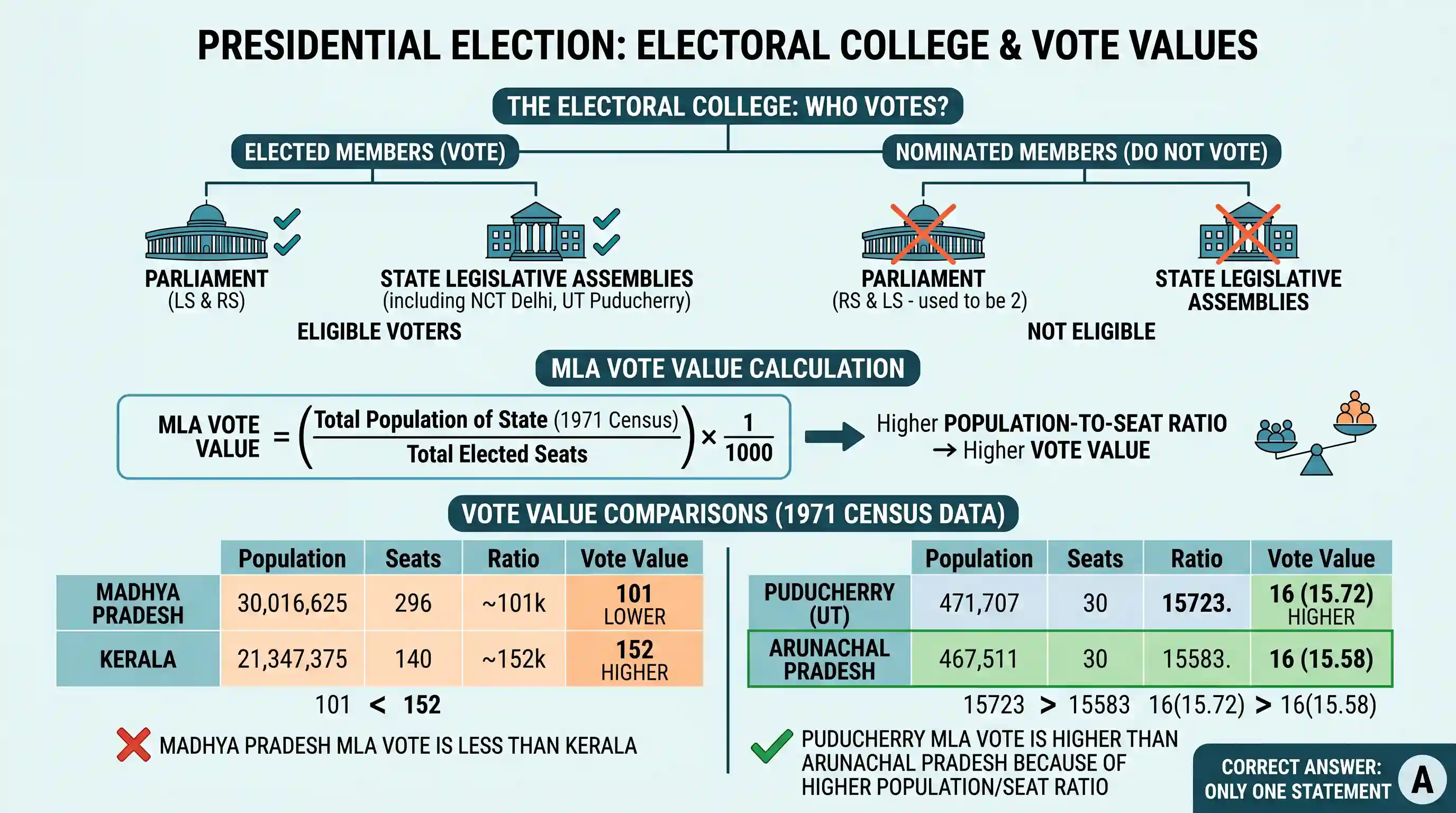
The Electoral College for the President's election comprises the elected members of both Houses of Parliament and the elected members of the Legislative Assemblies of the States (including the National Capital Territory of Delhi and the Union Territory of Puducherry). Nominated members to any House of Parliament or State Legislative Assemblies are not eligible to be included in the Electoral College. Thus, Statement 1 is Incorrect.
-
The value of the vote of an MLA is calculated using the formula: (Total Population of the State (1971 Census) / Total number of elected MLAs) x 1/1000. This implies that a higher ratio of population to elective Assembly seats results in a higher value of vote. If the number of elective Assembly seats increases while population is constant, the value of each MLA's vote would decrease. Thus, Statement 2 is Incorrect.
-
To compare the vote values of MLAs from Madhya Pradesh and Kerala (based on 1971 census data):
Kerala (1971 population: 21,347,375; Elected MLAs: 140). Vote value = (21,347,375 / 140) / 1000 ≈ 152.48, rounded to 152. Madhya Pradesh (1971 population: 30,016,625; Elected MLAs: 296). Vote value = (30,016,625 / 296) / 1000 ≈ 101.40, rounded to 101. Since 101 is less than 152, the value of vote of each MLA of Madhya Pradesh is not greater than that of Kerala. Thus, Statement 3 is Incorrect.
- To compare the vote values of MLAs from Puducherry and Arunachal Pradesh (based on 1971 census data):
Puducherry (1971 population: 471,707; Elected MLAs: 30). Ratio (Pop/MLAs) ≈ 15723.56. Vote value = (471,707 / 30) / 1000 ≈ 15.72, rounded to 16. Arunachal Pradesh (1971 population: 467,511; Elected MLAs: 30). Ratio (Pop/MLAs) ≈ 15583.7. Vote value = (467,511 / 30) / 1000 ≈ 15.58, rounded to 16. While both round to 16, the unrounded value for Puducherry (15.72) is indeed higher than that of Arunachal Pradesh (15.58), and the stated reason (ratio of total population to total number of elective seats in Puducherry is greater) is also correct. Thus, Statement 4 is Correct.
Therefore, only one statement is correct.
Related questions
More UPSC Prelims practice from the same subject and topic.
- Prelims 2023GS1polity-and-governance
In essence, what does 'Due Process of Law' mean?
- Prelims 2023GS1polity-and-governance
Which one of the following statements best reflects the Chief purpose of the 'Constitution' of a country?
- Prelims 2023GS1polity-and-governance
In India, which one of the following Constitutional Amendments was widely believed to be enacted to overcome the judicial interpretations of the Fundamental Rights?
- Prelims 2023GS1polity-and-governance
Consider the following statements: 1. If the election of the President of India is declared void by the Supreme Court of India, all acts done by him/her in the performance of duties of his/her office …
- Prelims 2023GS1polity-and-governance
With reference to Finance Bill and Money Bill in the Indian Parliament, consider the following statements: 1. When the Lok Sabha transmits Finance Bill to the Rajya Sabha, it can amend or reject the B…
- Prelims 2023GS1polity-and-governance
Consider the following statements: 1. According to the Constitution of India, the Central Government has a duty to protect States from internal disturbances. 2. The Constitution of India exempts the S…