The 5-digit number PQRST (all distinct digits) is such that T ≠ 0. P is thrice T. S is greater than Q by 4, while Q is greater than R by 3. How many such 5-digit numbers are possible?

- A3
- B4Correct
- C5
- D6
Explanation
To solve this, we identify the relationships between the digits P, Q, R, S, and T based on the given conditions:
-
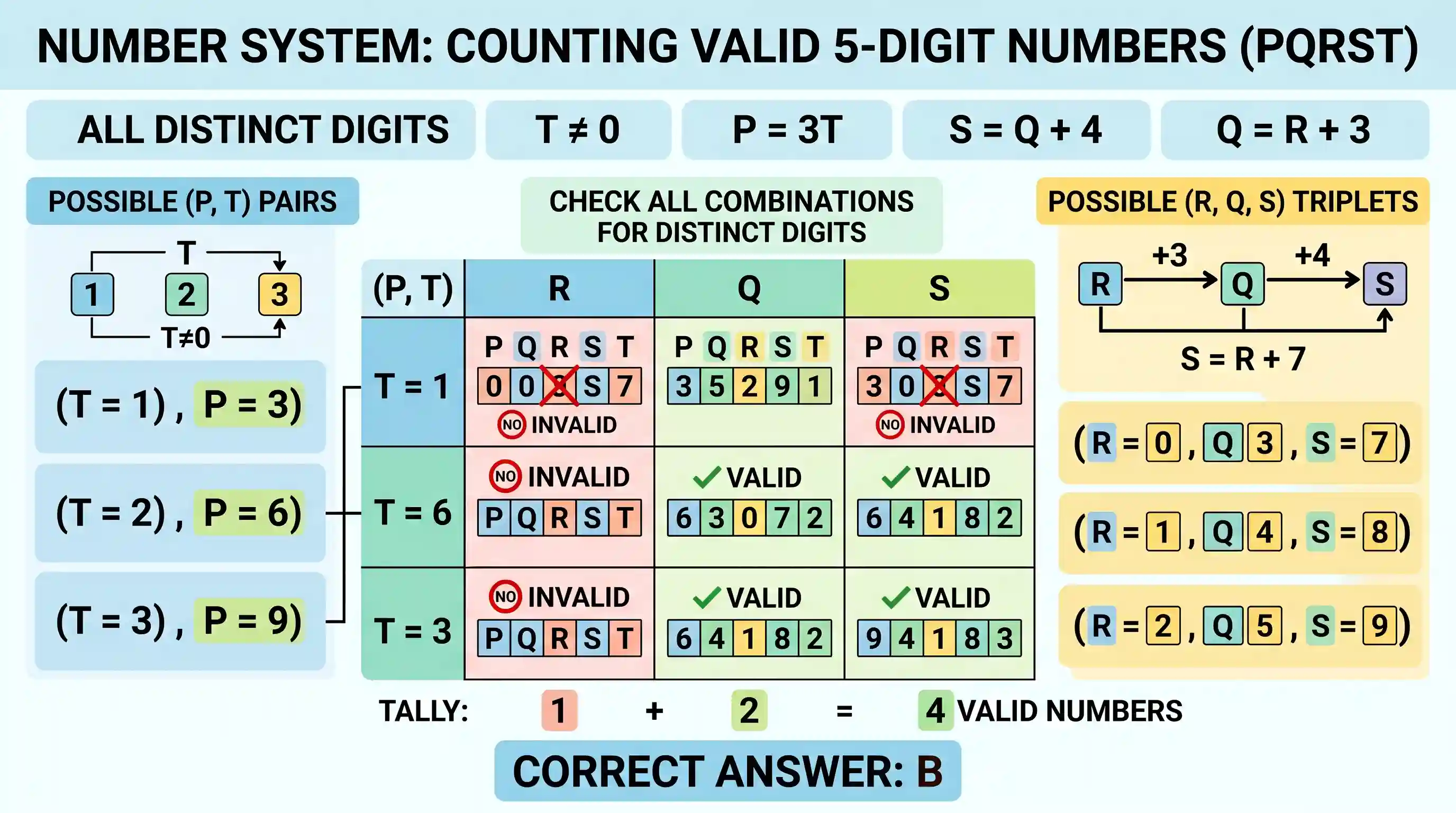
P is thrice T (P = 3T). Since P and T are single digits and T is not 0, T can only be 1, 2, or 3. If T = 1, then P = 3. If T = 2, then P = 6. If T = 3, then P = 9.
-
S is 4 more than Q, and Q is 3 more than R. This gives us the relationship: S = Q + 4 and Q = R + 3. Combining these, S = R + 7.
-
We test the possible values for R to find valid (R, Q, S) combinations: If R = 0, then Q = 3 and S = 7. If R = 1, then Q = 4 and S = 8. If R = 2, then Q = 5 and S = 9. R cannot be 3 or more because S would then exceed 9.
-
Now we combine (P, T) with (R, Q, S) while ensuring all five digits are distinct: Case 1: T = 1, P = 3. With (0, 3, 7): Invalid (3 is repeated). With (1, 4, 8): Invalid (1 is repeated). With (2, 5, 9): Valid (Digits: 3, 5, 2, 9, 1).
Case 2: T = 2, P = 6. With (0, 3, 7): Valid (Digits: 6, 3, 0, 7, 2). With (1, 4, 8): Valid (Digits: 6, 4, 1, 8, 2). With (2, 5, 9): Invalid (2 is repeated).
Case 3: T = 3, P = 9. With (0, 3, 7): Invalid (3 is repeated). With (1, 4, 8): Valid (Digits: 9, 4, 1, 8, 3). With (2, 5, 9): Invalid (9 is repeated).
Counting the valid combinations, we get 1 + 2 + 1 = 4 possible numbers. Therefore, option B is correct.
Related questions
More UPSC Prelims practice from the same subject and topic.
- Prelims 2025CSATQuantitative Aptitude
A natural number N is such that it can be expressed as N = p + q + r , where p, q and r are distinct factors of N. How many numbers below 50 have this property?
- Prelims 2025CSATQuantitative Aptitude
Three prime numbers p, q and r, each less than 20, are such that p - q = q - r . How many distinct possible values can we get for (p + q + r) ?
- Prelims 2025CSATQuantitative Aptitude
How many possible values of (p + q + r) are there satisfying (1)/(p) + (1)/(q) + (1)/(r) = 1 , where p, q and r are natural numbers (not necessarily distinct)?
- Prelims 2025CSATQuantitative Aptitude
A 4-digit number N is such that when divided by 3, 5, 6, 9 leaves a remainder 1, 3, 4, 7 respectively. What is the smallest value of N?
- Prelims 2025CSATQuantitative Aptitude
What is the unit digit in the multiplication of 1× 3× 5× 7× 9× … × 999 ?
- Prelims 2025CSATQuantitative Aptitude
Consider the first 100 natural numbers. How many of them are not divisible by any one of 2, 3, 5, 7 and 9?