Which among the following actions would constitute the most appropriate directive(s) in resolving interpersonal conflict in an office with culturally diverse personnel? 1. Direct personnel to practise activities that are the cultural markers of diverse groups 2. Allow conflicts to resolve naturally over time to set an appropriate precedent of leadership 3. Encourage personnel to seek each other's perspectives Select the answer using the code given below.

- A1 and 3
- B2 only
- C3 onlyCorrect
- D2 and 3
Explanation
Correct Answer: C (3 only)
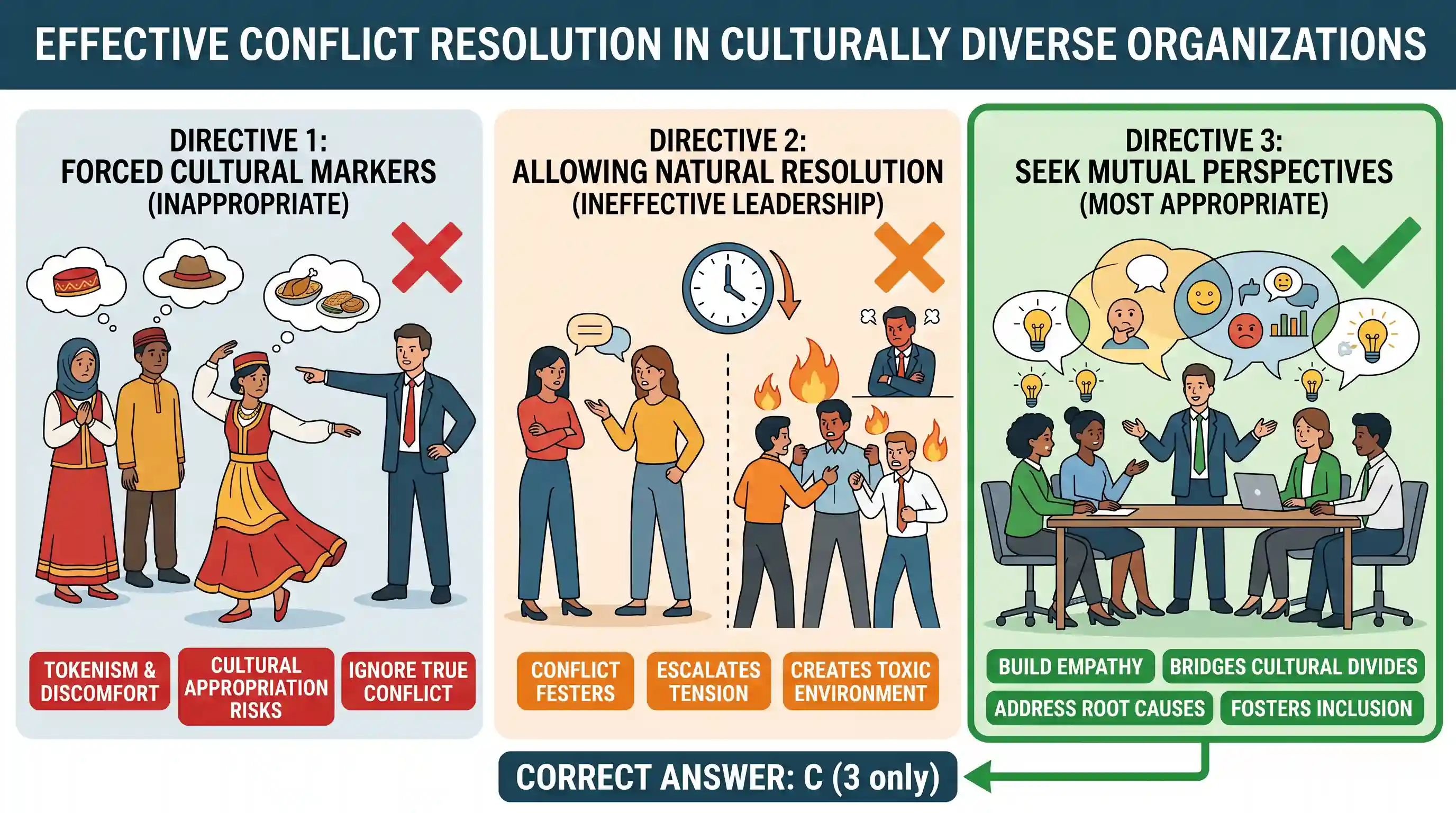
Why Option 3 is correct: Encouraging personnel to seek each other's perspectives (Statement 3) is a foundational principle of conflict resolution in modern organizational behavior. In a culturally diverse workplace, interpersonal conflicts frequently stem from miscommunication, unconscious biases, or differing cultural norms. According to human resource authorities such as the Society for Human Resource Management (SHRM), actively promoting perspective-taking and empathetic listening bridges cultural divides. This proactive dialogue addresses the root causes of misunderstandings, fosters psychological safety, and ensures that diverse viewpoints are respected rather than marginalized.
Why the other options are incorrect:
- Statement 1 is incorrect: Mandating personnel to engage in the "cultural markers" or practices of diverse groups is an inappropriate administrative directive. This forced participation can lead to tokenism, cultural appropriation, or deep discomfort, and it blatantly ignores the actual interpersonal dynamics causing the conflict.
- Statement 2 is incorrect: Adopting a laissez-faire approach—allowing conflicts to "resolve naturally" over time—is a failure of leadership. Unmanaged conflicts in diverse settings rarely resolve on their own; instead, they fester and escalate into toxic work environments, reducing team cohesion and productivity.
Concluding Takeaway: Effective administrative leadership requires a PRO approach to conflict: Proactive intervention, Respectful dialogue, and Open perspective-taking. Avoidance (laissez-faire) and forced cultural assimilation are always counterproductive in governance and management.
Related questions
More UPSC Prelims practice from the same subject and topic.
- Prelims 2026GS1other
Which of the following statements with regard to the Grand Slam Tennis Tournaments is/are correct ? 1. The tournaments have a shared governance structure establishing the partnership among the four Gr…
- Prelims 2026GS1other
Ms. X is a mid-level civil service official working in the urban development department of a major city. Recently, she was involved in approving a contract for a public infrastructure project — a new …
- Prelims 2026GS1other
Which one of the following pairs is not correctly matched? (Indian Army Corps) : (Headquarters)
- Prelims 2026CSATother
For ⅓ < x < y < 2, which of the following statements is/are always correct? I. x + 1/x < y + 1/y II. √(1 + y²)/y < √(1 + x²)/x Select the answer using the code given below.
- Prelims 2026CSATother
What is the minimum number of times one needs to measure to get 298 litres of water from a tank, if the measuring cylinders have capacities 1 litre, 6 litres, 25 litres and 100 litres?
- Prelims 2026CSATother
There are four types of weights, namely 1 kg, 2 kg, 5 kg and 10 kg. What is the maximum number of different ways one can measure 20 kg, if at least eight but not more than eleven weights of 1 kg are t…