Match List-I with List-II and select the answer using the code given below the Lists : List-I (Barrier to communication) A. Semantic B. Cognitive C. Organisational D. Affective List-II (Example) 1. Lack of feedback 2. Misunderstanding the meaning of a word 3. Fear of social stigma 4. Information overload Code :

- AA-3, B-1, C-4, D-2
- BA-3, B-4, C-1, D-2
- CA-2, B-1, C-4, D-3
- DA-2, B-4, C-1, D-3Correct
Explanation
The correct answer is Option D.
In communication theory, barriers are categorized based on their source or nature. The correct matching aligns with standard organizational behavior and communication studies:
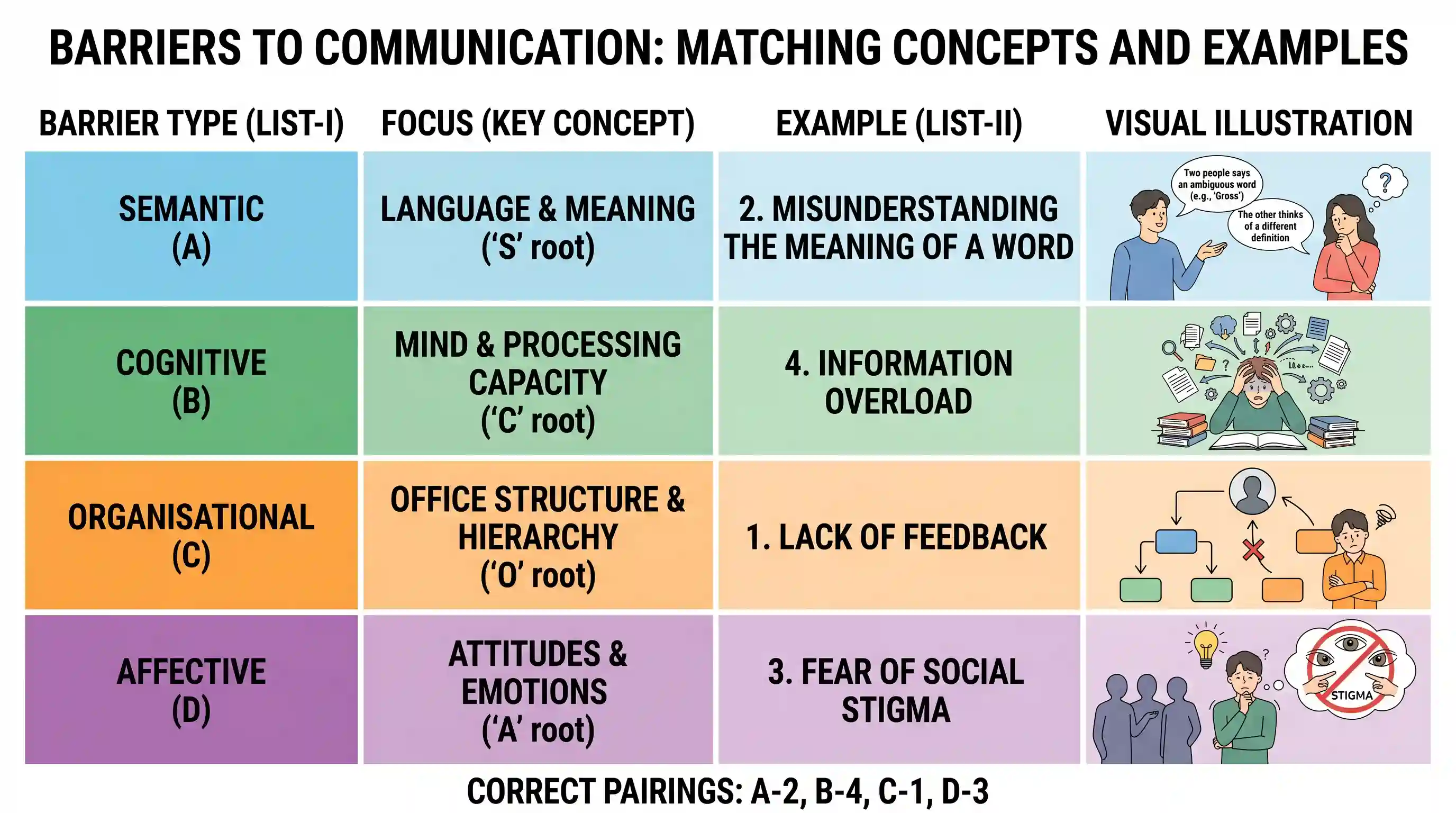
- Semantic Barrier (A-2): "Semantics" is the study of meaning in language. Semantic barriers occur when the sender and receiver have different interpretations of a message or symbol. Therefore, misunderstanding the meaning of a word is a classic semantic barrier.
- Cognitive Barrier (B-4): "Cognition" involves mental processes such as perception, memory, and analytical capacity. When an individual is bombarded with too much data, their brain's processing capacity is overwhelmed. Thus, information overload constitutes a cognitive barrier.
- Organisational Barrier (C-1): These barriers stem from rigid hierarchies, restrictive policies, or complex organizational structures. Such structural bottlenecks often block the upward or downward flow of communication, resulting in a lack of feedback.
- Affective Barrier (D-3): The term "affective" pertains to emotions, feelings, and psychological attitudes. Negative emotional states, such as anxiety, stress, or the fear of social stigma, prevent individuals from opening up and communicating honestly.
Why the other options are incorrect:
- Option A incorrectly pairs Semantic with Fear of social stigma (3). Stigma is an emotional (affective) barrier, not a linguistic one.
- Option B correctly matches Organisational with Lack of feedback (1), but wrongly pairs Semantic with Fear of social stigma (3), violating the linguistic definition of semantics.
- Option C correctly identifies the Semantic barrier (2), but incorrectly pairs Cognitive with Lack of feedback (1). Feedback deficiency is a structural issue, while cognition relates to mental limits like overload.
Takeaway Mnemonic: Remember the roots: Semantic = Speech/Language; Cognitive = Capacity of the mind; Organisational = Office structure/Hierarchy; Affective = Attitudes/Emotions.
Related questions
More UPSC Prelims practice from the same subject and topic.
- Prelims 2026GS1other
Which of the following statements with regard to the Grand Slam Tennis Tournaments is/are correct ? 1. The tournaments have a shared governance structure establishing the partnership among the four Gr…
- Prelims 2026GS1other
Ms. X is a mid-level civil service official working in the urban development department of a major city. Recently, she was involved in approving a contract for a public infrastructure project — a new …
- Prelims 2026GS1other
Which one of the following pairs is not correctly matched? (Indian Army Corps) : (Headquarters)
- Prelims 2026CSATother
For ⅓ < x < y < 2, which of the following statements is/are always correct? I. x + 1/x < y + 1/y II. √(1 + y²)/y < √(1 + x²)/x Select the answer using the code given below.
- Prelims 2026CSATother
What is the minimum number of times one needs to measure to get 298 litres of water from a tank, if the measuring cylinders have capacities 1 litre, 6 litres, 25 litres and 100 litres?
- Prelims 2026CSATother
There are four types of weights, namely 1 kg, 2 kg, 5 kg and 10 kg. What is the maximum number of different ways one can measure 20 kg, if at least eight but not more than eleven weights of 1 kg are t…