Our urban bodies cannot possibly ensure sustainable delivery of water in our cities unless financing mechanisms are put in place. Water delivery requires heavy investment in collecting it from a natural source, treating it to make it potable, and laying a distribution network of pipes for delivery to the users. It also requires investments in sewerage infrastructure and sewage treatment plants so that the sewers can carry the wastewater to these plants to ensure that no untreated sewage is discharged back into natural water bodies. If our cities were rich enough to meet the entire cost, water could be delivered free. They are not With reference to the above passage, the following assumptions have been made: Rich cities only can ensure sustainable delivery of water. Sustainable delivery of water in cities means much more than supplying water to households. Which of the above assumptions is/are valid?

- A1 only
- B2 onlyCorrect
- CBoth 1 and 2
- DNeither 1 nor 2
Explanation
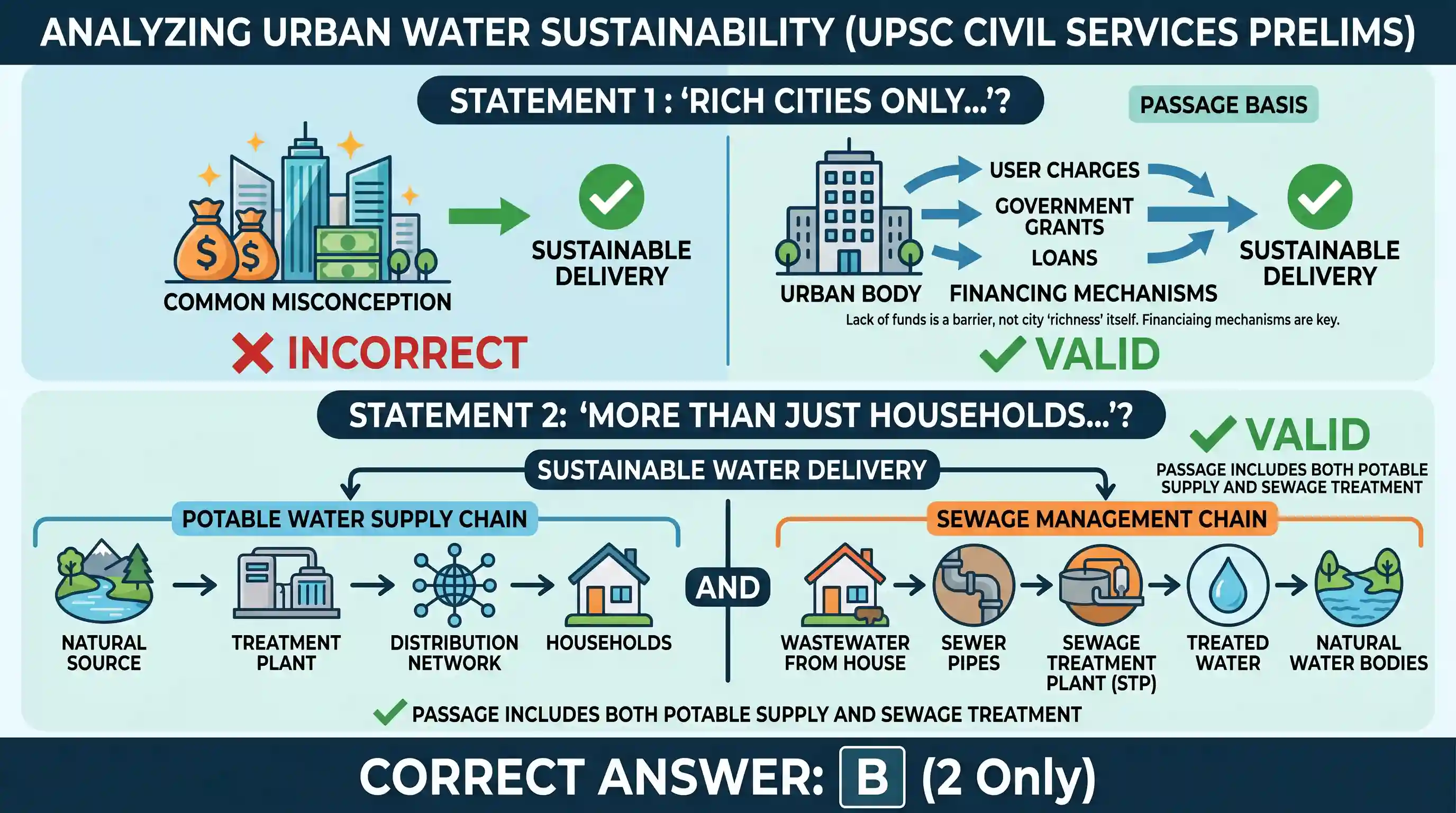
The passage highlights that sustainable water delivery requires heavy investment not only in collecting, treating, and distributing potable water to users (households) but also in sewerage infrastructure and sewage treatment plants to prevent untreated sewage discharge.
Analyzing Statement 1: "Rich cities only can ensure sustainable delivery of water." The passage states that "Our urban bodies cannot possibly ensure sustainable delivery of water in our cities unless financing mechanisms are put in place." It also mentions, "If our cities were rich enough to meet the entire cost, water could be delivered free. They are not." This implies that lack of funds is a major barrier and that being rich enough to cover the entire cost would allow free delivery. However, it does not state that only rich cities can ensure sustainable delivery. A city might not be inherently "rich" but can still achieve sustainable delivery through effective financing mechanisms (e.g., user charges, government grants, loans, public-private partnerships). The assumption that only rich cities can do it is an overstatement not directly supported by the passage.
Analyzing Statement 2: "Sustainable delivery of water in cities means much more than supplying water to households." The passage explicitly details the components of water delivery: "Water delivery requires heavy investment in collecting it from a natural source, treating it to make potable, and laying a distribution network of pipes for delivery to the users." It then adds, "It also requires investments in sewerage infrastructure and sewage treatment plants so that the sewers can carry the wastewater to these plants to ensure that no untreated sewage is discharged back into natural water bodies." The phrase "It also requires..." clearly indicates that sewerage and sewage treatment are integral parts of sustainable water delivery, going beyond just supplying potable water to households. This statement is directly supported by the passage.
Therefore, only assumption 2 is valid.
The final answer is B.
Related questions
More UPSC Prelims practice from the same subject and topic.
- Prelims 2020CSATReading Comprehension
In India, over the last decade or so, labour has been departing agriculture, but is only going to construction and unregistered manufacturing which are not markedly better jobs. Services, where labour…
- Prelims 2020CSATReading Comprehension
In India, the current focus on the right to privacy is based on some new realities of the digital age. A right is a substantive right only if it works in all situations, and for everyone. A right to f…
- Prelims 2020CSATReading Comprehension
One of the biggest ironies around water is that it comes from rivers and other wetlands. Yet it is seen as divorced from them. While water is used as a resource, public policy does not always grasp th…
- Prelims 2020CSATReading Comprehension
Asset allocation is the most important investment decision we will ever make, and sadly, most of us do not give that decision the importance it deserves. We are adamant about seeking predictability wi…
- Prelims 2020CSATReading Comprehension
Although most of the Genetically Modified (GM) crops cultivated now are genetically engineered for a single trait, in future, crops genetically engineered for more than one trait will be the norm. Thu…
- Prelims 2020CSATReading Comprehension
Although most of the Genetically Modified (GM) crops cultivated now are genetically engineered for a single trait, in future, crops genetically engineered for more than one trait will be the norm. Thu…