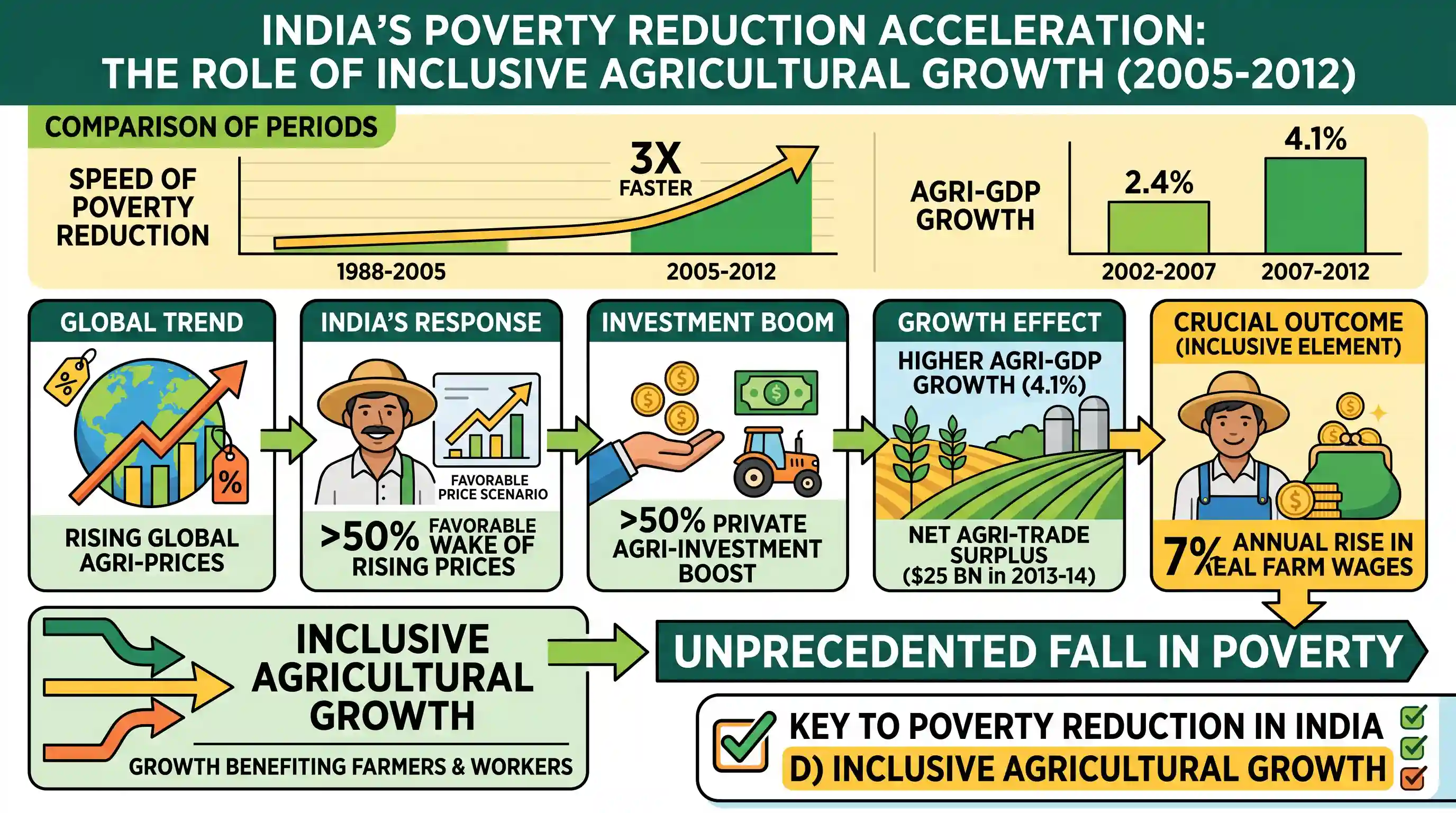
In India, agriculture still engages about half of workforce, and about 85 per cent of its farms mall and marginal. Compared to China Vietnam, which have experienced fast structural and rural transformation, India's story is of slow transformation. As a result, poverty reduction in India was at a much slower pace during 1988—2014, compared to China and Vietnam. India's poverty reduction was slow during 1988-2005, but during 2005-2012, it accelerated dramatically—almost three times faster than during the earlier period. What did India do during this period? Research reveals that the relative price scenario changed significantly (by more than 50%) in favour of agriculture in the wake of rising global prices. This boosted private investments in agriculture by more than 5o%. As a result, agri-GDP growth touched 4/1% during 2007- 2012 as against 2.4% during 2002—2007. The net surplus or agri-trade touched 25 billion in 2013-2014: real farm wages rose by 7% per annum. All this led to unprecedented fall in poverty. Which one of the following statements best reflects the critical message of the passage?

- AIndia should create large-scale off-farm rural employment to reduce poverty in the near future
- BIndia should create a large number of farmer producer companies
- CPrivate investment in agriculture should be given priority over public investment
- DInclusive agricultural growth is key to reduce poverty in the near future.Correct
Explanation
The critical message of the passage revolves around the period 2005-2012 when India experienced a dramatic acceleration in poverty reduction. The passage attributes this to several factors within the agricultural sector:
- A significant change in relative prices in favor of agriculture.
- A boost in private investments in agriculture.
- Resulting higher agri-GDP growth (4.1% vs 2.4%).
- Increased agri-trade surplus.
- Crucially, real farm wages rose by 7% per annum.
All these factors collectively led to an "unprecedented fall in poverty." This indicates that growth within the agricultural sector, which benefited a large segment of the population (especially those engaged in farming and farm labor, as evidenced by rising wages), was the key driver of poverty reduction.
Let's analyze the options:
A) India should create large-scale off-farm rural employment to reduce poverty in the near future. The passage focuses on the impact of on-farm improvements (agri-GDP growth, farm wages) on poverty reduction during the specified period. While off-farm employment is important for structural transformation, the passage's critical message specifically highlights the role of growth within agriculture in reducing poverty.
B) India should create a large number of farmer producer companies. Farmer producer companies (FPCs) are a mechanism that can help farmers achieve better prices and access investments. However, the passage does not explicitly mention or advocate for FPCs as the specific driver or solution. It talks about a general shift in prices and private investment, not a particular organizational structure.
C) Private investment in agriculture should be given priority over public investment. The passage notes that private investment in agriculture increased significantly. It does not, however, make a comparative argument prioritizing private over public investment. It merely states the positive impact of increased private investment, which itself was boosted by favorable price scenarios.
D) Inclusive agricultural growth is key to reduce poverty in the near future. This statement perfectly encapsulates the passage's message. "Inclusive agricultural growth" means growth in the agricultural sector that benefits a wide range of people, particularly the poor, who are engaged in agriculture. The passage explicitly states that higher agri-GDP growth, coupled with a significant rise in real farm wages, led to an "unprecedented fall in poverty." Since agriculture still engages about half of India's workforce and 85% of farms are small and marginal, growth that leads to higher wages and better incomes for these segments is inherently inclusive and directly impacts poverty reduction. The acceleration of poverty reduction was a direct result of agricultural growth that benefited the agricultural workforce.
The final answer is D
Related questions
More UPSC Prelims practice from the same subject and topic.
- Prelims 2020CSATReading Comprehension
In India, over the last decade or so, labour has been departing agriculture, but is only going to construction and unregistered manufacturing which are not markedly better jobs. Services, where labour…
- Prelims 2020CSATReading Comprehension
In India, the current focus on the right to privacy is based on some new realities of the digital age. A right is a substantive right only if it works in all situations, and for everyone. A right to f…
- Prelims 2020CSATReading Comprehension
One of the biggest ironies around water is that it comes from rivers and other wetlands. Yet it is seen as divorced from them. While water is used as a resource, public policy does not always grasp th…
- Prelims 2020CSATReading Comprehension
Asset allocation is the most important investment decision we will ever make, and sadly, most of us do not give that decision the importance it deserves. We are adamant about seeking predictability wi…
- Prelims 2020CSATReading Comprehension
Although most of the Genetically Modified (GM) crops cultivated now are genetically engineered for a single trait, in future, crops genetically engineered for more than one trait will be the norm. Thu…
- Prelims 2020CSATReading Comprehension
Although most of the Genetically Modified (GM) crops cultivated now are genetically engineered for a single trait, in future, crops genetically engineered for more than one trait will be the norm. Thu…