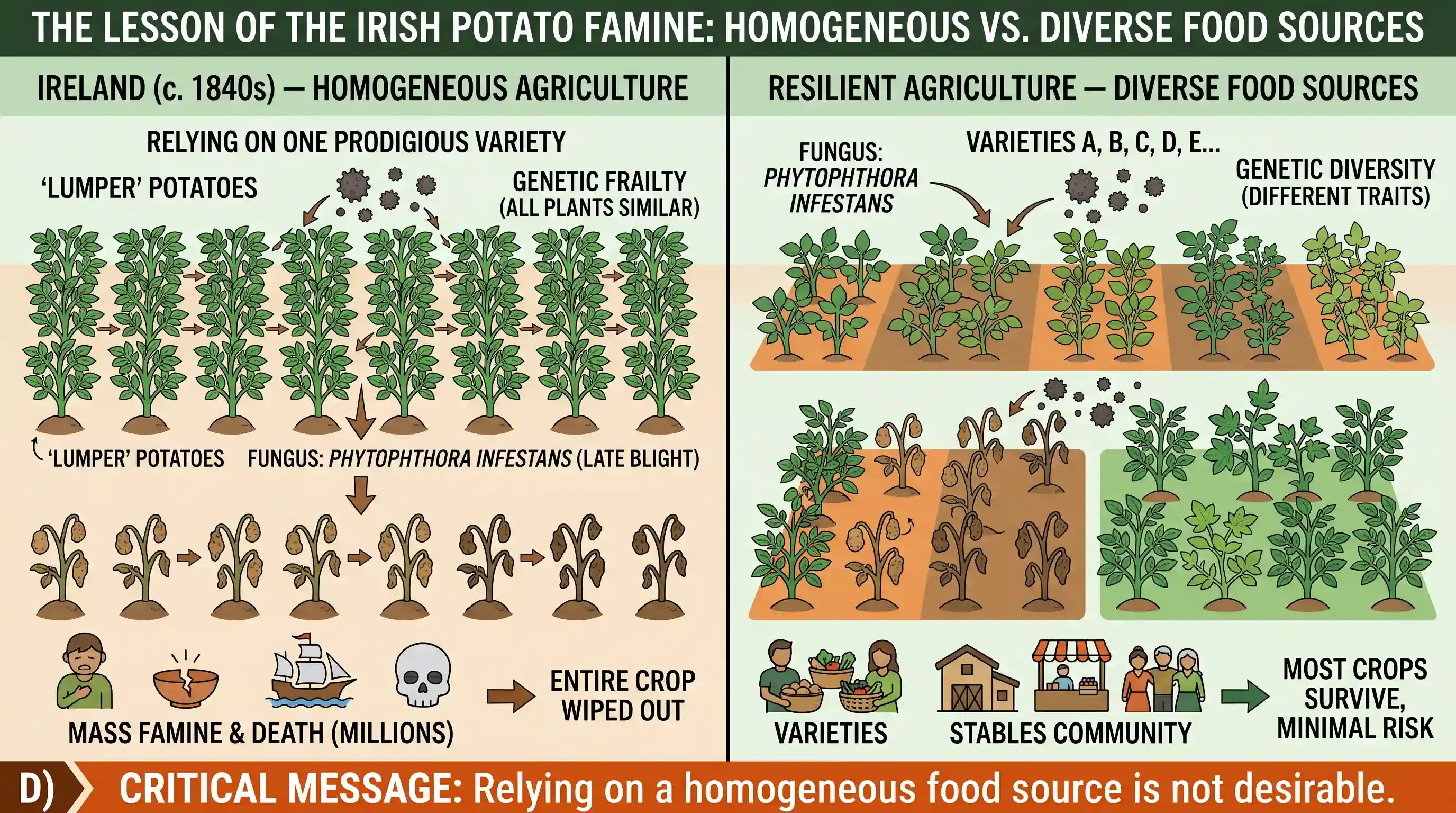
Spanish ships in the late 16th century first brought the potato tuber from South America to Europe whereby in the early 19th century, it bad become a reliable backup to cereal crops, particularly in the cold, rain- soaked soils of Ireland. The Irish were soon almost wholly dependent on the potato as their staple food. And they were planting primarily one prodigious variety, the 'Lumper' potato, whose genetic frailty would be cruelly exposed by the fungus 'Phytophthora infestans'. In 1845, spores of the deadly fungus began spreading across the country, destroying nearly all the Lumpers in its path. The resulting famine killed or displaced millions. Which one of the following statements best reflects the critical message or the passage?

- AFor introducing any foreign plant into a country, the soil and climate conditions of that country should be suitable
- BAs a staple food of a country, tuber crops like potato cannot replace cereal crops
- CSome or the fungal infections or plants cannot be prevented or stopped from spreading across large areas
- DRelying on a homogeneous food source is not desirable.Correct
Explanation
The critical message of the passage revolves around the disastrous consequences of Ireland's over-reliance on a single, genetically fragile variety of potato, the 'Lumper'. When a fungus attacked this one variety, the entire food system collapsed, leading to famine.
Let's analyze each option:
A) For introducing any foreign plant into a country, the soil and climate conditions of that country should be suitable. This statement is not the critical message. The passage explicitly states the potato did become a reliable backup and staple in Ireland, indicating the soil and climate were suitable. The problem wasn't suitability, but the subsequent over-reliance on a single variety.
B) As a staple food of a country, tuber crops like potato cannot replace cereal crops. This contradicts the passage. The passage states the Irish "were soon almost wholly dependent on the potato as their staple food," meaning it did replace cereal crops for them. The issue wasn't the replacement itself, but the lack of diversity in the replacement.
C) Some or the fungal infections or plants cannot be prevented or stopped from spreading across large areas. While the spread of the fungus was the immediate cause of the crop failure, this is a detail of the event, not the overarching critical message. The famine's devastating scale was due to the population's vulnerability created by relying on a single crop, not just the existence of the fungus. If there had been diverse potato varieties, the impact would have been mitigated.
D) Relying on a homogeneous food source is not desirable. This statement perfectly encapsulates the critical message. The Irish famine was a direct consequence of relying "almost wholly" on one "prodigious variety" (the 'Lumper' potato), which was genetically frail. This lack of diversity (homogeneity) made the entire population vulnerable to a single disease, leading to catastrophic famine. The passage serves as a cautionary tale against such reliance.
Related questions
More UPSC Prelims practice from the same subject and topic.
- Prelims 2020CSATReading Comprehension
In India, over the last decade or so, labour has been departing agriculture, but is only going to construction and unregistered manufacturing which are not markedly better jobs. Services, where labour…
- Prelims 2020CSATReading Comprehension
In India, the current focus on the right to privacy is based on some new realities of the digital age. A right is a substantive right only if it works in all situations, and for everyone. A right to f…
- Prelims 2020CSATReading Comprehension
One of the biggest ironies around water is that it comes from rivers and other wetlands. Yet it is seen as divorced from them. While water is used as a resource, public policy does not always grasp th…
- Prelims 2020CSATReading Comprehension
Asset allocation is the most important investment decision we will ever make, and sadly, most of us do not give that decision the importance it deserves. We are adamant about seeking predictability wi…
- Prelims 2020CSATReading Comprehension
Although most of the Genetically Modified (GM) crops cultivated now are genetically engineered for a single trait, in future, crops genetically engineered for more than one trait will be the norm. Thu…
- Prelims 2020CSATReading Comprehension
Although most of the Genetically Modified (GM) crops cultivated now are genetically engineered for a single trait, in future, crops genetically engineered for more than one trait will be the norm. Thu…