India is at once among the fastest growing global economies and home to the largest number of malnourished children in the world. There are regions where malnutrition is not the exception but the norm. And across the country, malnutrition is the cause of death for roughly half the 1-3 million children who die before their fifth birthday each year. Even those children who survive suffer permanently from the damage that has already been done to their bodies and minds from not getting enough of the right foods and nutrients. Around 44 million children under 5 are stunted. That makes it harder for them to learn in school and subsequently earn a living as adults. Their lifetime earnings potential is almost a quarter less than that or their healthy peers. With reference to the above passage, which of the following is/are the most rational and practical implication/ implications? India's Public Distribution System should be monitored by the Union Government. Girls should be encouraged to delay marriage and first pregnancy. Mothers should be encouraged to breastfeed their children immediately after birth. The supply of safe drinking water and proper sanitation facilities to all should be ensured. Authorities should ensure the vaccination as prescribed Select the correct answer using the code given below

- A1, 2, 3 and 4
- B2, 3, 4 and 5
- C1 onlyCorrect
- D3 and 5 only
Explanation
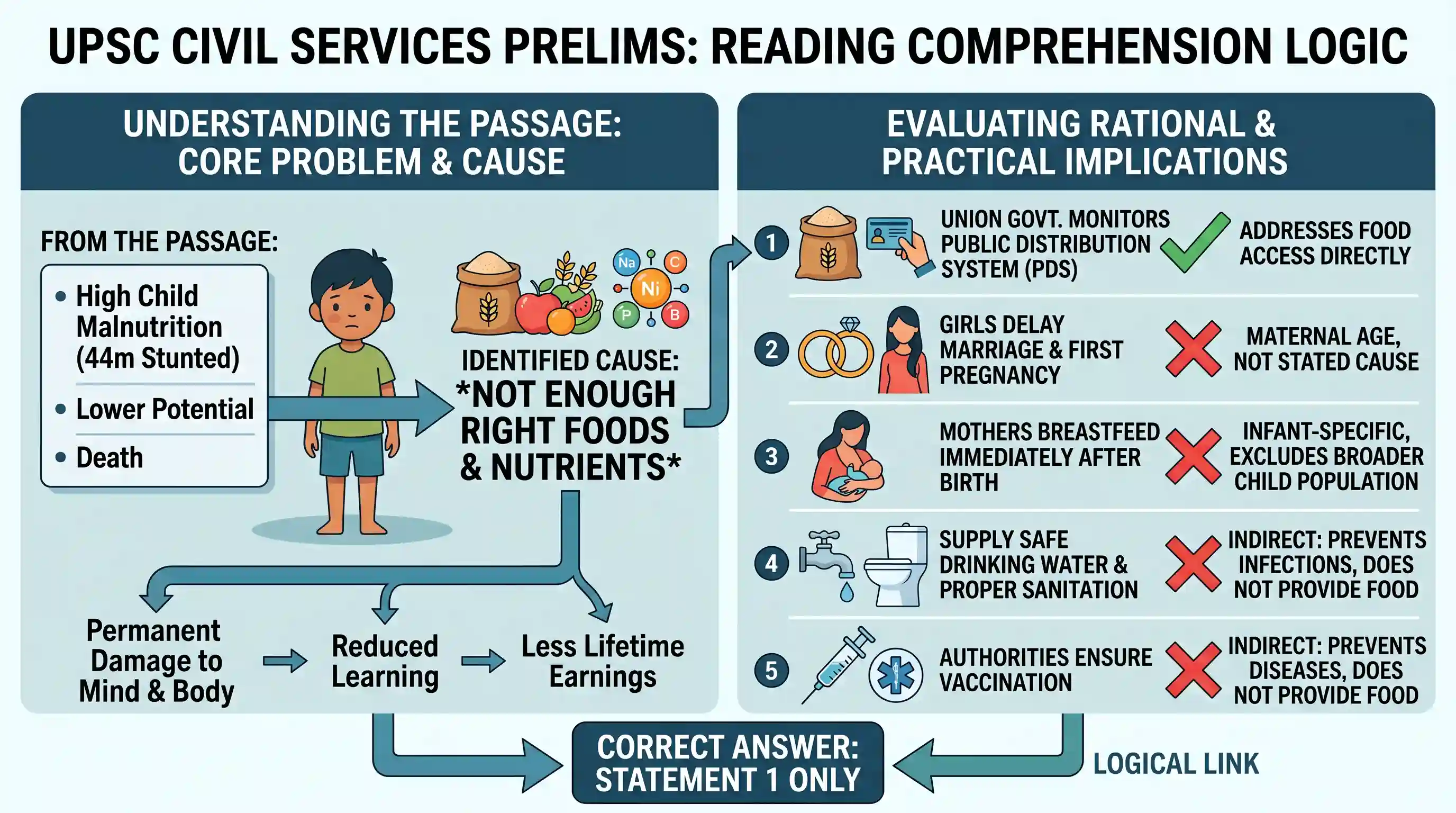
The passage highlights that India, despite economic growth, has a large number of malnourished children due to "not getting enough of the right foods and nutrients." This leads to stunting, learning difficulties, reduced earning potential, and death.
Let's analyze each statement:
-
India's Public Distribution System should be monitored by the Union Government.
- The passage clearly states the problem is "not getting enough of the right foods and nutrients." The Public Distribution System (PDS) is a key government mechanism for providing food security and ensuring access to food, especially for vulnerable populations. If malnutrition is widespread due to lack of food/nutrients, then monitoring and improving the PDS is a direct, rational, and practical implication to address the core problem of food access and availability.
-
Girls should be encouraged to delay marriage and first pregnancy.
- While delaying marriage and pregnancy has positive impacts on maternal and child health, the passage focuses specifically on the lack of food and nutrients causing malnutrition in children. It does not discuss maternal age or pregnancy timing as the direct cause of this specific problem. This is a broader social health implication, not the most direct one from the passage's focus.
-
Mothers should be encouraged to breastfeed their children immediately after birth.
- Breastfeeding is crucial for infant nutrition and immunity. However, the passage discusses malnutrition broadly, affecting children up to five years old, and specifically mentions "not getting enough of the right foods and nutrients" as the cause. While breastfeeding is part of "right nutrients" for infants, the passage's scope is wider than just immediate postnatal feeding. It implies a systemic issue of food and nutrient access for children across various stages, not solely a lack of breastfeeding.
-
The supply of safe drinking water and proper sanitation facilities to all should be ensured.
- Safe water and sanitation are vital for preventing infections (like diarrhea) that exacerbate malnutrition by impairing nutrient absorption. However, the passage explicitly attributes malnutrition to "not getting enough of the right foods and nutrients." While an important indirect factor, it's not the primary cause stated in the passage.
-
Authorities should ensure the vaccination as prescribed.
- Vaccinations prevent diseases, which can indirectly reduce malnutrition by keeping children healthy and improving their ability to absorb nutrients. Similar to safe water and sanitation, this is an important public health measure but not the direct cause of malnutrition highlighted in the passage, which is the lack of food and nutrients.
Conclusion: Statement 1 is the most direct, rational, and practical implication because it addresses the core issue identified in the passage: the lack of "enough of the right foods and nutrients" through a systemic governmental mechanism (PDS). The other statements, while important for overall child health, are either indirect implications or address only a specific aspect of the broader malnutrition problem as described in the passage.
The final answer is C
Related questions
More UPSC Prelims practice from the same subject and topic.
- Prelims 2020CSATReading Comprehension
In India, over the last decade or so, labour has been departing agriculture, but is only going to construction and unregistered manufacturing which are not markedly better jobs. Services, where labour…
- Prelims 2020CSATReading Comprehension
In India, the current focus on the right to privacy is based on some new realities of the digital age. A right is a substantive right only if it works in all situations, and for everyone. A right to f…
- Prelims 2020CSATReading Comprehension
One of the biggest ironies around water is that it comes from rivers and other wetlands. Yet it is seen as divorced from them. While water is used as a resource, public policy does not always grasp th…
- Prelims 2020CSATReading Comprehension
Asset allocation is the most important investment decision we will ever make, and sadly, most of us do not give that decision the importance it deserves. We are adamant about seeking predictability wi…
- Prelims 2020CSATReading Comprehension
Although most of the Genetically Modified (GM) crops cultivated now are genetically engineered for a single trait, in future, crops genetically engineered for more than one trait will be the norm. Thu…
- Prelims 2020CSATReading Comprehension
Although most of the Genetically Modified (GM) crops cultivated now are genetically engineered for a single trait, in future, crops genetically engineered for more than one trait will be the norm. Thu…