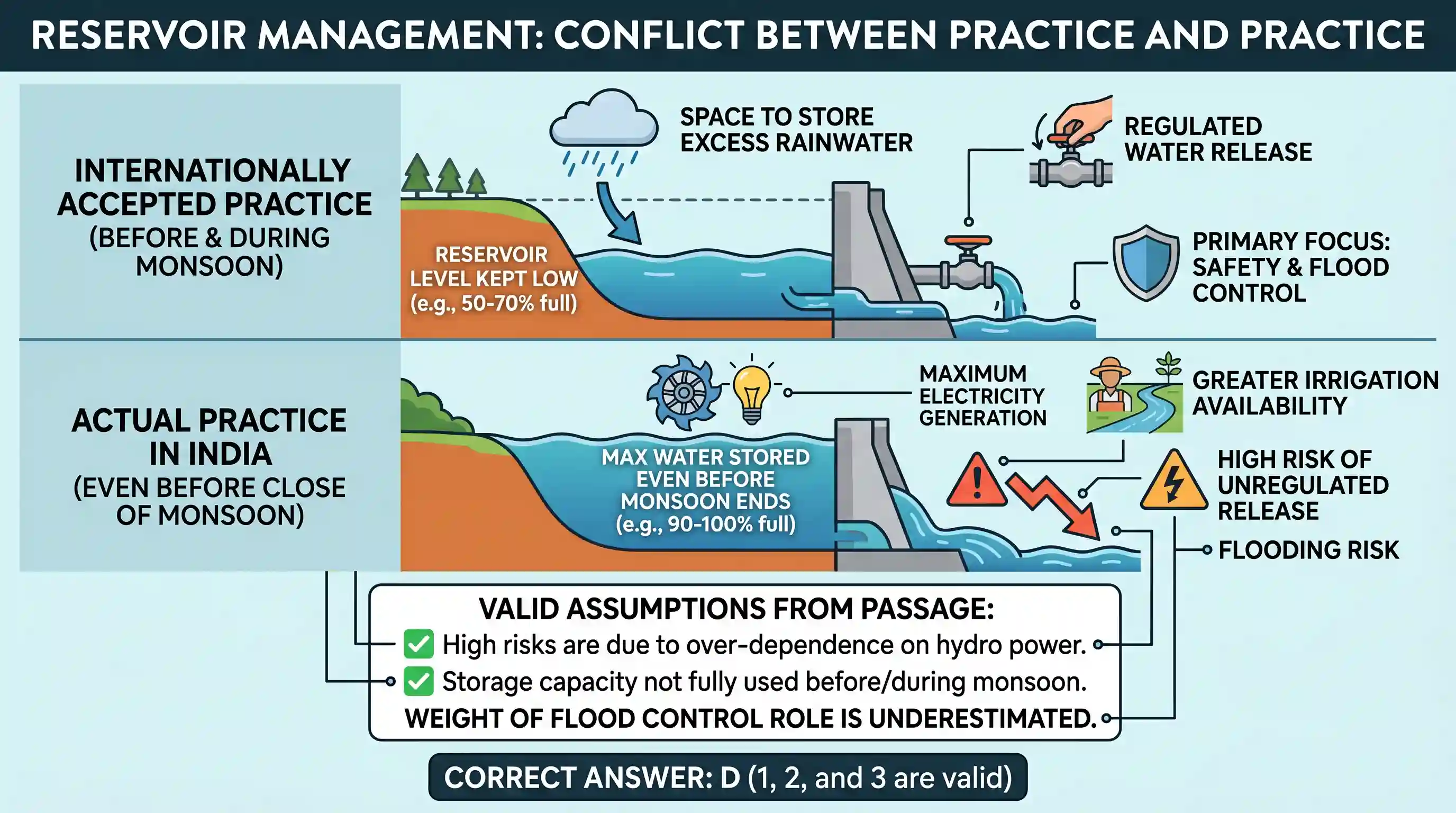
In India, authorities always look to store the maximum amount of water in reservoirs during the monsoon season, which is then used for irrigation and generation of electricity during the summer months. It is an internationally accepted practice that the water level or a reservoir should be kept below a certain level before the onset of monsoon season. This is so that when monsoon rains come, there is space to store the excess rainwater and also so that water can be released in a regulated manner. But the authorities store the maximum amount of water in reservoirs even before the close of the monsoon, only to ensure greater electricity generation and irrigation. With reference to the above passage, the following assumptions have been made: High risks involved in holding maximum water in reservoirs are due to our over- dependence on hydro power projects. Storage capacity of dams should not be fully used before or during monsoon season. Role of dams in flood control is underestimated in India. Which of the above assumptions is/are valid?

- A1 and 2 only
- B2- only
- C3 only
- D1, 2 and 3Correct
Explanation
The passage highlights a conflict between an internationally accepted practice for reservoir management and the actual practice in India.
Let's analyze each assumption:
-
High risks involved in holding maximum water in reservoirs are due to our over-dependence on hydro power projects. The passage states that Indian authorities store maximum water "only to ensure greater electricity generation and irrigation." This implies that the primary motivation for this risky practice (going against international norms) is the need for electricity and irrigation. If they prioritize electricity generation to this extent, it suggests a significant dependence on hydropower. The "high risks" are implied by the deviation from the internationally accepted practice, which aims to prevent issues by leaving space for excess water and regulated release. Thus, linking these risks to over-dependence on hydropower (a major source of electricity from reservoirs) is a valid assumption.
-
Storage capacity of dams should not be fully used before or during monsoon season. The passage explicitly states: "It is an internationally accepted practice that the water level or a reservoir should be kept below a certain level before the onset of monsoon season. This is so that when monsoon rains come, there is space to store the excess rainwater and also so that water can be released in a regulated manner." This directly supports the idea that the storage capacity should not be fully utilized before or during the monsoon to allow for flood absorption and regulated release. This assumption is directly stated as an international practice.
-
Role of dams in flood control is underestimated in India. The international practice mentioned is to keep reservoir levels low to "store the excess rainwater and also so that water can be released in a regulated manner." These actions are crucial for flood control. By contrasting this with the Indian practice of storing maximum water "even before the close of the monsoon" for electricity and irrigation, the passage implies that the flood control aspect (leaving space for excess water) is being overlooked or not prioritized. If authorities are not following practices that facilitate flood control, it suggests that this role of dams is underestimated in favor of other benefits like power generation and irrigation.
All three assumptions are valid inferences or direct statements derived from the provided passage.
The final answer is D
Related questions
More UPSC Prelims practice from the same subject and topic.
- Prelims 2020CSATReading Comprehension
In India, over the last decade or so, labour has been departing agriculture, but is only going to construction and unregistered manufacturing which are not markedly better jobs. Services, where labour…
- Prelims 2020CSATReading Comprehension
In India, the current focus on the right to privacy is based on some new realities of the digital age. A right is a substantive right only if it works in all situations, and for everyone. A right to f…
- Prelims 2020CSATReading Comprehension
One of the biggest ironies around water is that it comes from rivers and other wetlands. Yet it is seen as divorced from them. While water is used as a resource, public policy does not always grasp th…
- Prelims 2020CSATReading Comprehension
Asset allocation is the most important investment decision we will ever make, and sadly, most of us do not give that decision the importance it deserves. We are adamant about seeking predictability wi…
- Prelims 2020CSATReading Comprehension
Although most of the Genetically Modified (GM) crops cultivated now are genetically engineered for a single trait, in future, crops genetically engineered for more than one trait will be the norm. Thu…
- Prelims 2020CSATReading Comprehension
Although most of the Genetically Modified (GM) crops cultivated now are genetically engineered for a single trait, in future, crops genetically engineered for more than one trait will be the norm. Thu…