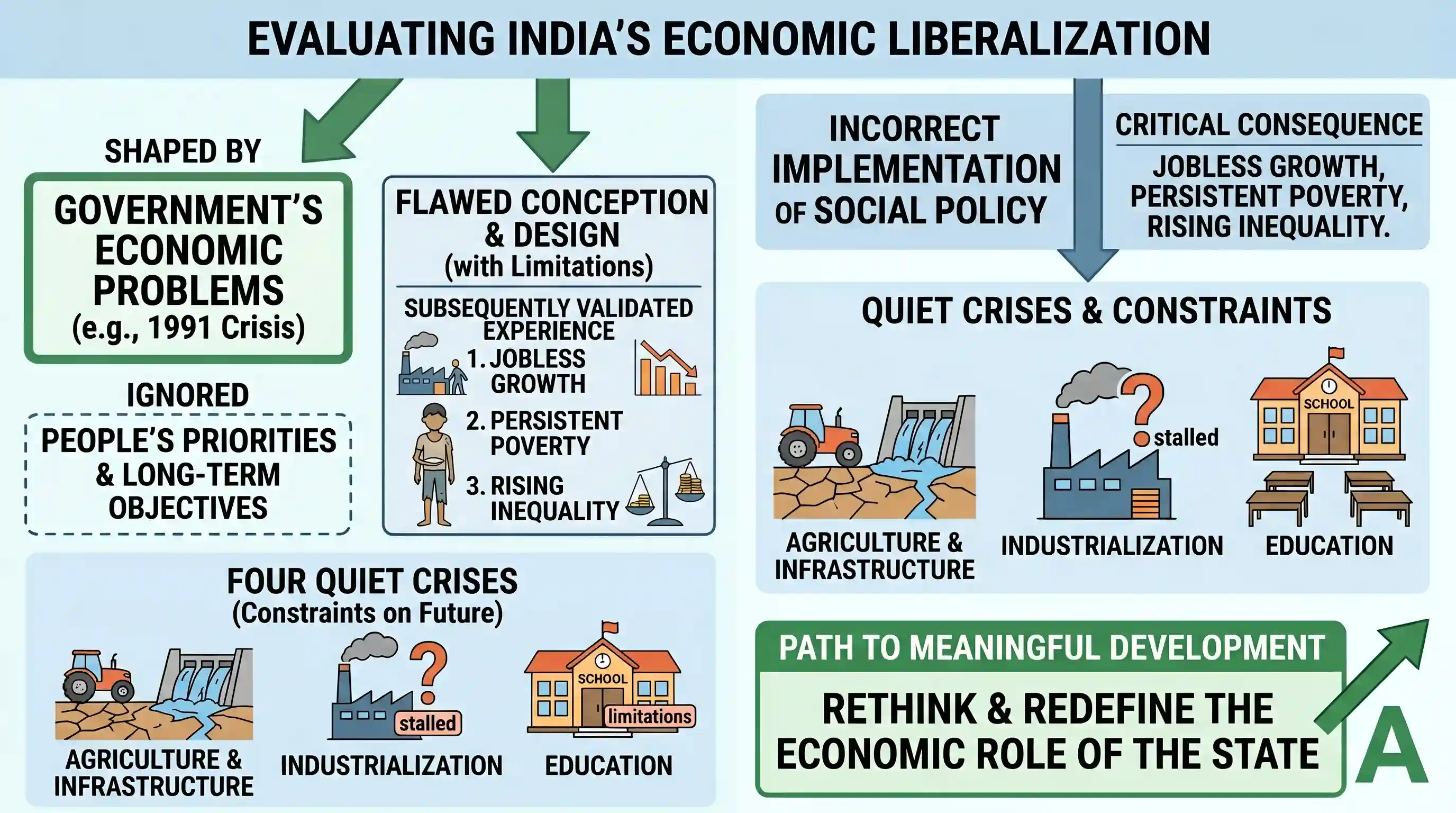
Economic liberalization in India was shaped largely by the economic problems of the government than by the economic priorities of the people or by the long-term development objectives. Thus, there were limitations in conception and design which have been subsequently validated by experience. Jobless growth, persistent poverty and rising inequality have mounted as problems since economic liberalization began. And all these years later, four quiet crises confront the economy: agriculture infrastructure, industrialization and education as constraints on the country’s future prospects. These problems must be resolved if economic growth has to be sustained and transformed into meaningful development. Which of the following is/are the most rational and logical Inference/ Inferences that can be made from the passage? It is essential to rethink and redefine the economic role of the state in the quest for development. India has not made effective implementation of its policies in social sectors nor made sufficient investments in them. Select the correct answer using the code given below

- A1 onlyCorrect
- B2 only
- CBoth 1 and 2
- DNeither 1 nor 2
Explanation
The passage argues that economic liberalization in India was flawed in its conception and design because it was driven by government problems rather than long-term development objectives or people's priorities. This led to persistent issues like jobless growth, poverty, inequality, and ongoing crises in agriculture, infrastructure, industrialization, and education. The passage concludes that these problems must be resolved for sustained and meaningful development.
Let's analyze each statement:
-
It is essential to rethink and redefine the economic role of the state in the quest for development.
- The passage clearly states that the initial "conception and design" of liberalization had "limitations" because it wasn't guided by "long-term development objectives." It then lists several "quiet crises" that act as "constraints on the country's future prospects" and need to be "resolved if economic growth has to be sustained and transformed into meaningful development."
- This strongly implies that the current approach, which includes the state's role (or lack thereof, or its ineffective role), needs re-evaluation. If the initial design was flawed and problems persist, a rethinking of the state's role in achieving "meaningful development" is a rational and logical inference.
-
India has not made effective implementation of its policies in social sectors nor made sufficient investments in them.
- The passage mentions "education" as one of the "quiet crises." It also notes "persistent poverty and rising inequality." While these issues often relate to social sectors, the passage does not explicitly state that India has failed in "effective implementation of its policies in social sectors" (plural) or made "insufficient investments in them."
- It identifies "education" as a crisis, but it doesn't generalize this to all social sectors, nor does it pinpoint "ineffective implementation" or "insufficient investment" as the specific reasons for the problems. The passage focuses more on the initial conception and design of liberalization and the resulting economic problems. This statement makes a broader claim than what can be directly and strongly inferred from the text.
Therefore, Statement 1 is a more direct and logical inference from the passage.
The final answer is A
Related questions
More UPSC Prelims practice from the same subject and topic.
- Prelims 2020CSATReading Comprehension
In India, over the last decade or so, labour has been departing agriculture, but is only going to construction and unregistered manufacturing which are not markedly better jobs. Services, where labour…
- Prelims 2020CSATReading Comprehension
In India, the current focus on the right to privacy is based on some new realities of the digital age. A right is a substantive right only if it works in all situations, and for everyone. A right to f…
- Prelims 2020CSATReading Comprehension
One of the biggest ironies around water is that it comes from rivers and other wetlands. Yet it is seen as divorced from them. While water is used as a resource, public policy does not always grasp th…
- Prelims 2020CSATReading Comprehension
Asset allocation is the most important investment decision we will ever make, and sadly, most of us do not give that decision the importance it deserves. We are adamant about seeking predictability wi…
- Prelims 2020CSATReading Comprehension
Although most of the Genetically Modified (GM) crops cultivated now are genetically engineered for a single trait, in future, crops genetically engineered for more than one trait will be the norm. Thu…
- Prelims 2020CSATReading Comprehension
Although most of the Genetically Modified (GM) crops cultivated now are genetically engineered for a single trait, in future, crops genetically engineered for more than one trait will be the norm. Thu…