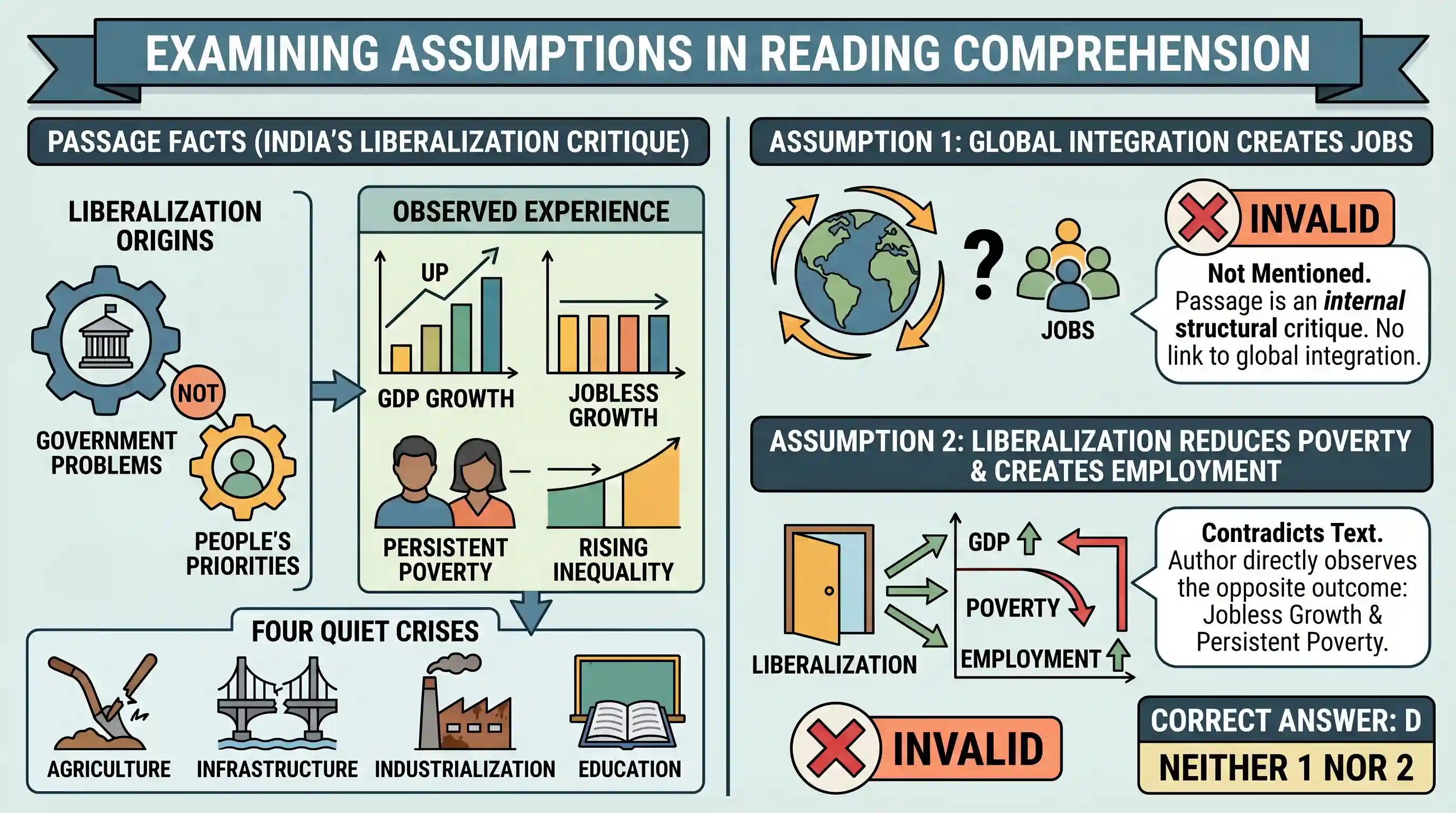
Economic liberalization in India was shaped largely by the economic problems of the government than by the economic priorities of the people or by the long-term development objectives. Thus, there were limitations in conception and design which have been subsequently validated by experience. Jobless growth, persistent poverty and rising inequality have mounted as problems since economic liberalization began. And all these years later, four quiet crises confront the economy: agriculture, infrastructure, industrialization and education as constraints on the country's future prospects. These problems must be resolved if economic growth has to be sustained and transformed into meaningful development. With reference to the above passage, the following assumptions have been made: 1. India's economy needs to be greatly integrated with global economy so as to create large number of jobs and to sustain its growth momentum. 2. Economic liberalization would cause large economic growth which would reduce poverty and create sufficient employment in the long run. Which of the above assumptions is/are valid?

- A1 only
- B2 only
- CBoth 1 and 2
- DNeither 1 nor 2Correct
Explanation
An assumption is something taken for granted by the author of the passage.
-
India's economy needs to be greatly integrated with the global economy to create jobs and sustain growth — Invalid. The passage does not mention global integration as a means to create jobs or sustain growth. It only critiques the way liberalization was designed and the crises that have emerged since. Linking growth to global integration is not assumed in the text.
-
Economic liberalization would cause large economic growth which would reduce poverty and create sufficient employment in the long run — Invalid. The passage actually undermines this assumption: it states that since liberalization began there has been "jobless growth, persistent poverty and rising inequality." So the author does not assume liberalization will reduce poverty or create employment; rather he observes the opposite outcome.
Neither assumption is valid. Answer: D.
Related questions
More UPSC Prelims practice from the same subject and topic.
- Prelims 2020CSATReading Comprehension
In India, over the last decade or so, labour has been departing agriculture, but is only going to construction and unregistered manufacturing which are not markedly better jobs. Services, where labour…
- Prelims 2020CSATReading Comprehension
In India, the current focus on the right to privacy is based on some new realities of the digital age. A right is a substantive right only if it works in all situations, and for everyone. A right to f…
- Prelims 2020CSATReading Comprehension
One of the biggest ironies around water is that it comes from rivers and other wetlands. Yet it is seen as divorced from them. While water is used as a resource, public policy does not always grasp th…
- Prelims 2020CSATReading Comprehension
Asset allocation is the most important investment decision we will ever make, and sadly, most of us do not give that decision the importance it deserves. We are adamant about seeking predictability wi…
- Prelims 2020CSATReading Comprehension
Although most of the Genetically Modified (GM) crops cultivated now are genetically engineered for a single trait, in future, crops genetically engineered for more than one trait will be the norm. Thu…
- Prelims 2020CSATReading Comprehension
Although most of the Genetically Modified (GM) crops cultivated now are genetically engineered for a single trait, in future, crops genetically engineered for more than one trait will be the norm. Thu…