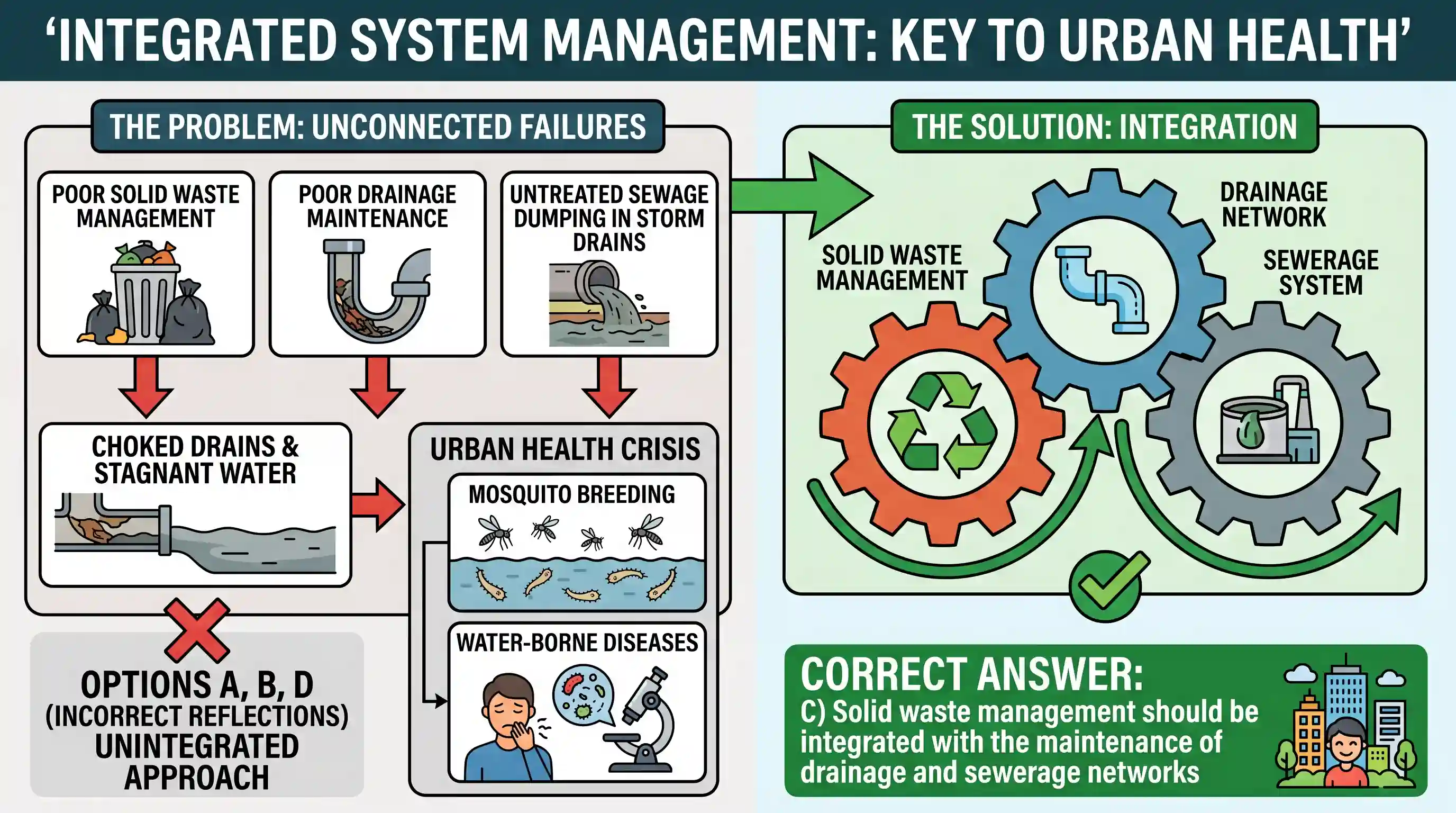
Many people understand the connection n solid waste management and health in terms of the consequences of unattended heaps of garbage which become home for flies and other Vermin. However, there is another aspect that is not well-understood, that is, what happens when unscientific solid waste management combines with poor drainage and dumping of untreated sewage into drains which are meant to carry storm water during rains. The result is choked drains which are full of stagnant water breeding mosquitoes, resulting in the spread of water- borne diseases. In the context of India, which one of the following statements best reflects the critical message of the passage?

- AIn India, the drainage networks are not separate for sewerage and storm water
- BUrban local bodies do not have enough resources and legislative authority to deal with the problems or waste management
- CSolid waste management should be integrated with the maintenance of drainage and sewerage networksCorrect
- DBad management of solid waste and sewerage systems by our municipalities is the reason for drinking water shortages in our cities.
Explanation
The passage describes a complex problem where unscientific solid waste management combines with poor drainage and untreated sewage in storm drains, leading to choked drains, stagnant water, mosquitoes, and water-borne diseases. The critical message is about the interconnectedness of these issues and the disastrous consequences when they are not managed together.
Analyzing the options:
A) In India, the drainage networks are not separate for sewerage and storm water. This statement describes a contributing factor to the problem mentioned in the passage ("dumping of untreated sewage into drains which are meant to carry storm water"). However, it's a factual observation of a system flaw, not the overarching "critical message" about how to address the combined problem. The passage goes beyond just stating this fact to explain its consequences.
B) Urban local bodies do not have enough resources and legislative authority to deal with the problems or waste management. The passage focuses on the mechanisms of the problem and its health consequences, not the reasons behind poor management (like lack of resources or authority). While this might be true in reality, it is not the critical message conveyed by this specific passage.
C) Solid waste management should be integrated with the maintenance of drainage and sewerage networks. This statement directly addresses the core problem highlighted in the passage. The passage explicitly details how the combination of solid waste management, poor drainage, and untreated sewage leads to severe issues. Therefore, the critical message is that these systems cannot be managed in isolation; they must be integrated to prevent the described problems. This option proposes the direct solution implied by the problem's description.
D) Bad management of solid waste and sewerage systems by our municipalities is the reason for drinking water shortages in our cities. The passage discusses the spread of "water-borne diseases" due to stagnant water. It does not mention "drinking water shortages" as a consequence. This option introduces a new consequence not discussed in the passage, making it an incorrect reflection of the passage's message.
Therefore, option C best reflects the critical message because the passage emphasizes the combined effect of solid waste, drainage, and sewerage issues, implying that an integrated approach is essential for effective management and public health.
Related questions
More UPSC Prelims practice from the same subject and topic.
- Prelims 2020CSATReading Comprehension
In India, over the last decade or so, labour has been departing agriculture, but is only going to construction and unregistered manufacturing which are not markedly better jobs. Services, where labour…
- Prelims 2020CSATReading Comprehension
In India, the current focus on the right to privacy is based on some new realities of the digital age. A right is a substantive right only if it works in all situations, and for everyone. A right to f…
- Prelims 2020CSATReading Comprehension
One of the biggest ironies around water is that it comes from rivers and other wetlands. Yet it is seen as divorced from them. While water is used as a resource, public policy does not always grasp th…
- Prelims 2020CSATReading Comprehension
Asset allocation is the most important investment decision we will ever make, and sadly, most of us do not give that decision the importance it deserves. We are adamant about seeking predictability wi…
- Prelims 2020CSATReading Comprehension
Although most of the Genetically Modified (GM) crops cultivated now are genetically engineered for a single trait, in future, crops genetically engineered for more than one trait will be the norm. Thu…
- Prelims 2020CSATReading Comprehension
Although most of the Genetically Modified (GM) crops cultivated now are genetically engineered for a single trait, in future, crops genetically engineered for more than one trait will be the norm. Thu…