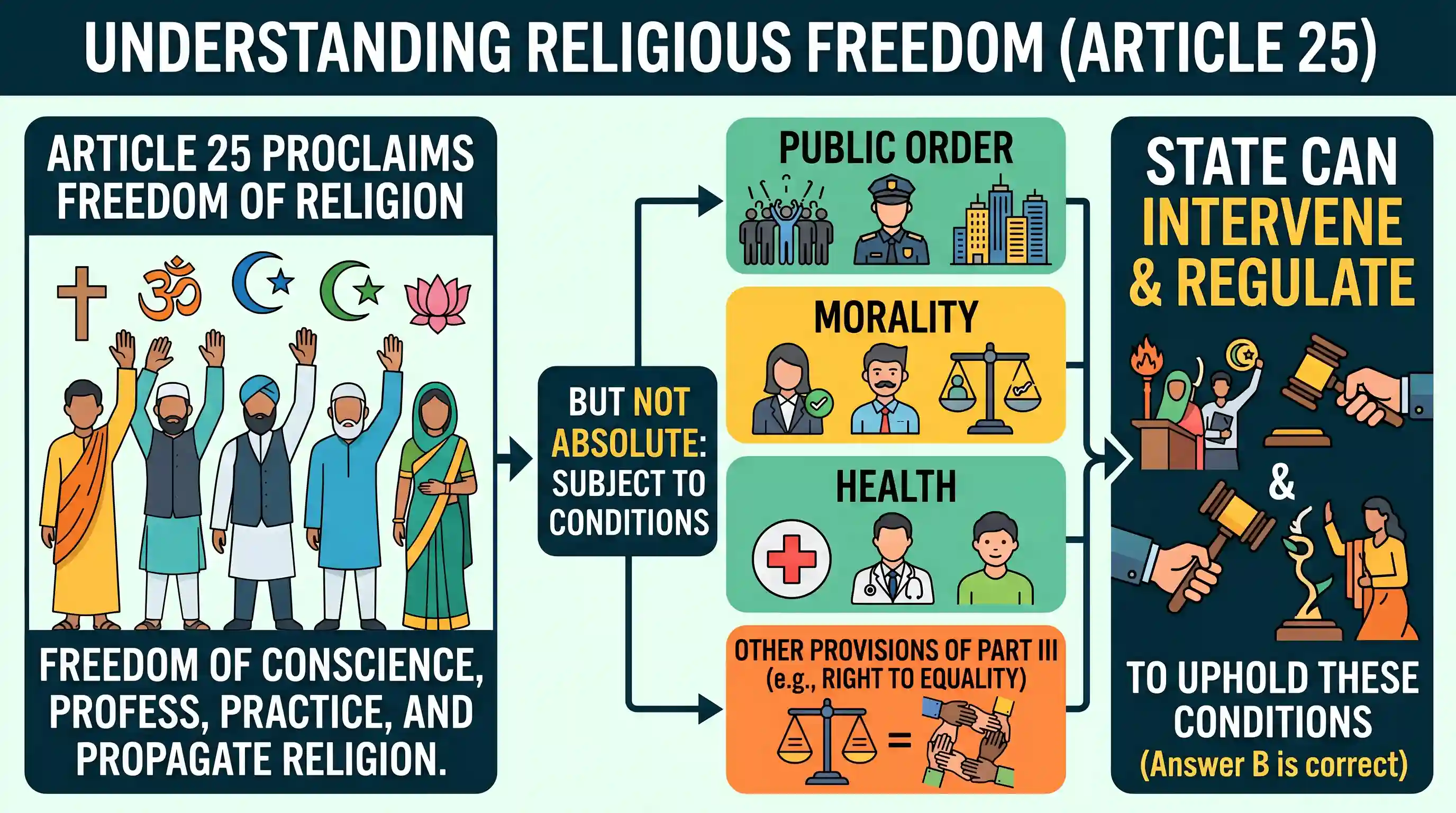
In Part III of the constitution which assures people certain fundamental rights, Article 25 proclaims that "all persons are equally entitled to freedom of conscience and the right freely to profess, practice and propagate religion". What people fail to notice is that this Proclamation is prefixed with the words "subject to public order, morality, health and to the other provisions of this Part", Which set conditions precedent for the legal protection of religious practices of any Community. The closing words of this prefatory rider in Article 25 virtually constitute a subordination clause placing other fundamental rights mentioned in Part III over and above the right to religious freedom. Among those other fundamental rights is the rights to equality before law and equal protection of laws-assured at the outset and elaborated in later articles to mean, inter alia, that the State shall not deny equal protection of laws to any person or group of persons on the basis of religion alone. What is the most logical inference from the above passage?

- AState shall not interfere with the religious affairs of the Citizens
- BReligious freedom under the Constitution is open to State interventionCorrect
- CReligious freedom of the citizens is not covered under fundamental rights
- DReligious practices of any Community are immune to State laws.
Explanation
The passage explicitly states that the proclamation of religious freedom in Article 25 is "prefixed with the words 'subject to public order, morality, health and to the other provisions of this Part'". This phrase directly implies that religious freedom is not absolute and can be restricted or regulated by the State to uphold these conditions.
Analyzing the options: A) State shall not interfere with the religious affairs of the Citizens - This is incorrect. The passage clearly indicates conditions under which the State can interfere (public order, morality, health). B) Religious freedom under the Constitution is open to State intervention - This is correct. The "subject to public order, morality, health" clause is a direct acknowledgement that the State can intervene to regulate religious practices. C) Religious freedom of the citizens is not covered under fundamental rights - This is incorrect. The passage explicitly states Article 25 is "In Part III of the constitution which assures people certain fundamental rights". D) Religious practices of any Community are immune to State laws - This is incorrect. The "subject to" clause means they are not immune and can be regulated by State laws.
Therefore, the most logical inference is that religious freedom is open to State intervention.
Related questions
More UPSC Prelims practice from the same subject and topic.
- Prelims 2020CSATReading Comprehension
In India, over the last decade or so, labour has been departing agriculture, but is only going to construction and unregistered manufacturing which are not markedly better jobs. Services, where labour…
- Prelims 2020CSATReading Comprehension
In India, the current focus on the right to privacy is based on some new realities of the digital age. A right is a substantive right only if it works in all situations, and for everyone. A right to f…
- Prelims 2020CSATReading Comprehension
One of the biggest ironies around water is that it comes from rivers and other wetlands. Yet it is seen as divorced from them. While water is used as a resource, public policy does not always grasp th…
- Prelims 2020CSATReading Comprehension
Asset allocation is the most important investment decision we will ever make, and sadly, most of us do not give that decision the importance it deserves. We are adamant about seeking predictability wi…
- Prelims 2020CSATReading Comprehension
Although most of the Genetically Modified (GM) crops cultivated now are genetically engineered for a single trait, in future, crops genetically engineered for more than one trait will be the norm. Thu…
- Prelims 2020CSATReading Comprehension
Although most of the Genetically Modified (GM) crops cultivated now are genetically engineered for a single trait, in future, crops genetically engineered for more than one trait will be the norm. Thu…