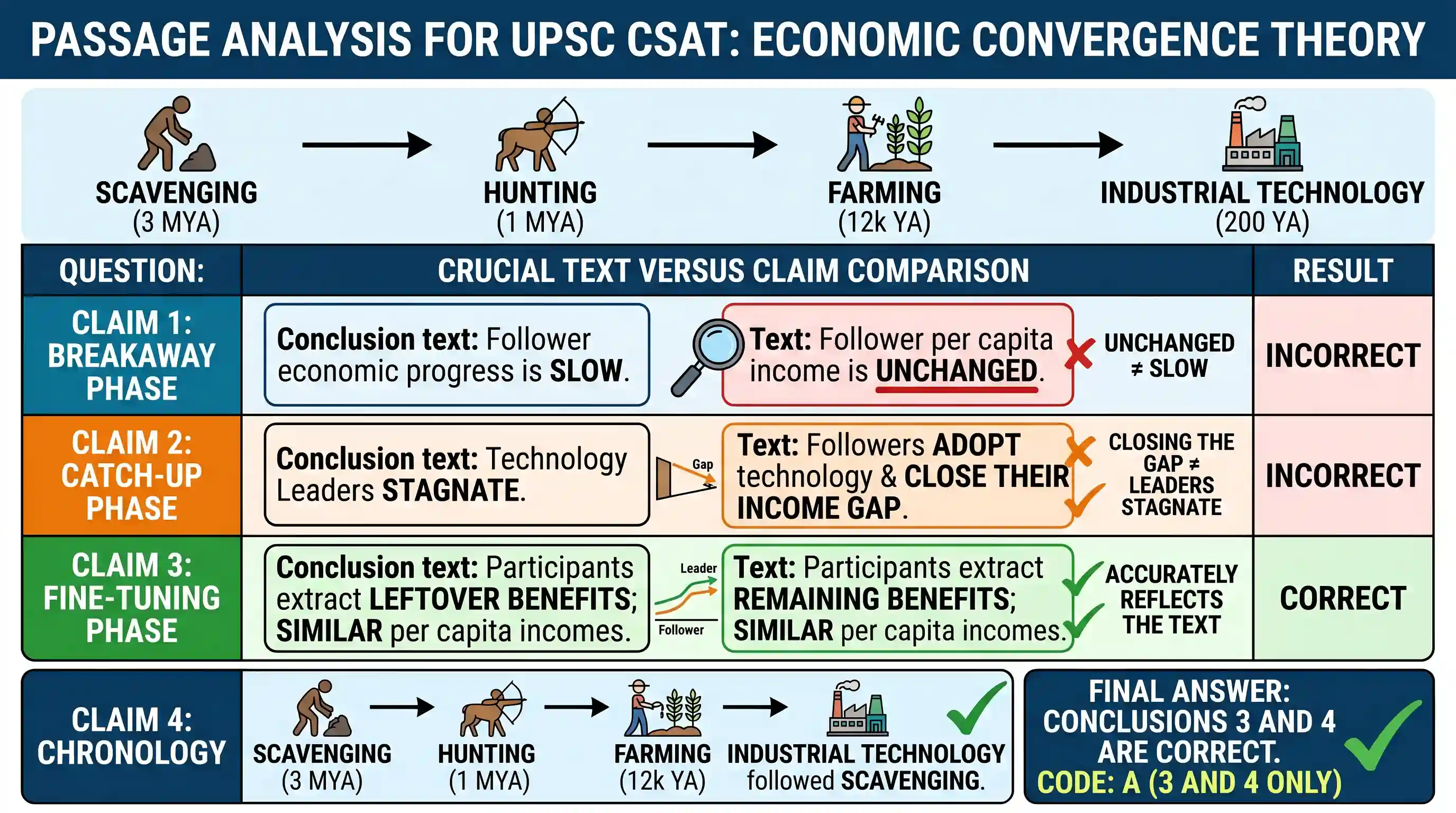
Passage: The process by which countries close their labour-productivity gap with the technology leader is based on convergence theory. The convergence model divides economic eras into three phases : the breakaway, the catch-up, and the fine-tuning phase. It also divides economic entities into two categories : the technology leaders and the technology followers. The process begins with the development of a new technology, such as scavenging three million years ago (MYA), hunting—one MYA, farming—12 thousand years ago, and industrial technology—a little more than 200 years ago. During the breakaway phase, the per capita income of the technology leaders (e.g., Western Europe and North America in the industrial era) rises, but is unchanged for the technology followers. In the catch-up phase, the followers adopt the new technology and close their per capita income gap with the technology leaders. In the fine-tuning phase, where participants try to extract the remaining benefits from an increasingly exhausted technology, leaders and followers have similar per capita incomes. Question: Which of the following conclusions are correct? 1. In the breakaway phase, economic progress is slow for the technology followers. 2. In the catch-up phase, leaders stagnate and followers, therefore, close the gap between them and the leaders. 3. In the fine-tuning phase, technology is exhausted, as it were, and both leaders and followers attempt to extract leftover benefits, leading to more or less similar per capita income levels. 4. Industrial technology followed scavenging, which preceded hunting, which itself was followed by farming. Select the answer using the code given below.

- A3 and 4 onlyCorrect
- B1, 2, 3 and 4
- C1 and 2 only
- D2, 3 and 4 only
Explanation
Based on the provided passage, the correct answer is Option A (3 and 4 only). This is a Reading Comprehension question grounded in economic growth models, specifically variations of the macroeconomic Convergence Theory.
Why the correct option is correct:
- Statement 3 is correct: The passage explicitly states that in the fine-tuning phase, participants try to "extract the remaining benefits from an increasingly exhausted technology," resulting in leaders and followers having similar per capita incomes.
- Statement 4 is correct: The passage outlines a clear chronological sequence of eras: Scavenging (3 million years ago) → Hunting (1 million years ago) → Farming (12,000 years ago) → Industrial technology (200 years ago). Therefore, industrial technology followed scavenging. Furthermore, scavenging (3 MYA) preceded hunting (1 MYA), and hunting was subsequently followed by farming (12k YA). The chronological logic holds perfectly.
Why the other statements are incorrect:
- Statement 1 is incorrect: The passage explicitly states that during the breakaway phase, the per capita income for technology followers is "unchanged." The word "unchanged" indicates absolute stagnation (zero progress), rendering the phrase "economic progress is slow" factually inconsistent with the author's precise wording.
- Statement 2 is incorrect: The text notes that during the catch-up phase, followers "adopt the new technology and close their per capita income gap." It does not state that the technology leaders stagnate. The gap closes because followers experience exponentially faster growth by adopting established technologies, not because leaders halt their own progress.
Concluding Takeaway: In CSAT Reading Comprehension, avoid extrapolating external assumptions (e.g., leaders "stagnating") and pay strict attention to absolute keywords in the text (e.g., recognizing that "unchanged" mathematically contradicts "slow progress").
Related questions
More UPSC Prelims practice from the same subject and topic.
- Prelims 2026GS1economy
Consider the following statements with reference to the Sagarmala Programme of the Government of India : I. The Sagarmala Programme seeks to achieve port-led economic growth through cost-effective and…
- Prelims 2026GS1economy
In what way(s) does the Vizhinjam International Seaport represent a structural shift in India's maritime trade and logistics policy? 1. By functioning exclusively as a domestic cargo hub to reduce rel…
- Prelims 2026GS1economy
An e-commerce revenue model where the seller has control over pricing but doesn't keep products in stock and instead transfers customer orders and shipment details to a third-party supplier, who then …
- Prelims 2026GS1economy
Which one of the following correctly represents the three key sub-indices of the Financial Inclusion Index (FI-Index) of the Reserve Bank of India (RBI) ?
- Prelims 2026GS1economy
Which one of the following best describes the key objective of India's 'Open Network for Digital Commerce' (ONDC) initiative ?
- Prelims 2026GS1economy
Which one of the following statements about Unified Payments Interface (UPI) and Central Bank Digital Currency (Digital Rupee) is not correct ?