Which one of the following best describes the 'Crowding Out Effect' in the context of fiscal policy ?

- AA situation where private investment increases due to increased Government spending
- BA situation where Government borrowing leads to higher interest rates, which reduces private investmentCorrect
- CA situation where an increase in taxes leads to increased private sector investment
- DA situation where Government spending has no impact on aggregate demand
Explanation
The 'Crowding Out Effect' is a fundamental concept in macroeconomics that describes a situation where increased public sector spending replaces, or drives down, private sector spending.
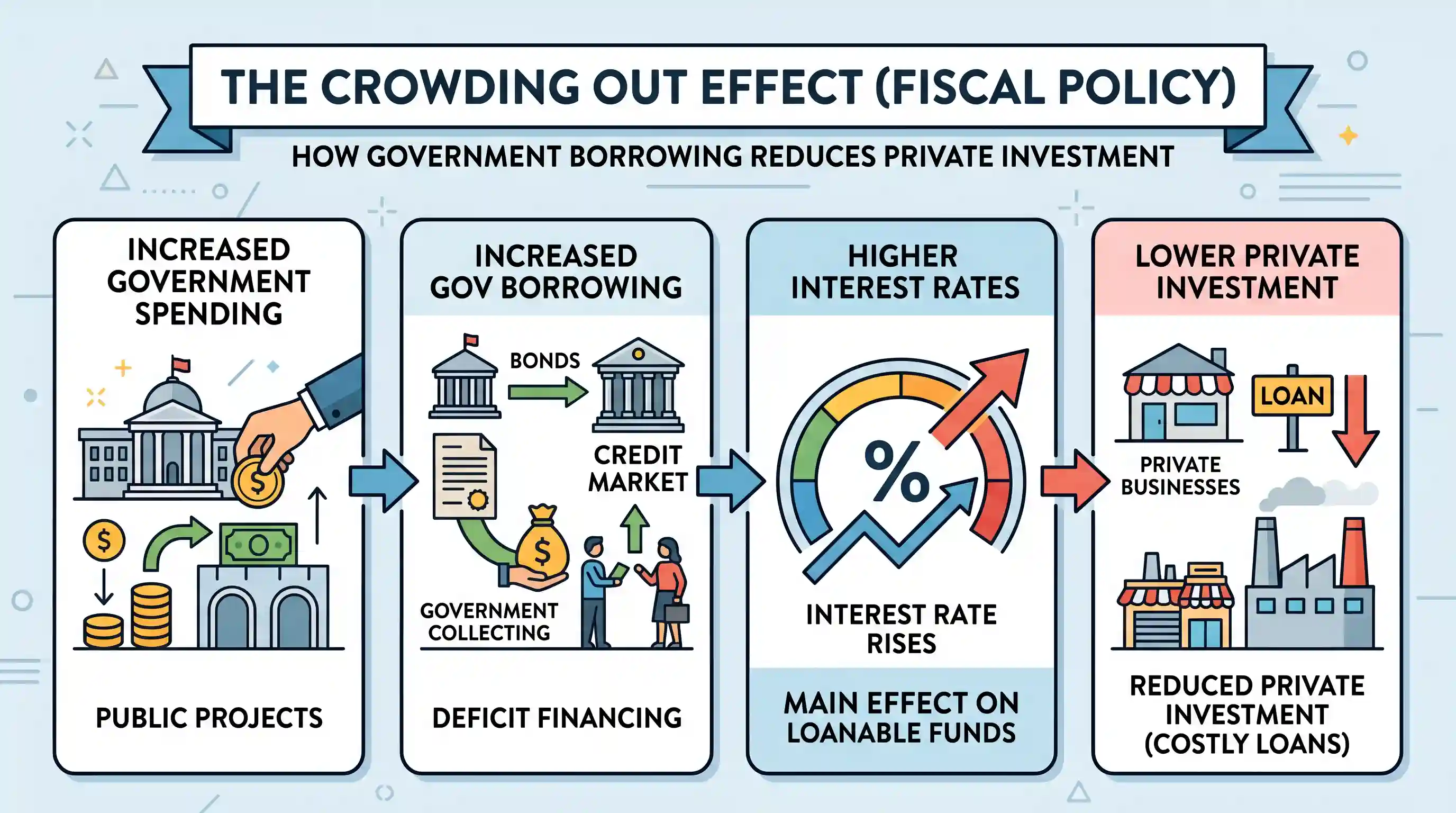
Why Option B is correct: In the context of fiscal policy, when a government runs a budget deficit to finance expansionary initiatives, it must borrow from the financial market by issuing bonds. This surge in government borrowing increases the overall demand for loanable funds. Consequently, this drives up the equilibrium interest rate in the economy. Higher interest rates make borrowing more expensive for businesses and consumers, leading to a direct decline in private investment. According to standard macroeconomic definitions by institutions like the International Monetary Fund (IMF), the government effectively "crowds out" private investors from the credit market. Therefore, Option B accurately describes this phenomenon.
Why the other options are incorrect:
- Option A: A situation where government spending stimulates and increases private investment is known as the 'Crowding In Effect' (often seen during severe recessions when economic capacity is underutilized), which is the exact opposite of crowding out.
- Option C: An increase in taxes reduces disposable income and corporate profits, typically dampening rather than increasing private sector investment. This mechanism is unrelated to the borrowing and interest rate dynamic central to the crowding out effect.
- Option D: Expansionary government spending directly increases aggregate demand. While the crowding out effect may partially offset this growth by lowering private investment, it is factually incorrect to state that government spending has no impact on aggregate demand.
Concluding Takeaway: To quickly recall the Crowding Out Effect, remember this chain reaction: Government Deficit → Increased Market Borrowing → Higher Interest Rates → Lower Private Investment. The government "crowds" the loan market, leaving fewer and costlier funds for private enterprises.
Related questions
More UPSC Prelims practice from the same subject and topic.
- Prelims 2026GS1economy
Consider the following statements with reference to the Sagarmala Programme of the Government of India : I. The Sagarmala Programme seeks to achieve port-led economic growth through cost-effective and…
- Prelims 2026GS1economy
In what way(s) does the Vizhinjam International Seaport represent a structural shift in India's maritime trade and logistics policy? 1. By functioning exclusively as a domestic cargo hub to reduce rel…
- Prelims 2026GS1economy
An e-commerce revenue model where the seller has control over pricing but doesn't keep products in stock and instead transfers customer orders and shipment details to a third-party supplier, who then …
- Prelims 2026GS1economy
Which one of the following correctly represents the three key sub-indices of the Financial Inclusion Index (FI-Index) of the Reserve Bank of India (RBI) ?
- Prelims 2026GS1economy
Which one of the following best describes the key objective of India's 'Open Network for Digital Commerce' (ONDC) initiative ?
- Prelims 2026GS1economy
Which one of the following statements about Unified Payments Interface (UPI) and Central Bank Digital Currency (Digital Rupee) is not correct ?