Which of the following statements about insurance in aviation sector is/are correct ? 1. 'Aviation Hull Insurance' covers the physical aircraft, including the body, engine, and on-board equipment. 2. Under the Montreal Convention, adopted in 1999 by over 130 countries, including India, airlines are strictly liable to pay compensation to the family/nominee of every deceased passenger without requiring the family to prove fault. Select the answer using the code given below :

- A1 only
- B2 only
- CBoth 1 and 2Correct
- DNeither 1 nor 2
Explanation
The correct answer is Option C (Both 1 and 2), as both statements provide accurate definitions of aviation insurance and legal liability frameworks.
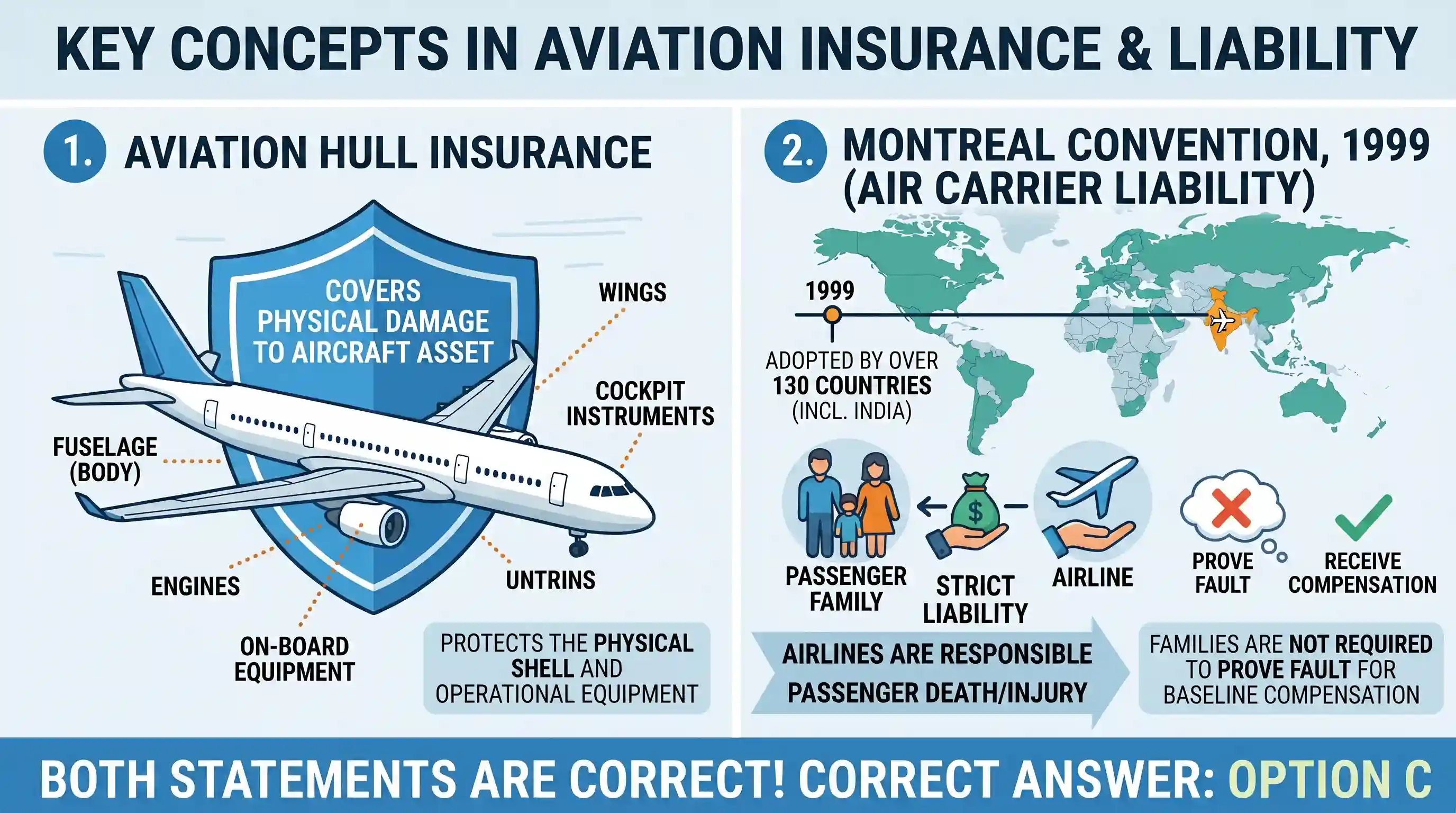
Statement 1 is correct: 'Aviation Hull Insurance' is a specialized policy designed to cover the physical damage or loss of the aircraft itself. It specifically covers the fuselage (body), wings, engines, and on-board instruments or equipment against risks like in-flight incidents, ground collisions, and natural disasters. It operates distinctly from aviation liability insurance, which covers third-party injuries or property damage.
Statement 2 is correct: The Montreal Convention (formally the Convention for the Unification of Certain Rules for International Carriage by Air) was adopted in 1999. India is a signatory to this treaty, having ratified and implemented it via the Carriage by Air (Amendment) Act, 2009. The Convention enforces a two-tier liability regime. Under the first tier, air carriers face "strict liability" up to a set limit (originally 100,000 Special Drawing Rights, periodically adjusted). This means airlines must pay compensation for the death or bodily injury of a passenger, and families are not required to prove negligence or fault by the airline to receive this baseline amount.
Why the other options are wrong:
- Option A is incorrect because it fails to recognize the strict liability mandate under the 1999 Montreal Convention.
- Option B is incorrect because it wrongly dismisses the accurate definition of Aviation Hull Insurance.
- Option D is incorrect because both statements are factually true.
Takeaway: Remember the distinction: Hull Insurance protects the physical "shell" and operational assets of the aircraft, while the Montreal Convention protects the people by ensuring strict, fault-free baseline compensation for passengers and their families.
Related questions
More UPSC Prelims practice from the same subject and topic.
- Prelims 2026GS1economy
Consider the following statements with reference to the Sagarmala Programme of the Government of India : I. The Sagarmala Programme seeks to achieve port-led economic growth through cost-effective and…
- Prelims 2026GS1economy
In what way(s) does the Vizhinjam International Seaport represent a structural shift in India's maritime trade and logistics policy? 1. By functioning exclusively as a domestic cargo hub to reduce rel…
- Prelims 2026GS1economy
An e-commerce revenue model where the seller has control over pricing but doesn't keep products in stock and instead transfers customer orders and shipment details to a third-party supplier, who then …
- Prelims 2026GS1economy
Which one of the following correctly represents the three key sub-indices of the Financial Inclusion Index (FI-Index) of the Reserve Bank of India (RBI) ?
- Prelims 2026GS1economy
Which one of the following best describes the key objective of India's 'Open Network for Digital Commerce' (ONDC) initiative ?
- Prelims 2026GS1economy
Which one of the following statements about Unified Payments Interface (UPI) and Central Bank Digital Currency (Digital Rupee) is not correct ?