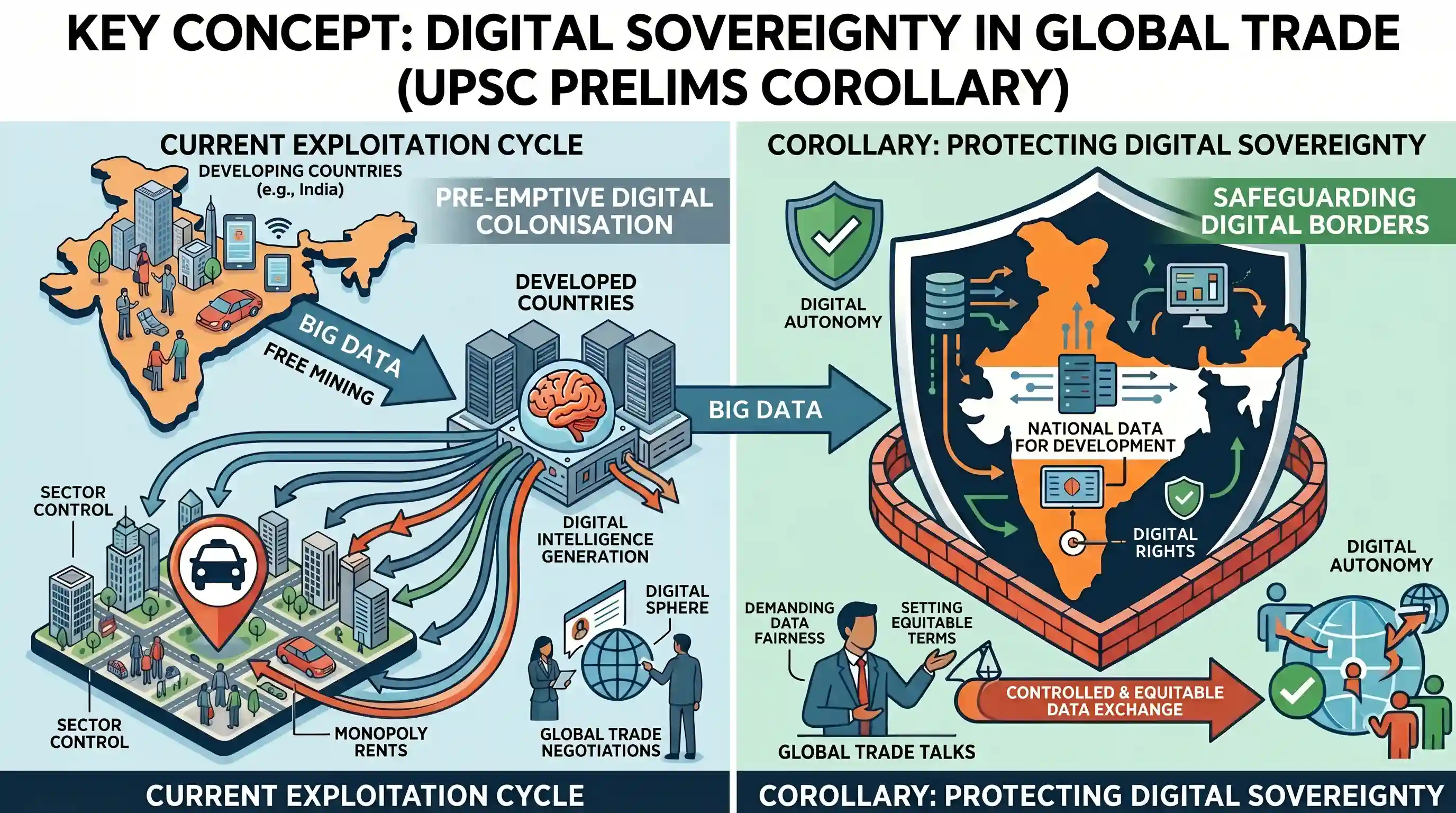
With the digital phenomenon restructuring most social sectors, it is little surprise that global trade negotiations are now eyeing the digital area in an attempt to pre-emptively colonise it. Big Data is freely collected or mined from developing countries, and converted into digital intelligence in developed countries. This intelligence begins to control different sectors and extract monopoly rents. A large foreign company providing cab service, for instance, is not a work of cars and drivers, it is digital intelligence about commuting, public transport, roads, traffic, city events, presonal behavioural characteristics of commuters and driver and so on. Which one of the following is the most logical and rational corollary to the above passage?

- AGlobalization is not in the interests of India as it undermines its socio-economic structures
- BIndia should be careful to protect its digital sovereignty in global trade talksCorrect
- CIndia should charge monopoly rents from multinational companies in exchange for Big Data
- DThe loss of Big Data from India is proportional to the degree/value of its foreign trade.
Explanation
The passage highlights that global trade negotiations are attempting to "pre-emptively colonise" the digital area. It explains how Big Data is freely collected from developing countries, converted into digital intelligence in developed countries, and then used to control sectors and extract "monopoly rents." The example of a cab service company illustrates that its value lies in digital intelligence, not just physical assets.
Let's analyze the options:
A) Globalization is not in the interests of India as it undermines its socio-economic structures. This is an overgeneralization. The passage discusses a specific problematic aspect of globalization (digital data exploitation), not all of globalization. It doesn't conclude that globalization as a whole is against India's interests.
B) India should be careful to protect its digital sovereignty in global trade talks. This is the most logical corollary. The passage explicitly states that global trade talks are eyeing the digital area for "colonisation" and describes how data from developing countries is exploited. "Digital sovereignty" refers to a nation's control over its digital infrastructure, data, and the rules governing them. Given the threat of "pre-emptive colonisation" and exploitation of data, it logically follows that India needs to protect its control and rights over its digital domain in these negotiations.
C) India should charge monopoly rents from multinational companies in exchange for Big Data. While the passage mentions "monopoly rents" being extracted by developed countries, the logical response to being exploited is to prevent that exploitation and protect one's resources, not necessarily to mirror the exploitative behavior. This option focuses on a specific economic strategy rather than the fundamental need for protection and control.
D) The loss of Big Data from India is proportional to the degree/value of its foreign trade. The passage describes the mechanism of data collection and exploitation, but it does not establish any proportional relationship between the amount or value of data loss and the volume or value of foreign trade. This statement introduces a quantitative relationship not supported by the passage.
Therefore, the passage's central concern about digital exploitation and "colonisation" directly leads to the conclusion that India must protect its digital sovereignty.
The final answer is B
Related questions
More UPSC Prelims practice from the same subject and topic.
- Prelims 2019CSATReading Comprehension
What stands in the way of the widespread and careful adoption of 'Genetic Modification (GM)' technology is an 'Intellectual Property Rights' regime that seeks to create private monopolies for such tec…
- Prelims 2019CSATReading Comprehension
Passage-1 What stands in the way of the widespread and careful adoption of 'Genetic Modification (GM)' technology is an 'Intellectual Property Rights' regime that seeks to create private monopolies fo…
- Prelims 2019CSATReading Comprehension
Most invasive species are neither terribly successful nor very harmful. Britain's invasive plants are not widespread, not spreading especially quickly, and often less of a nuisance than vigorous nativ…
- Prelims 2019CSATReading Comprehension
Diarrhoeal deaths among Indian children are mostly due to food and water contamination. Use of contaminated groundwater and unsafe chemicals in agriculture, poor hygiene in storage and handling of foo…
- Prelims 2019CSATReading Comprehension
The interests of working and poor people have historically been neglected in the planning of our cities. Our cities are increasingly intolerant, unsafe and unlivable places for large numbers of citize…
- Prelims 2019CSATReading Comprehension
A vast majority of Indians are poor, with barely 10 percent employed in the organised sector. We are being convinced that vigorous economic growth is generating substantial employment. But this is not…