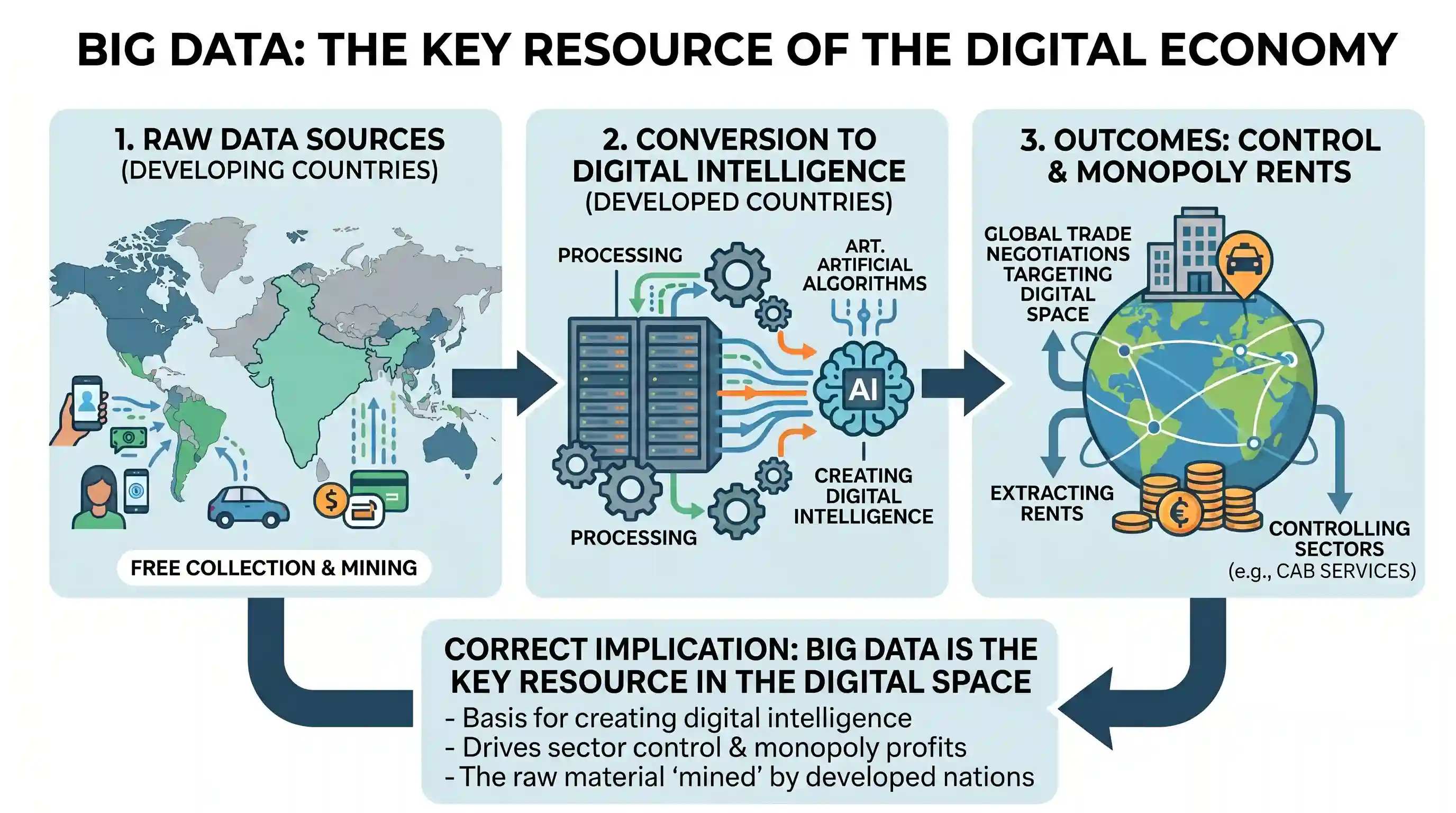
With the digital phenomenon restructuring most social sectors, it is little surprise that global trade negotiations are now eyeing the digital area in an attempt to pre-emptively colonise it. Big Data is freely collected or mined from developing countries, and converted into digital intelligence in developed countries. This intelligence begins to control different sectors and extract monopoly rents. A large foreign company providing cab service, for instance, is not a work of cars and drivers, it is digital intelligence about commuting, public transport, roads, traffic, city events, presonal behavioural characteristics of commuters and driver and so on. Which of the following is most definitively implied by the above passage?

- A7 Big Data is the key resource in the digital spaceCorrect
- BBig economies create Big Data
- CAccess to Big Data is the prerogative of developed countries
- DAccess to and possession of Big Data is a characteristic of developed countries.
Explanation
The passage describes Big Data as something that is "collected or mined," converted into "digital intelligence," and then used to "control different sectors and extract monopoly rents." The example of the cab service company further illustrates how "digital intelligence" (derived from Big Data) is the true value. The phrase "pre-emptively colonise" the digital area also implies that there is a valuable resource within it. All these points strongly indicate that Big Data is considered the fundamental and most important resource in the digital space, making option A the most definitively implied statement.
Analysis of other options: B) Big economies create Big Data. This is incorrect. The passage explicitly states, "Big Data is freely collected or mined from developing countries," implying developing countries are the source, not big economies. C) Access to Big Data is the prerogative of developed countries. While developed countries are shown to be collecting and converting Big Data, the passage doesn't state that access is their exclusive prerogative. It mentions data is collected "from developing countries," suggesting developing countries are the source and thus have some form of initial access, even if it's being exploited. D) Access to and possession of Big Data is a characteristic of developed countries. Similar to C, the passage highlights that data is collected from developing countries. So, while developed countries process and utilize it, they are not necessarily the primary possessors or originators of the raw data itself. The characteristic described for developed countries is converting data into intelligence and extracting value, not necessarily exclusive access or possession of the raw data.
Related questions
More UPSC Prelims practice from the same subject and topic.
- Prelims 2019CSATReading Comprehension
What stands in the way of the widespread and careful adoption of 'Genetic Modification (GM)' technology is an 'Intellectual Property Rights' regime that seeks to create private monopolies for such tec…
- Prelims 2019CSATReading Comprehension
Passage-1 What stands in the way of the widespread and careful adoption of 'Genetic Modification (GM)' technology is an 'Intellectual Property Rights' regime that seeks to create private monopolies fo…
- Prelims 2019CSATReading Comprehension
Most invasive species are neither terribly successful nor very harmful. Britain's invasive plants are not widespread, not spreading especially quickly, and often less of a nuisance than vigorous nativ…
- Prelims 2019CSATReading Comprehension
Diarrhoeal deaths among Indian children are mostly due to food and water contamination. Use of contaminated groundwater and unsafe chemicals in agriculture, poor hygiene in storage and handling of foo…
- Prelims 2019CSATReading Comprehension
The interests of working and poor people have historically been neglected in the planning of our cities. Our cities are increasingly intolerant, unsafe and unlivable places for large numbers of citize…
- Prelims 2019CSATReading Comprehension
A vast majority of Indians are poor, with barely 10 percent employed in the organised sector. We are being convinced that vigorous economic growth is generating substantial employment. But this is not…