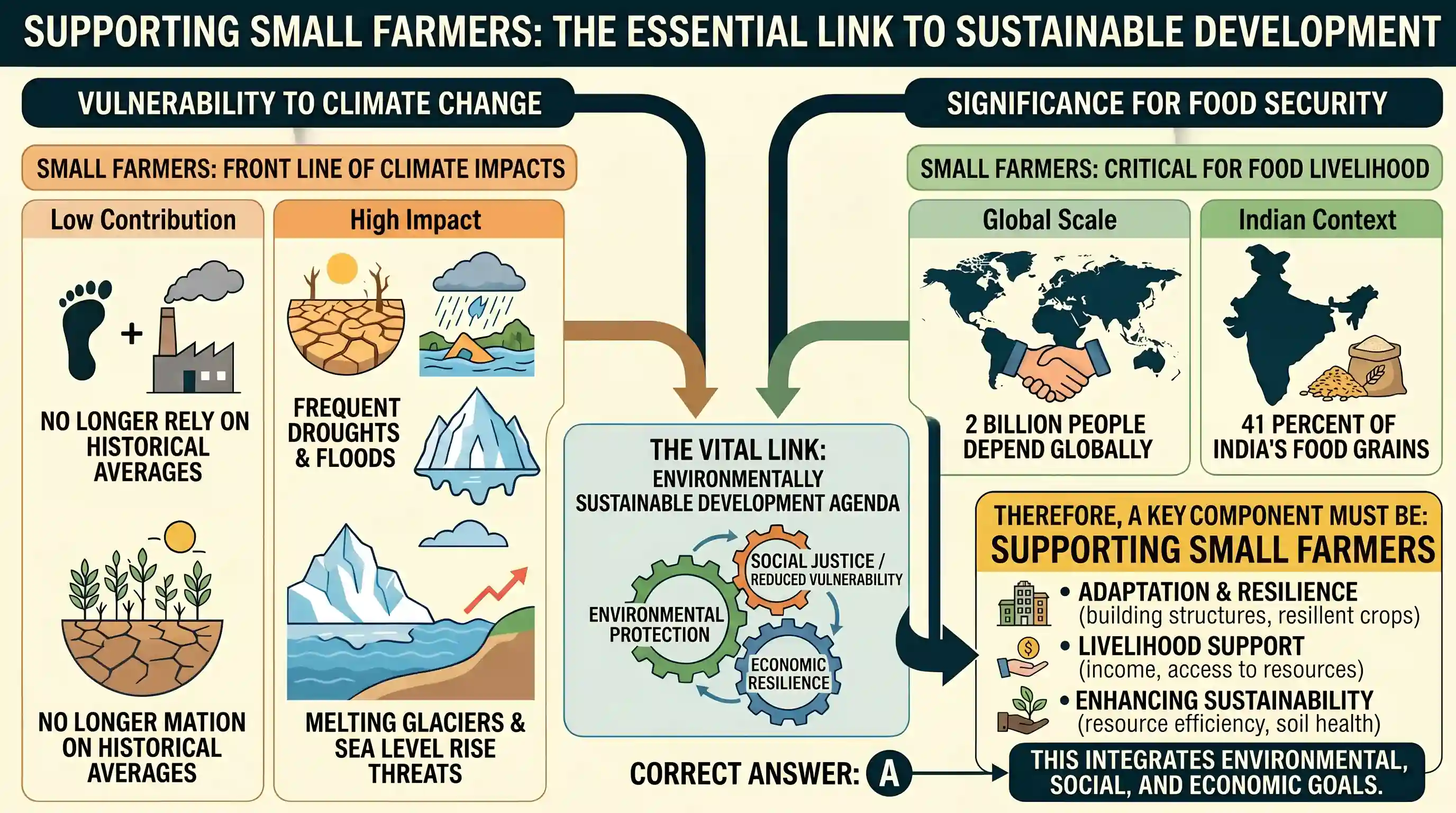
The rural poor across the world, including India, have contributed little to human-induced climate change, yet they are on the frontline in coping with its effects. Farmers can no longer rely on historical averages for rainfall and temperature, and the more frequent and extreme weather events, such as droughts and floods, can spell disaster. And there are new threats, such as sea level rise and the impact of melting glaciers on water supply. How significant are small farms? As many as two billion peopre worldwide depend on them for their food and livelihood. Small-holder farmers in India produce 41 percent of the country's food grains, and other food items that contribute to local and national food security. What is the most logical and rational Corry to the above passage?

- ASupporting small farmers is an important part of any agenda regarding environmentally sustainable developmentCorrect
- BPoor countries have little role to play in the mitigation of global warming
- CDue to a large number of farmer households, India will not have food security problem in the foreseeable future
- Donly small-holder farmers in India can ensure food security.
Explanation
The passage highlights two main points:
- Small farmers, despite contributing little to climate change, are disproportionately affected by its impacts (unreliable weather, extreme events, sea level rise).
- Small farms are crucial for global and national food security, with two billion people worldwide depending on them, and Indian small-holders producing a significant portion of the country's food.
Let's analyze the options:
A) Supporting small farmers is an important part of any agenda regarding environmentally sustainable development. This option logically connects all the key themes. "Environmentally sustainable development" aims to meet present needs without compromising future generations' ability to meet their own, balancing environmental protection with social and economic development. The passage explicitly links climate change (environmental) to the vulnerability of small farmers (social/economic livelihood) and their vital role in food security (development). Therefore, supporting these farmers who are on the frontline of climate change impacts and are crucial for food production is indeed a critical component of environmentally sustainable development.
B) Poor countries have little role to play in the mitigation of global warming. The passage states that the rural poor (often in poor countries) have contributed little to climate change. It does not discuss their role in mitigation (reducing emissions). This option makes an unsupported leap and is not a logical corollary to the passage, which focuses on their vulnerability and importance for food security.
C) Due to a large number of farmer households, India will not have food security problem in the foreseeable future. The passage emphasizes the threats to food security posed by climate change impacts on these very farmers (droughts, floods, unreliable weather). While small farmers contribute significantly to food security, the passage implies that these climate challenges endanger it. Concluding that India will not have a food security problem is an optimistic and potentially false inference given the stated threats.
D) only small-holder farmers in India can ensure food security. The passage states that small-holder farmers produce 41 percent of India's food grains and contribute to food security. It highlights their significance but does not claim they are the only ones who can ensure food security. The word "only" makes this statement too absolute and unsupported by the text.
Therefore, option A is the most logical and rational corollary as it synthesizes the environmental challenges faced by small farmers, their critical role in food security, and the necessity of supporting them within a broader framework of sustainable development.
Related questions
More UPSC Prelims practice from the same subject and topic.
- Prelims 2019CSATReading Comprehension
What stands in the way of the widespread and careful adoption of 'Genetic Modification (GM)' technology is an 'Intellectual Property Rights' regime that seeks to create private monopolies for such tec…
- Prelims 2019CSATReading Comprehension
Passage-1 What stands in the way of the widespread and careful adoption of 'Genetic Modification (GM)' technology is an 'Intellectual Property Rights' regime that seeks to create private monopolies fo…
- Prelims 2019CSATReading Comprehension
Most invasive species are neither terribly successful nor very harmful. Britain's invasive plants are not widespread, not spreading especially quickly, and often less of a nuisance than vigorous nativ…
- Prelims 2019CSATReading Comprehension
Diarrhoeal deaths among Indian children are mostly due to food and water contamination. Use of contaminated groundwater and unsafe chemicals in agriculture, poor hygiene in storage and handling of foo…
- Prelims 2019CSATReading Comprehension
The interests of working and poor people have historically been neglected in the planning of our cities. Our cities are increasingly intolerant, unsafe and unlivable places for large numbers of citize…
- Prelims 2019CSATReading Comprehension
A vast majority of Indians are poor, with barely 10 percent employed in the organised sector. We are being convinced that vigorous economic growth is generating substantial employment. But this is not…