A majority of the TB infected in India are poor and lack sufficient nutrition, suitable housing and have little understanding of prevention. TB then devastates families, makes the poor poorer, particularly affects women and children, and leads to ostracisation and loss of employment. The truth is that even if TB does not kill them, hunger and poverty will. Another truth is that deep-seated stigma, lack of counselling, expensive treatment and lack of adequate support from providers and family, coupled with torturous side-effects demotivate patients to continue treatment — with disastrous health consequences. Which one of the following is the most logical, rational and crucial message conveyed by the above passage?

- ATB is not a curable disease in Indian circumstances
- BCuring TB requires more than diagnosis and medical treatmentCorrect
- CGovernment's surveillance mechanism is deficient; and poor people have no access to treatment
- DIndia will be free from diseases like TB only when its poverty alleviation programmes are effectively and successfully implemented.
Explanation
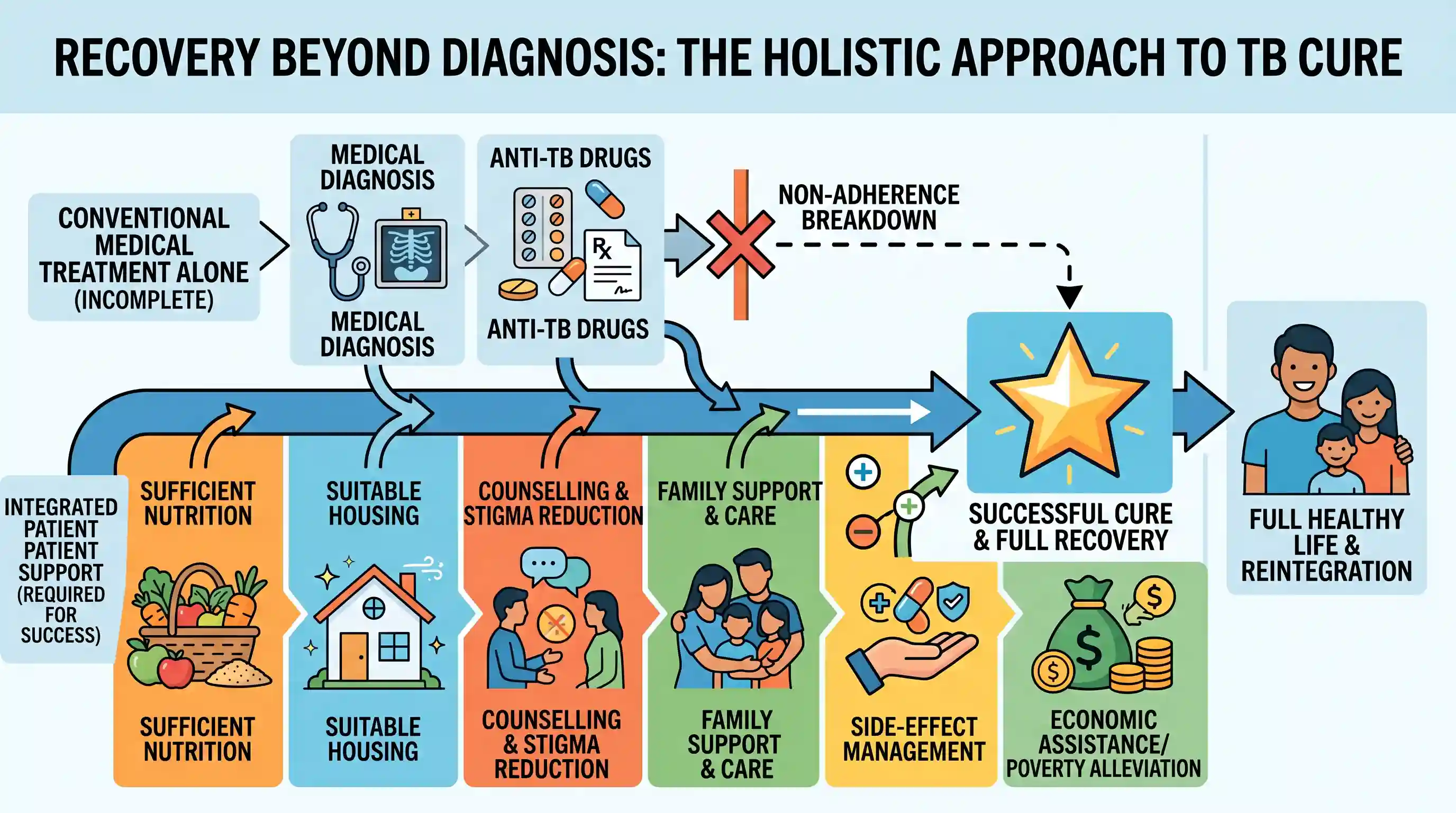
The passage describes how TB is not just a medical issue but is deeply intertwined with socio-economic factors (poverty, nutrition, housing), psychological barriers (stigma, lack of counselling), and systemic support issues (expensive treatment, lack of support, side-effects). It highlights that these non-medical factors often demotivate patients from continuing treatment, leading to disastrous health consequences.
A) TB is not a curable disease in Indian circumstances. This is incorrect. The passage does not state that TB is incurable. Instead, it details the challenges in successfully treating it due to various barriers, implying that if these barriers are overcome, treatment can be successful.
B) Curing TB requires more than diagnosis and medical treatment. This option perfectly encapsulates the passage's main message. The passage explicitly lists numerous factors beyond just medical diagnosis and treatment (like nutrition, housing, prevention understanding, stigma, counselling, support, cost, side-effects management) that are crucial for patients to complete treatment and recover. It argues that medical intervention alone is insufficient given the complex socio-economic and psychological context.
C) Government's surveillance mechanism is deficient; and poor people have no access to treatment. While the passage hints at issues like "lack of adequate support from providers" and "expensive treatment," it does not primarily focus on the government's surveillance mechanism. It also doesn't state that poor people have no access to treatment, but rather highlights barriers to continuing treatment. This option is too specific and doesn't capture the full breadth of the message.
D) India will be free from diseases like TB only when its poverty alleviation programmes are effectively and successfully implemented. While the passage strongly links TB to poverty and suggests poverty alleviation is crucial, stating that only poverty alleviation will make India free from diseases like TB is an extreme claim. The passage highlights a multi-faceted problem, including medical adherence, stigma, and support, not just poverty. Option B is more direct in addressing the process of curing TB as described in the passage, which involves a holistic approach beyond just medical treatment.
Therefore, option B is the most logical, rational, and crucial message conveyed, as it addresses the comprehensive nature of successful TB treatment beyond just medical aspects.
Related questions
More UPSC Prelims practice from the same subject and topic.
- Prelims 2019CSATReading Comprehension
What stands in the way of the widespread and careful adoption of 'Genetic Modification (GM)' technology is an 'Intellectual Property Rights' regime that seeks to create private monopolies for such tec…
- Prelims 2019CSATReading Comprehension
Passage-1 What stands in the way of the widespread and careful adoption of 'Genetic Modification (GM)' technology is an 'Intellectual Property Rights' regime that seeks to create private monopolies fo…
- Prelims 2019CSATReading Comprehension
Most invasive species are neither terribly successful nor very harmful. Britain's invasive plants are not widespread, not spreading especially quickly, and often less of a nuisance than vigorous nativ…
- Prelims 2019CSATReading Comprehension
Diarrhoeal deaths among Indian children are mostly due to food and water contamination. Use of contaminated groundwater and unsafe chemicals in agriculture, poor hygiene in storage and handling of foo…
- Prelims 2019CSATReading Comprehension
The interests of working and poor people have historically been neglected in the planning of our cities. Our cities are increasingly intolerant, unsafe and unlivable places for large numbers of citize…
- Prelims 2019CSATReading Comprehension
A vast majority of Indians are poor, with barely 10 percent employed in the organised sector. We are being convinced that vigorous economic growth is generating substantial employment. But this is not…