India's economic footprint, given its population, still remains small compared to the US, the European Union or China. It has much to learn from other economies, yet must implement solutions that fit its unique circumstances. India especially needs an effective long- term regulatory system based on collaboration rather than the current top- down approach. Regulations seek desirable outcomes yet are repeatedly used as political tools to push one agenda or another. Often, regulations fail to consider impacts on jobs and economic growth - or less restrictive alternatives. Regulations may be used to protect local markets at the expense of more widely shared prosperity in the future. Additionally, regulations inevitably result in numerous unintended consequences. In today's hyper competitive global economy, regulations need to be viewed as "weapons" that seek cost- justified social and environmental benefits while improving the economic well- being of most citizens. Which one of the following is the most logical, rational and crucial inference that can be derived from the above passage?

- AA better regulatory system will help India achieve the size of economy appropriate to its populationCorrect
- BIn a competitive global economy, India must use regulations strategically
- CRegulations in India do not favour its integration with today's hyper competitive global economy
- DJob creation and economic growth should be dominant considerations in developing India's regulatory system.
Explanation
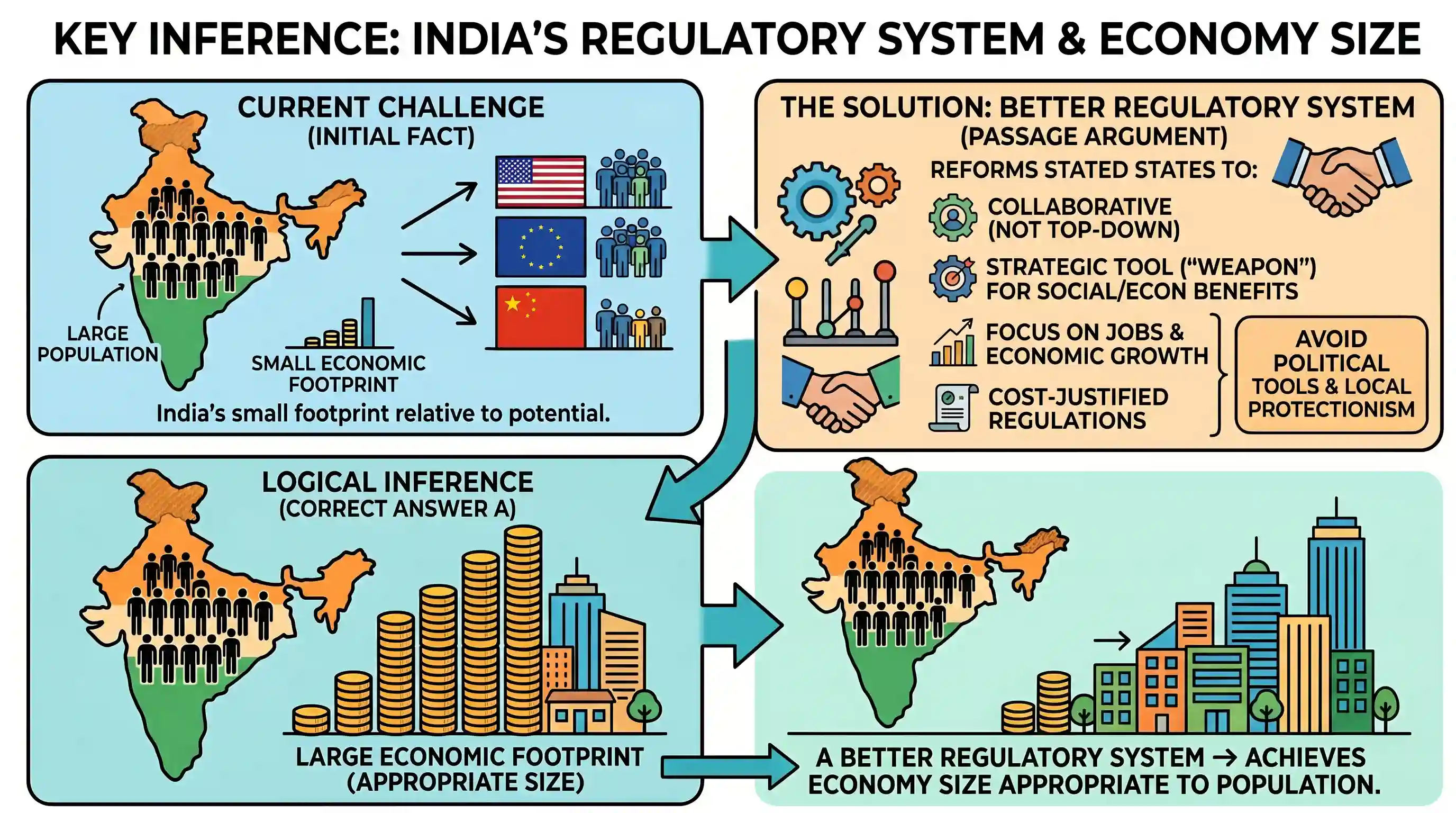
The passage begins by stating India's economic footprint is small given its population and then dedicates the rest of the text to criticizing the current regulatory system and advocating for a better one that improves economic well-being. The most logical inference is that improving this regulatory system is key to addressing the initial problem of India's small economic size relative to its population.
A) A better regulatory system will help India achieve the size of economy appropriate to its population. This is correct. The passage highlights India's small economic footprint relative to its population and then extensively discusses the need for an effective, collaborative regulatory system that considers economic growth and well-being. This option directly connects the problem identified at the beginning with the solution discussed throughout the passage.
B) In a competitive global economy, India must use regulations strategically. While the passage mentions a "hyper competitive global economy" and viewing regulations as "weapons," implying strategic use, this is a supporting detail for how regulations should be improved, not the overarching inference that links the regulatory system to India's overall economic size and potential, which is the initial premise.
C) Regulations in India do not favour its integration with today's hyper competitive global economy. The passage suggests that current regulations protect local markets at the expense of wider prosperity, which could hinder integration. However, the primary focus is on India's overall economic footprint and well-being, not solely on integration. Option A is a broader and more fundamental inference.
D) Job creation and economic growth should be dominant considerations in developing India's regulatory system. This is a key recommendation within the passage for what a better regulatory system should achieve. However, it is a component or goal of the improved system, not the most crucial inference regarding the ultimate impact of such a system on India's economic standing, which is captured by option A.
Related questions
More UPSC Prelims practice from the same subject and topic.
- Prelims 2019CSATReading Comprehension
What stands in the way of the widespread and careful adoption of 'Genetic Modification (GM)' technology is an 'Intellectual Property Rights' regime that seeks to create private monopolies for such tec…
- Prelims 2019CSATReading Comprehension
Passage-1 What stands in the way of the widespread and careful adoption of 'Genetic Modification (GM)' technology is an 'Intellectual Property Rights' regime that seeks to create private monopolies fo…
- Prelims 2019CSATReading Comprehension
Most invasive species are neither terribly successful nor very harmful. Britain's invasive plants are not widespread, not spreading especially quickly, and often less of a nuisance than vigorous nativ…
- Prelims 2019CSATReading Comprehension
Diarrhoeal deaths among Indian children are mostly due to food and water contamination. Use of contaminated groundwater and unsafe chemicals in agriculture, poor hygiene in storage and handling of foo…
- Prelims 2019CSATReading Comprehension
The interests of working and poor people have historically been neglected in the planning of our cities. Our cities are increasingly intolerant, unsafe and unlivable places for large numbers of citize…
- Prelims 2019CSATReading Comprehension
A vast majority of Indians are poor, with barely 10 percent employed in the organised sector. We are being convinced that vigorous economic growth is generating substantial employment. But this is not…