India's economic footprint, given its population, still remains small compared to the US, the European Union or China. It has much to learn from other economies, yet must implement solutions that fit its unique circumstances. India especially needs an effective long- term regulatory system based on collaboration rather than the current top- down approach. Regulations seek desirable outcomes yet are repeatedly used as political tools to push one agenda or another. Often, regulations fail to consider impacts on jobs and economic growth - or less restrictive alternatives. Regulations may be used to protect local markets at the expense of more widely shared prosperity in the future. Additionally, regulations inevitably result in numerous unintended consequences. In today's hyper competitive global economy, regulations need to be viewed as "weapons" that seek cost- justified social and environmental benefits while improving the economic well- being of most citizens. On the basis of the above passage, the following assumptions have been made : In today's global economy, 1. regulations are not effectively used to protect local markets. 2. social and environmental concerns are generally ignored by the governments across the world while implementing the regulations. Which of the above assumptions is/are valid ?

- A1 only
- B2 only
- CBoth 1 and 2Correct
- DNeither 1 nor 2
Explanation
Here's a brief analysis of each assumption based on the passage:
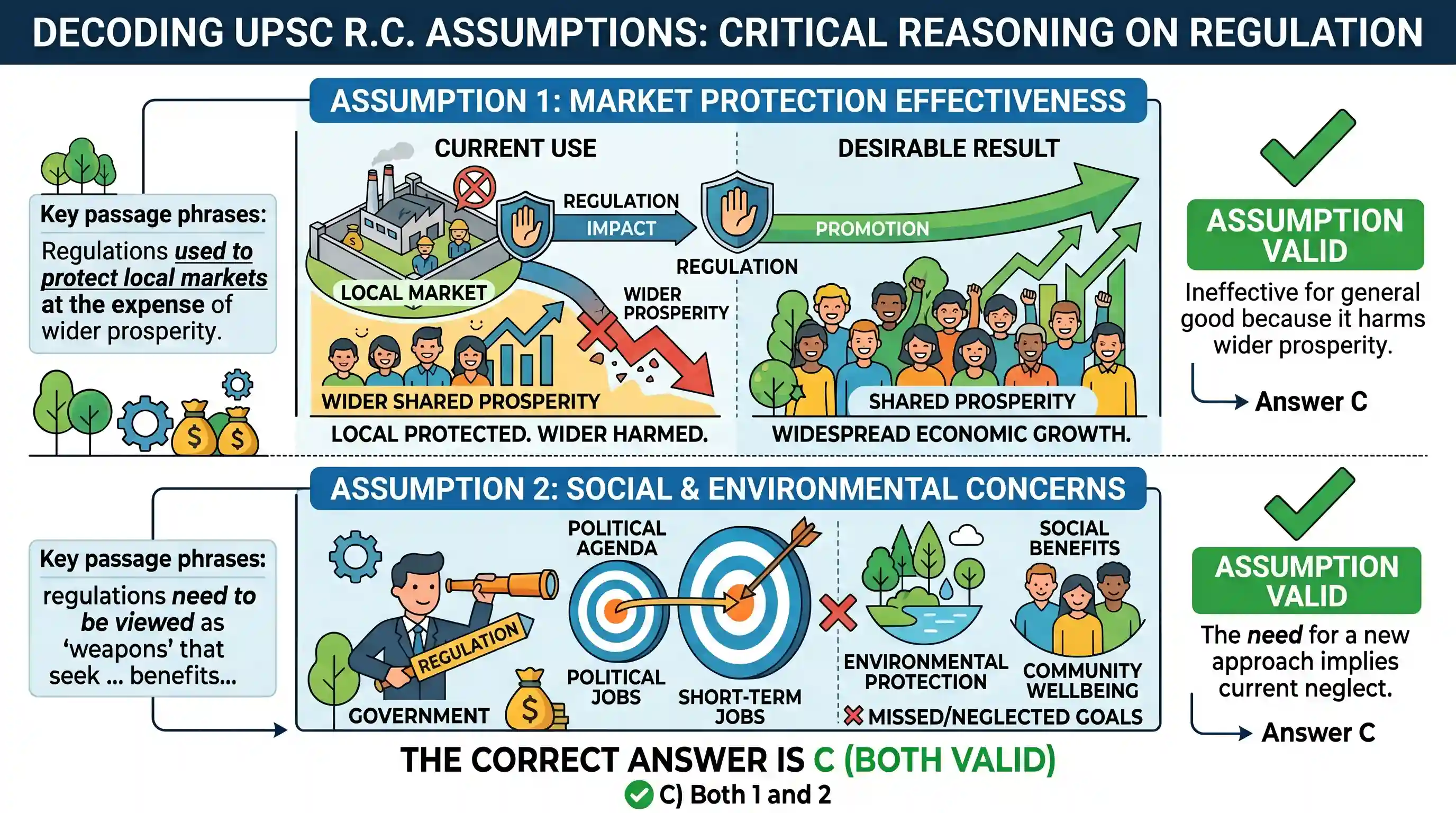
Assumption 1: "regulations are not effectively used to protect local markets." The passage states: "Regulations may be used to protect local markets at the expense of more widely shared prosperity in the future." This implies that while regulations might succeed in protecting local markets, this comes at a cost to broader economic well-being. From the perspective of achieving "more widely shared prosperity" (which the author advocates for as a desirable outcome for regulations), using them to protect local markets "at the expense" of this wider prosperity means they are not effectively used for the overall good. Thus, the author assumes that the current use of regulations for local market protection is not effective in achieving shared prosperity. This assumption is valid.
Assumption 2: "social and environmental concerns are generally ignored by the governments across the world while implementing the regulations." The passage concludes by stating: "regulations need to be viewed as 'weapons' that seek cost- justified social and environmental benefits while improving the economic well-being of most citizens." The use of "need to be viewed as" strongly suggests that regulations are not currently adequately considering or prioritizing these social and environmental benefits. If they were, there would be no need for such a strong prescriptive statement. Therefore, the author assumes that these concerns are generally ignored or not adequately addressed in current regulatory practices. This assumption is valid.
Since both assumptions are valid based on the passage, option C is the correct answer.
The final answer is C
Related questions
More UPSC Prelims practice from the same subject and topic.
- Prelims 2019CSATReading Comprehension
What stands in the way of the widespread and careful adoption of 'Genetic Modification (GM)' technology is an 'Intellectual Property Rights' regime that seeks to create private monopolies for such tec…
- Prelims 2019CSATReading Comprehension
Passage-1 What stands in the way of the widespread and careful adoption of 'Genetic Modification (GM)' technology is an 'Intellectual Property Rights' regime that seeks to create private monopolies fo…
- Prelims 2019CSATReading Comprehension
Most invasive species are neither terribly successful nor very harmful. Britain's invasive plants are not widespread, not spreading especially quickly, and often less of a nuisance than vigorous nativ…
- Prelims 2019CSATReading Comprehension
Diarrhoeal deaths among Indian children are mostly due to food and water contamination. Use of contaminated groundwater and unsafe chemicals in agriculture, poor hygiene in storage and handling of foo…
- Prelims 2019CSATReading Comprehension
The interests of working and poor people have historically been neglected in the planning of our cities. Our cities are increasingly intolerant, unsafe and unlivable places for large numbers of citize…
- Prelims 2019CSATReading Comprehension
A vast majority of Indians are poor, with barely 10 percent employed in the organised sector. We are being convinced that vigorous economic growth is generating substantial employment. But this is not…