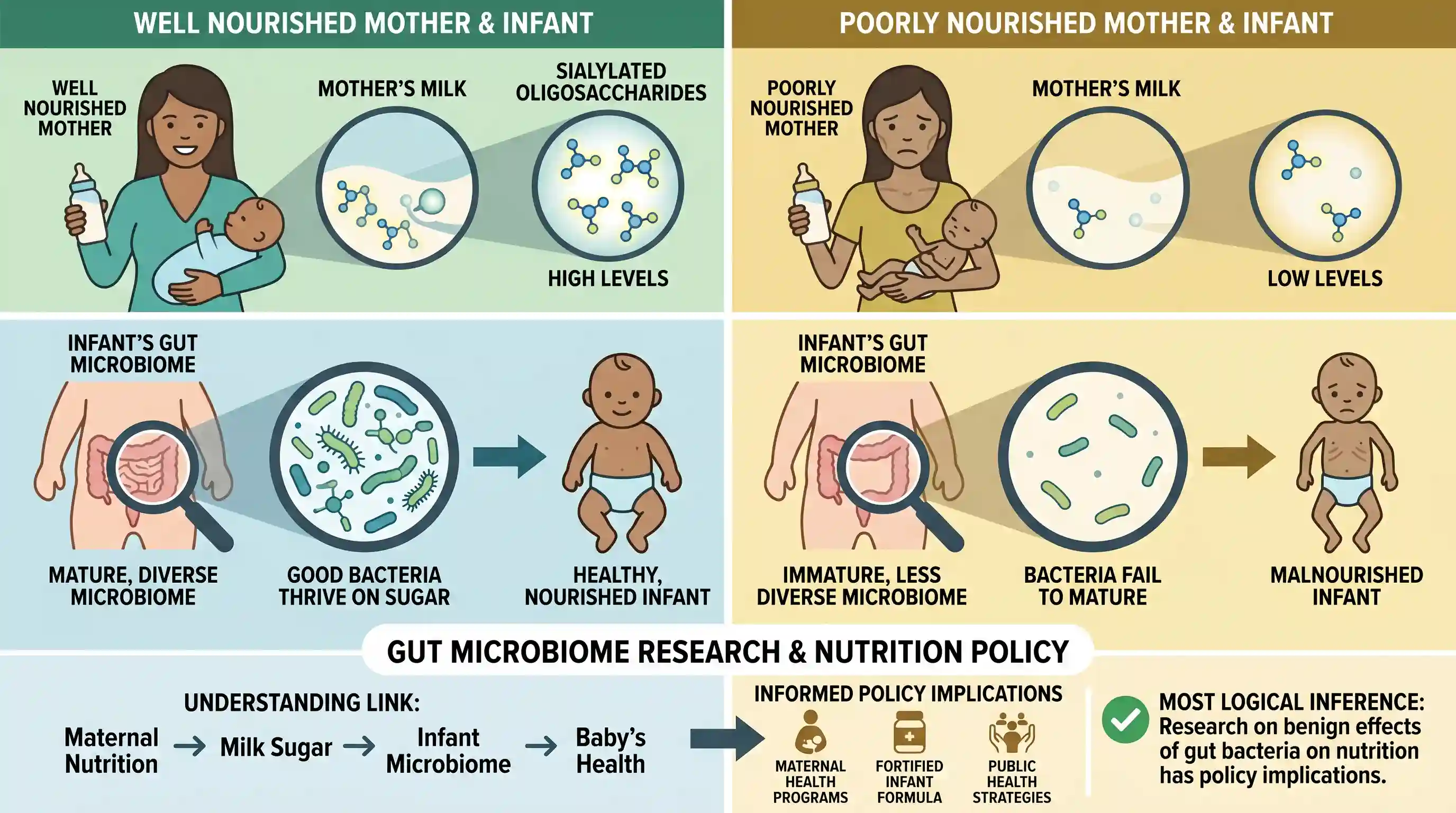
In a study, scientists compared the microbiomes of poorly nourished and well nourished infants and young children. Gut microbes were isolated from faecal samples of malnourished and healthy children. The microbiome was "immature" and less diverse in malnourished children compared to the better developed "mature" microbiome found in healthy children of the same age. According to some studies, the chemical composition of mother's milk has shown the presence of a modified sugar (sialylated oligosaccharides). This is not utilized by the baby for its own nutrition. However, the bacteria constituting the infant's microbiome thrive on this sugar which serves as their food. Malnourished mothers have low levels of this sugar in their milk. Consequently, the microbiomes of their infants fail to mature. That in turn, leads to malnourished babies Which one of the following is the most logical, rational and crucial inference that can be derived from the above passage?

- AIf malnourished condition in children is caused by gut bacteria, it cannot be treated
- BThe guts of malnourished babies should be inoculated with mature microbiomes
- CBabies of malnourished mothers should be fed with dairy milk fortified with sialylated oligosaccharides instead of mother's milk
- DResearch on benign effects of gut bacteria on nutrition has policy implicationsCorrect
Explanation
The passage describes a critical link between mother's milk composition (sialylated oligosaccharides), the development of a healthy infant gut microbiome, and the prevention of malnutrition. It highlights that malnourished mothers have low levels of this crucial sugar, leading to immature microbiomes and malnourished babies.
Let's analyze each option:
A) If malnourished condition in children is caused by gut bacteria, it cannot be treated. This is an illogical and unsupported inference. The passage identifies a cause (immature microbiome due to lack of specific sugar) which implies that if the cause is understood, potential treatments or interventions could be developed. It does not state that it "cannot be treated."
B) The guts of malnourished babies should be inoculated with mature microbiomes. While this might be a potential intervention, it's not the most logical or crucial inference. The passage emphasizes that the food for the bacteria (sialylated oligosaccharides) is essential for the microbiome to thrive and mature. Simply inoculating without addressing the underlying dietary deficiency might not lead to a sustainable solution. The passage focuses on the mechanism of maturation through diet.
C) Babies of malnourished mothers should be fed with dairy milk fortified with sialylated oligosaccharides instead of mother's milk. This is an incorrect and potentially harmful inference. The passage states that mother's milk contains these oligosaccharides. The problem is low levels in malnourished mothers' milk. The logical step would be to improve maternal nutrition, supplement the mother's milk, or provide supplements to the baby alongside mother's milk, not replace mother's milk which has numerous other benefits.
D) Research on benign effects of gut bacteria on nutrition has policy implications. This is the most logical, rational, and crucial inference. The passage details how specific gut bacteria, nourished by a component in mother's milk, play a beneficial role ("benign effects") in infant nutrition, preventing malnutrition. The finding that maternal malnutrition impacts this process and leads to infant malnutrition has direct implications for public health policies. These policies could include strategies for improving maternal nutrition, fortifying infant formulas, or developing supplements to ensure infants receive adequate sialylated oligosaccharides to foster a healthy microbiome and prevent malnutrition. This research isn't just academic; it points to actionable steps on a larger scale.
The final answer is D
Related questions
More UPSC Prelims practice from the same subject and topic.
- Prelims 2019CSATReading Comprehension
What stands in the way of the widespread and careful adoption of 'Genetic Modification (GM)' technology is an 'Intellectual Property Rights' regime that seeks to create private monopolies for such tec…
- Prelims 2019CSATReading Comprehension
Passage-1 What stands in the way of the widespread and careful adoption of 'Genetic Modification (GM)' technology is an 'Intellectual Property Rights' regime that seeks to create private monopolies fo…
- Prelims 2019CSATReading Comprehension
Most invasive species are neither terribly successful nor very harmful. Britain's invasive plants are not widespread, not spreading especially quickly, and often less of a nuisance than vigorous nativ…
- Prelims 2019CSATReading Comprehension
Diarrhoeal deaths among Indian children are mostly due to food and water contamination. Use of contaminated groundwater and unsafe chemicals in agriculture, poor hygiene in storage and handling of foo…
- Prelims 2019CSATReading Comprehension
The interests of working and poor people have historically been neglected in the planning of our cities. Our cities are increasingly intolerant, unsafe and unlivable places for large numbers of citize…
- Prelims 2019CSATReading Comprehension
A vast majority of Indians are poor, with barely 10 percent employed in the organised sector. We are being convinced that vigorous economic growth is generating substantial employment. But this is not…