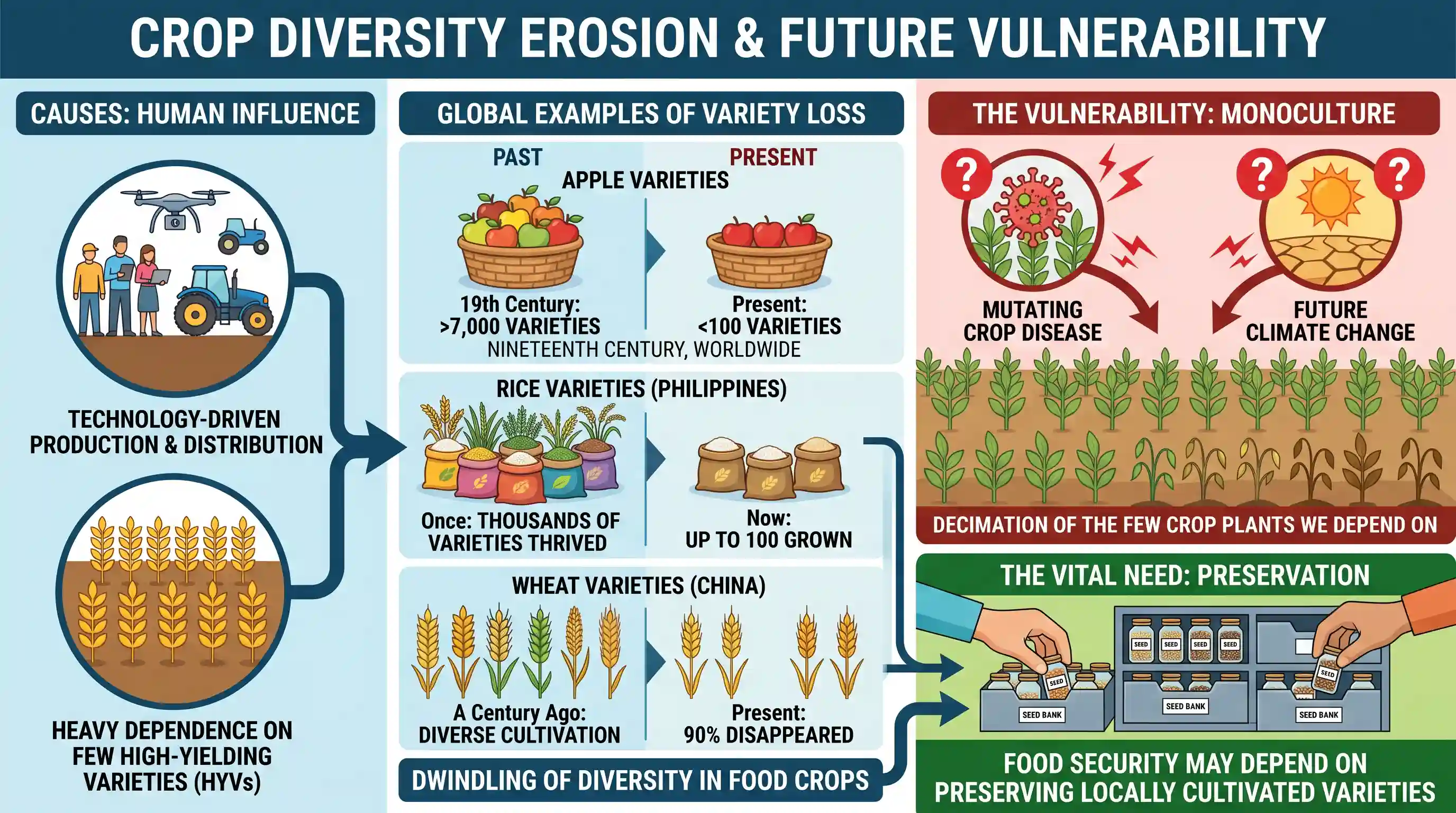
Food varieties extinction is happening all over the world --- and it is happening fast. For example, of the 7,000 apple varieties that were grown during the nineteenth century, fewer than o hundred remain. In the Philippines, thousands of varieties of rice once thrived; now only up to a hundred are grown there. In China, 90 percent of the wheat varieties cultivated just a century ago have disappeared. Farmers in the past painstakingly bred and developed crops well suited to the peculiarities of their local climate and environment. In the recent past, our heavy dependence on a few high yielding varieties and technology-driven production and distribution of food is causing the dwindling of diversity in food crops. If some mutating crop disease or future climate change decimates the few crop plants we have come to depend on to feed our growing population, we might desperately need some of those varieties we have let go extinct. On the basis of the above passage, the following assumptions have been made: 1. Humans have been the main reason for the large scale extinction of plant species. 2. Consumption of food mainly from locally cultivated crops ensures crop diversity. 3. The present style of production and distribution of food will finally lead to the problem of food scarcity in the near future. 4. Our food security may depend on our ability to preserve the locally cultivated varieties of crops. Which of the above assumptions are valid ?

- A1 and 3
- B2 and 4
- C2 and 3
- D1 and 4Correct
Explanation
The passage discusses the rapid extinction of food crop varieties due to human activities and warns about the potential consequences for food security. Let's analyze each assumption:
-
Humans have been the main reason for the large scale extinction of plant species.
- The passage explicitly states: "our heavy dependence on a few high yielding varieties and technology-driven production and distribution of food is causing the dwindling of diversity in food crops." It provides examples of thousands of varieties disappearing, directly attributing this "dwindling of diversity" (i.e., large-scale extinction of varieties) to human actions. While "plant species" is broad, in the context of the passage, it refers to the cultivated food plant species/varieties. This assumption is valid.
-
Consumption of food mainly from locally cultivated crops ensures crop diversity.
- The passage mentions that "Farmers in the past painstakingly bred and developed crops well suited to the peculiarities of their local climate and environment," which implies this practice led to diversity. It also contrasts this with the current "heavy dependence on a few high yielding varieties." While local cultivation contributes to diversity, the passage doesn't state that consumption alone "ensures" it. "Ensures" is a strong word, and the passage focuses more on the breeding and development aspect by farmers in the past. This assumption is not directly and strongly supported as an "ensurance."
-
The present style of production and distribution of food will finally lead to the problem of food scarcity in the near future.
- The passage uses conditional language: "If some mutating crop disease or future climate change decimates the few crop plants... we might desperately need some of those varieties we have let go extinct." This is a warning about a potential vulnerability to food scarcity under specific future conditions, not a definite prediction that the current style will finally lead to scarcity in the "near future." The certainty implied by "will finally lead to" is not supported. This assumption is invalid.
-
Our food security may depend on our ability to preserve the locally cultivated varieties of crops.
- The passage warns that if current few crop plants are decimated by disease or climate change, "we might desperately need some of those varieties we have let go extinct." These "varieties we have let go extinct" are the diverse, locally cultivated varieties mentioned earlier. The statement directly links the preservation of these varieties to future needs for feeding the population, which is food security. The phrasing "may depend on" accurately reflects the conditional warning in the passage. This assumption is valid.
Based on the analysis, assumptions 1 and 4 are valid.
The final answer is D
Related questions
More UPSC Prelims practice from the same subject and topic.
- Prelims 2019CSATReading Comprehension
What stands in the way of the widespread and careful adoption of 'Genetic Modification (GM)' technology is an 'Intellectual Property Rights' regime that seeks to create private monopolies for such tec…
- Prelims 2019CSATReading Comprehension
Passage-1 What stands in the way of the widespread and careful adoption of 'Genetic Modification (GM)' technology is an 'Intellectual Property Rights' regime that seeks to create private monopolies fo…
- Prelims 2019CSATReading Comprehension
Most invasive species are neither terribly successful nor very harmful. Britain's invasive plants are not widespread, not spreading especially quickly, and often less of a nuisance than vigorous nativ…
- Prelims 2019CSATReading Comprehension
Diarrhoeal deaths among Indian children are mostly due to food and water contamination. Use of contaminated groundwater and unsafe chemicals in agriculture, poor hygiene in storage and handling of foo…
- Prelims 2019CSATReading Comprehension
The interests of working and poor people have historically been neglected in the planning of our cities. Our cities are increasingly intolerant, unsafe and unlivable places for large numbers of citize…
- Prelims 2019CSATReading Comprehension
A vast majority of Indians are poor, with barely 10 percent employed in the organised sector. We are being convinced that vigorous economic growth is generating substantial employment. But this is not…