A research team examined a long-term owl roost. Owls prey on small mammals and the excreted remains of those meals that accumulated over the time, provide us an insight into the composition and structure of small mammals over the past 'millennia. The research suggested that when the Earth went through a period of rapid warming about 13,000 years ago, the small mammal community was stable and resilient. But, from the last quarter of the nineteenth century, human-made changes to the environment had caused an enormous drop in biomass and energy flow. This dramatic decline in energy flow means modern ecosystems are not adapting as easily as they did in the past. On the basis of the above passage, the following assumptions have been made : 1. Global warming is a frequently occurring natural phenomenon. 2. The impending global warming will not adversely affect small mammals. 3. Humans are responsible for the loss of the Earth's natural resilience. Which of the above assumptions is/are valid?

- A1 and 2 only
- B3 onlyCorrect
- C2 and 3 only
- D1, 2 and 3
Explanation
Analysis of the statements:
-
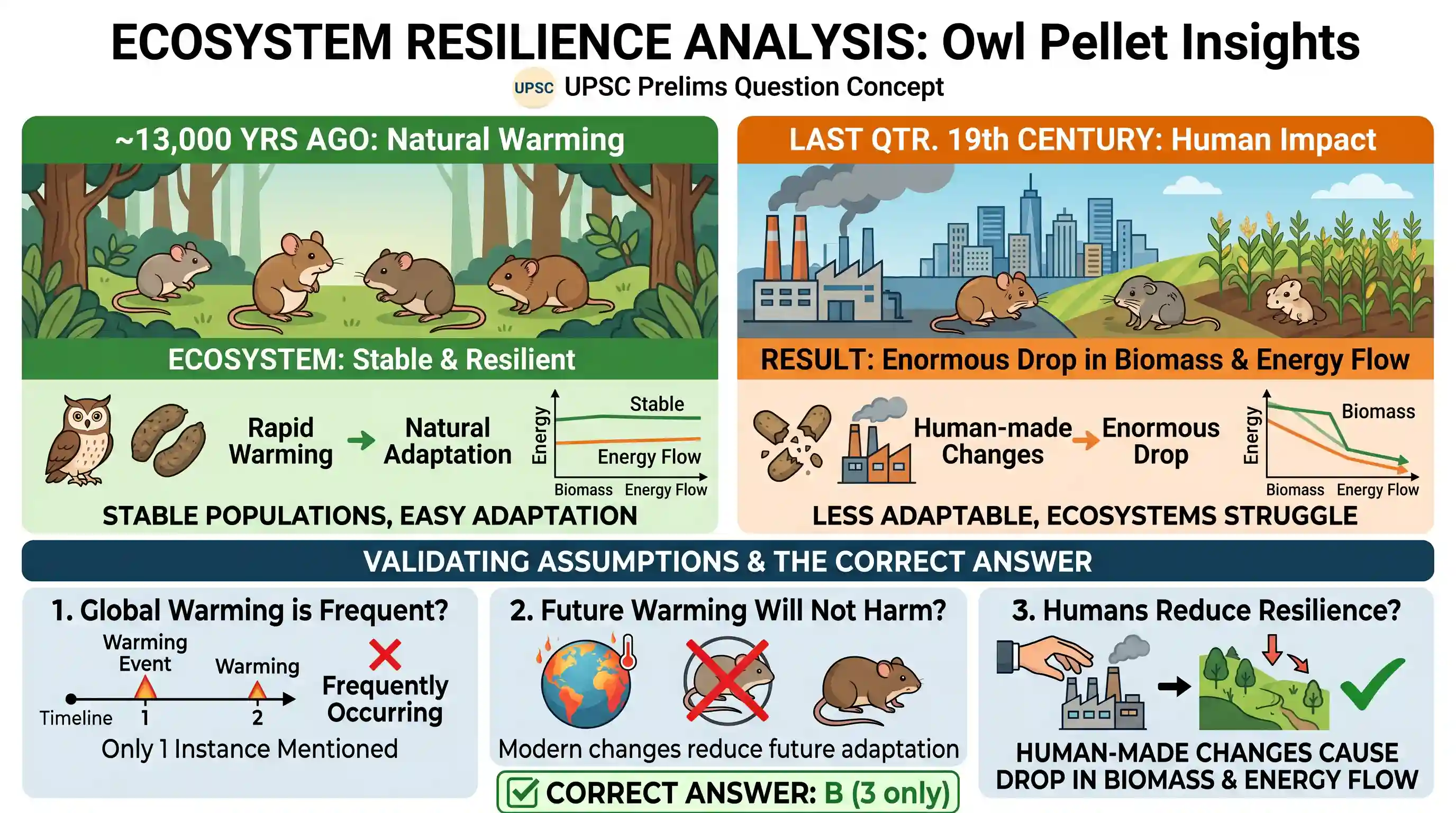
Global warming is a frequently occurring natural phenomenon. The passage mentions only one instance of rapid warming about 13,000 years ago, which was natural. It does not provide enough information to conclude that such phenomena are "frequently occurring." Therefore, this assumption is not valid.
-
The impending global warming will not adversely affect small mammals. The passage states that while small mammals were resilient during past natural warming, "from the last quarter of the nineteenth century, human-made changes to the environment had caused an enormous drop in biomass and energy flow. This dramatic decline in energy flow means modern ecosystems are not adapting as easily as they did in the past." This implies that modern ecosystems, due to human impact, will be adversely affected by future warming, unlike in the past. Therefore, this assumption is not valid; in fact, the passage suggests the opposite.
-
Humans are responsible for the loss of the Earth's natural resilience. The passage explicitly states that "human-made changes to the environment had caused an enormous drop in biomass and energy flow," and this decline means "modern ecosystems are not adapting as easily as they did in the past." This directly links human actions to a reduced capacity of ecosystems to adapt, which is a loss of natural resilience compared to the past. Therefore, this assumption is valid.
Based on the analysis, only assumption 3 is valid.
The final answer is B) 3 only.
Related questions
More UPSC Prelims practice from the same subject and topic.
- Prelims 2019CSATReading Comprehension
What stands in the way of the widespread and careful adoption of 'Genetic Modification (GM)' technology is an 'Intellectual Property Rights' regime that seeks to create private monopolies for such tec…
- Prelims 2019CSATReading Comprehension
Passage-1 What stands in the way of the widespread and careful adoption of 'Genetic Modification (GM)' technology is an 'Intellectual Property Rights' regime that seeks to create private monopolies fo…
- Prelims 2019CSATReading Comprehension
Most invasive species are neither terribly successful nor very harmful. Britain's invasive plants are not widespread, not spreading especially quickly, and often less of a nuisance than vigorous nativ…
- Prelims 2019CSATReading Comprehension
Diarrhoeal deaths among Indian children are mostly due to food and water contamination. Use of contaminated groundwater and unsafe chemicals in agriculture, poor hygiene in storage and handling of foo…
- Prelims 2019CSATReading Comprehension
The interests of working and poor people have historically been neglected in the planning of our cities. Our cities are increasingly intolerant, unsafe and unlivable places for large numbers of citize…
- Prelims 2019CSATReading Comprehension
A vast majority of Indians are poor, with barely 10 percent employed in the organised sector. We are being convinced that vigorous economic growth is generating substantial employment. But this is not…