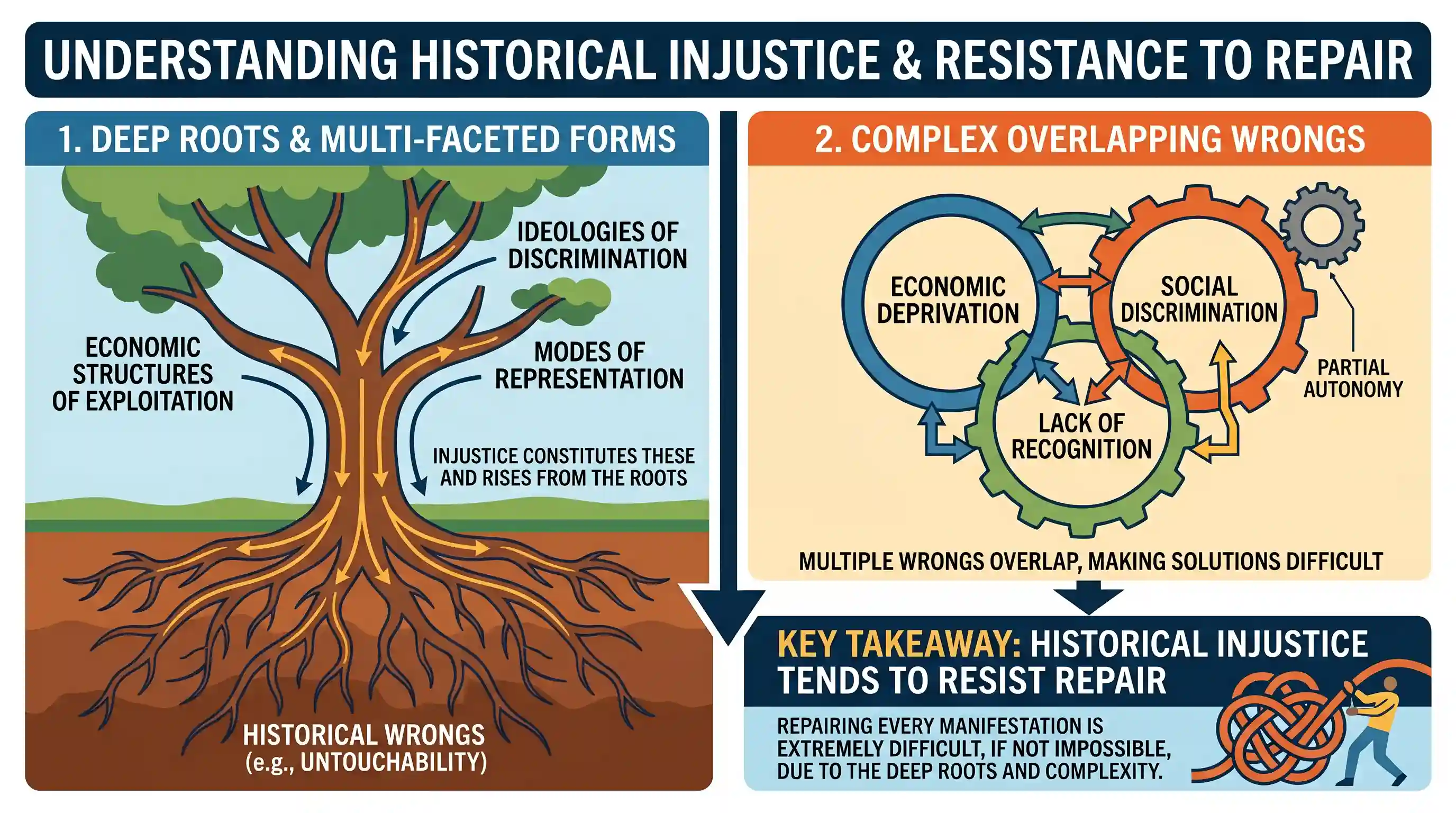
Political theorists no doubt have to take history of injustice, for example, untouchability, seriously. The concept of historical injustice takes note of a variety of historical wrongs that continue into the present in some form or the other and tend to resist repair. Two reasons might account for resistance to repair. One, not only are the roots of injustice buried deep in history, injustice itself constitutes economic structures of exploitation, ideologies of discrimination and modes of representation. Two, the category of historical injustice generally extends across a number of wrongs such as economic deprivation, social discrimination and lack of recognition. This category is complex, not only because of the overlap between a number of wrongs, but because one or the other wrong, generally discrimination, tends to acquire partial autonomy from others. This is borne out by the history of repair in India. What is the main idea that we can infer from the passage?

- AUntouchability in India has not been taken seriously by political theorists.
- BHistorical injustice is inevitable in any society and is always beyond repair
- CSocial discrimination and deprivation have their roots in bad economies
- DIt is difficult, if not impossible, to repair every manifestation of historical injustice.Correct
Explanation
The main idea of the passage revolves around the challenges in repairing historical injustices.
Analysis of options:
A) Untouchability in India has not been taken seriously by political theorists. Incorrect. The passage states, "Political theorists no doubt have to take history of injustice, for example, untouchability, seriously." This indicates that theorists must take it seriously, not that they haven't.
B) Historical injustice is inevitable in any society and is always beyond repair. Incorrect. The passage states historical injustice "tend to resist repair," implying difficulty, not absolute impossibility or that it's "always beyond repair." It also doesn't discuss the inevitability of injustice.
C) Social discrimination and deprivation have their roots in bad economies. Incorrect. The passage mentions that injustice "constitutes economic structures of exploitation, ideologies of discrimination and modes of representation." It lists economic deprivation, social discrimination, and lack of recognition as different wrongs, noting their overlap but also that discrimination can acquire "partial autonomy." This suggests a complex interplay, not a singular root in "bad economies."
D) It is difficult, if not impossible, to repair every manifestation of historical injustice. Correct. The passage repeatedly emphasizes that historical wrongs "continue into the present... and tend to resist repair." It then provides two detailed reasons for this resistance: the deep roots and complex constitution of injustice (economic, ideological, representational) and the intricate, overlapping nature of various wrongs (economic, social, recognition), where some can even acquire partial autonomy. The phrase "borne out by the history of repair in India" further supports the idea of inherent difficulty. This option accurately summarizes the central theme of the passage.
Related questions
More UPSC Prelims practice from the same subject and topic.
- Prelims 2019CSATReading Comprehension
What stands in the way of the widespread and careful adoption of 'Genetic Modification (GM)' technology is an 'Intellectual Property Rights' regime that seeks to create private monopolies for such tec…
- Prelims 2019CSATReading Comprehension
Passage-1 What stands in the way of the widespread and careful adoption of 'Genetic Modification (GM)' technology is an 'Intellectual Property Rights' regime that seeks to create private monopolies fo…
- Prelims 2019CSATReading Comprehension
Most invasive species are neither terribly successful nor very harmful. Britain's invasive plants are not widespread, not spreading especially quickly, and often less of a nuisance than vigorous nativ…
- Prelims 2019CSATReading Comprehension
Diarrhoeal deaths among Indian children are mostly due to food and water contamination. Use of contaminated groundwater and unsafe chemicals in agriculture, poor hygiene in storage and handling of foo…
- Prelims 2019CSATReading Comprehension
The interests of working and poor people have historically been neglected in the planning of our cities. Our cities are increasingly intolerant, unsafe and unlivable places for large numbers of citize…
- Prelims 2019CSATReading Comprehension
A vast majority of Indians are poor, with barely 10 percent employed in the organised sector. We are being convinced that vigorous economic growth is generating substantial employment. But this is not…