Political theorists no doubt have to take history of injustice, for example, untouchability, seriously. The concept of historical injustice takes note of a variety of historical wrongs that continue into the present in some form or the other and tend to resist repair. Two reasons might account for resistance to repair. One, not only are the roots of injustice buried deep in history, injustice itself constitutes economic structures of exploitation, ideologies of discrimination and modes of representation. Two, the category of historical injustice generally extends across a number of wrongs such as economic deprivation, social discrimination and lack of recognition. This category is complex, not only because of the overlap between a number of wrongs, but because one or the other wrong, generally discrimination, tends to acquire partial autonomy from others. This is borne out by the history of repair in India. On the basis of the above passage, the following assumptions have been made : 1. Removal of economic discrimination leads to removal of social discrimination. 2. Democratic polity is the best way to repair historical wrongs. Which of the above assumptions is/are valid ?

- A1 only
- B2 only
- CBoth 1 and 2
- DNeither 1 nor 2Correct
Explanation
The passage discusses the complexity of historical injustice, noting that it involves economic exploitation, social discrimination, and lack of recognition, and that these wrongs can acquire "partial autonomy from others." It also highlights the deep-rooted nature of injustice and its resistance to repair.
Let's analyze each assumption:
-
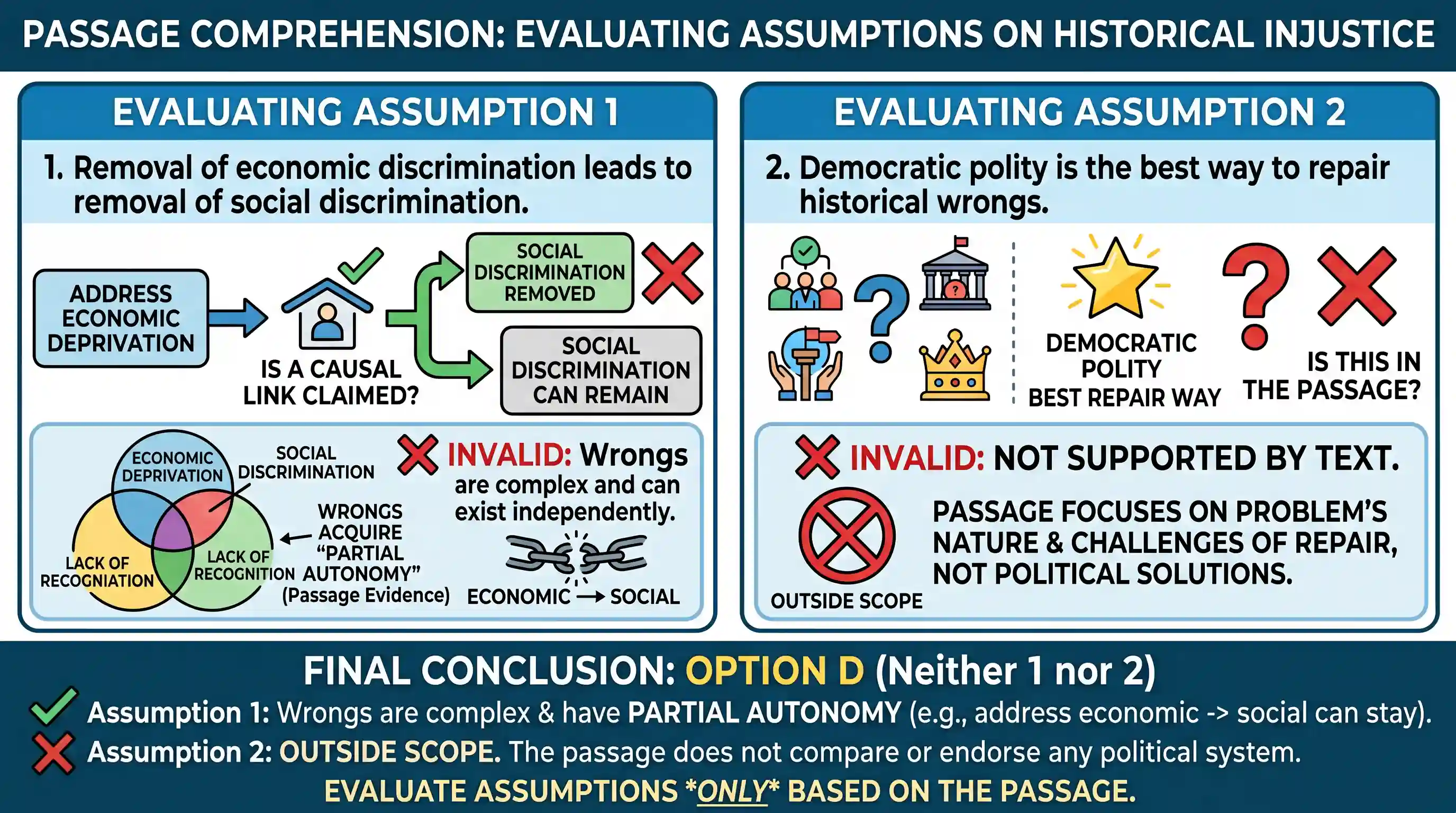
Removal of economic discrimination leads to removal of social discrimination. The passage states that historical injustice is complex "not only because of the overlap between a number of wrongs, but because one or the other wrong, generally discrimination, tends to acquire partial autonomy from others." This implies that social discrimination can exist independently to some extent, even if economic discrimination is addressed. Therefore, removing economic economic discrimination alone may not automatically lead to the removal of social discrimination. This assumption is not supported by the passage.
-
Democratic polity is the best way to repair historical wrongs. The passage talks about the nature of historical injustice and its resistance to repair, mentioning "the history of repair in India." However, it does not discuss or endorse any specific political system, such as a democratic polity, as the "best way" to repair these wrongs. The passage focuses on the challenges of repair, not the political mechanisms for it. This assumption is not supported by the passage.
Since neither assumption is valid based on the information provided in the passage, option D is the correct answer.
Related questions
More UPSC Prelims practice from the same subject and topic.
- Prelims 2019CSATReading Comprehension
What stands in the way of the widespread and careful adoption of 'Genetic Modification (GM)' technology is an 'Intellectual Property Rights' regime that seeks to create private monopolies for such tec…
- Prelims 2019CSATReading Comprehension
Passage-1 What stands in the way of the widespread and careful adoption of 'Genetic Modification (GM)' technology is an 'Intellectual Property Rights' regime that seeks to create private monopolies fo…
- Prelims 2019CSATReading Comprehension
Most invasive species are neither terribly successful nor very harmful. Britain's invasive plants are not widespread, not spreading especially quickly, and often less of a nuisance than vigorous nativ…
- Prelims 2019CSATReading Comprehension
Diarrhoeal deaths among Indian children are mostly due to food and water contamination. Use of contaminated groundwater and unsafe chemicals in agriculture, poor hygiene in storage and handling of foo…
- Prelims 2019CSATReading Comprehension
The interests of working and poor people have historically been neglected in the planning of our cities. Our cities are increasingly intolerant, unsafe and unlivable places for large numbers of citize…
- Prelims 2019CSATReading Comprehension
A vast majority of Indians are poor, with barely 10 percent employed in the organised sector. We are being convinced that vigorous economic growth is generating substantial employment. But this is not…