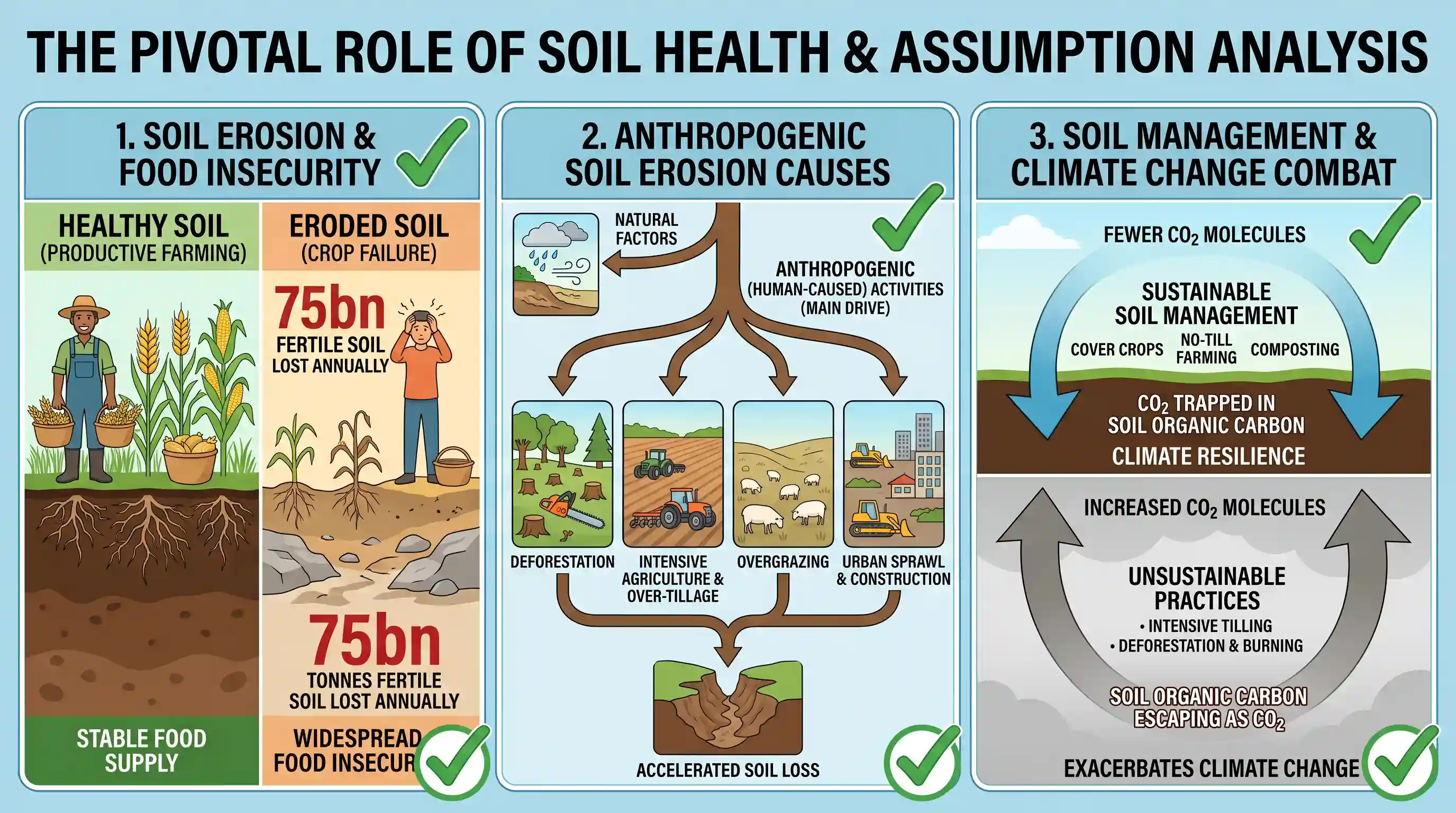
Soil, in which nearly all our food grows, is a living resource that takes years to form. Yet it can vanish in minutes. Each year 75 billion tonnes of fertile soil is lost to erosion. That is alarming – and not just for food producers. Soil can trap huge quantities of carbon dioxide in the form of organic carbon and prevent it from escaping into the atmosphere. On the basis of the above passage, the following assumptions have been made : 1. Large scale soil erosion is a major reason for widespread food insecurity in the world. 2. Soil erosion is mainly anthropogenic. 3. Sustainable management of soils helps in combating climate change. Which of the above assumptions is/are valid?

- A1 and 2 only
- B3 only
- C2 and 3 only
- D1, 2 and 3Correct
Explanation
The passage highlights two main concerns related to soil:
- Food Security: Soil is where "nearly all our food grows," and 75 billion tonnes of fertile soil are lost annually to erosion, which is "alarming – and not just for food producers."
- Climate Change: Soil can "trap huge quantities of carbon dioxide in the form of organic carbon and prevent it from escaping into the atmosphere."
Let's analyze each assumption:
-
Large scale soil erosion is a major reason for widespread food insecurity in the world.
- The passage states that soil is where "nearly all our food grows" and that the loss of 75 billion tonnes of fertile soil to erosion is "alarming – and not just for food producers." The phrase "not just for food producers" implies that it is indeed alarming for food producers, meaning it directly impacts their ability to produce food. Losing such a vast amount of fertile soil, which is essential for food production, directly leads to food insecurity. This assumption is valid.
-
Soil erosion is mainly anthropogenic.
- The passage describes the loss of soil as "alarming" and mentions that soil "can vanish in minutes," despite taking "years to form." The scale of loss (75 billion tonnes annually) and the rapid vanishing suggest an unnatural, accelerated process. While natural erosion exists, such a massive and alarming rate of loss of a vital resource is typically understood in environmental contexts to be significantly driven or exacerbated by human activities (e.g., deforestation, unsustainable agricultural practices, overgrazing). Therefore, it is a reasonable assumption that the "alarming" large-scale erosion referred to is "mainly anthropogenic" (i.e., primarily caused or significantly accelerated by human actions). This assumption is valid.
-
Sustainable management of soils helps in combating climate change.
- The passage explicitly states that "Soil can trap huge quantities of carbon dioxide in the form of organic carbon and prevent it from escaping into the atmosphere." If soil has the capacity to trap CO2, then managing soil in a way that maintains or enhances this capacity (i.e., sustainable management) would directly contribute to preventing CO2 from entering the atmosphere, thereby helping to combat climate change. This assumption is directly supported by the passage. This assumption is valid.
Since all three assumptions are valid based on the information provided and reasonable inferences, option D is the correct answer.
The final answer is $\boxed{D}$
Related questions
More UPSC Prelims practice from the same subject and topic.
- Prelims 2019CSATReading Comprehension
What stands in the way of the widespread and careful adoption of 'Genetic Modification (GM)' technology is an 'Intellectual Property Rights' regime that seeks to create private monopolies for such tec…
- Prelims 2019CSATReading Comprehension
Passage-1 What stands in the way of the widespread and careful adoption of 'Genetic Modification (GM)' technology is an 'Intellectual Property Rights' regime that seeks to create private monopolies fo…
- Prelims 2019CSATReading Comprehension
Most invasive species are neither terribly successful nor very harmful. Britain's invasive plants are not widespread, not spreading especially quickly, and often less of a nuisance than vigorous nativ…
- Prelims 2019CSATReading Comprehension
Diarrhoeal deaths among Indian children are mostly due to food and water contamination. Use of contaminated groundwater and unsafe chemicals in agriculture, poor hygiene in storage and handling of foo…
- Prelims 2019CSATReading Comprehension
The interests of working and poor people have historically been neglected in the planning of our cities. Our cities are increasingly intolerant, unsafe and unlivable places for large numbers of citize…
- Prelims 2019CSATReading Comprehension
A vast majority of Indians are poor, with barely 10 percent employed in the organised sector. We are being convinced that vigorous economic growth is generating substantial employment. But this is not…