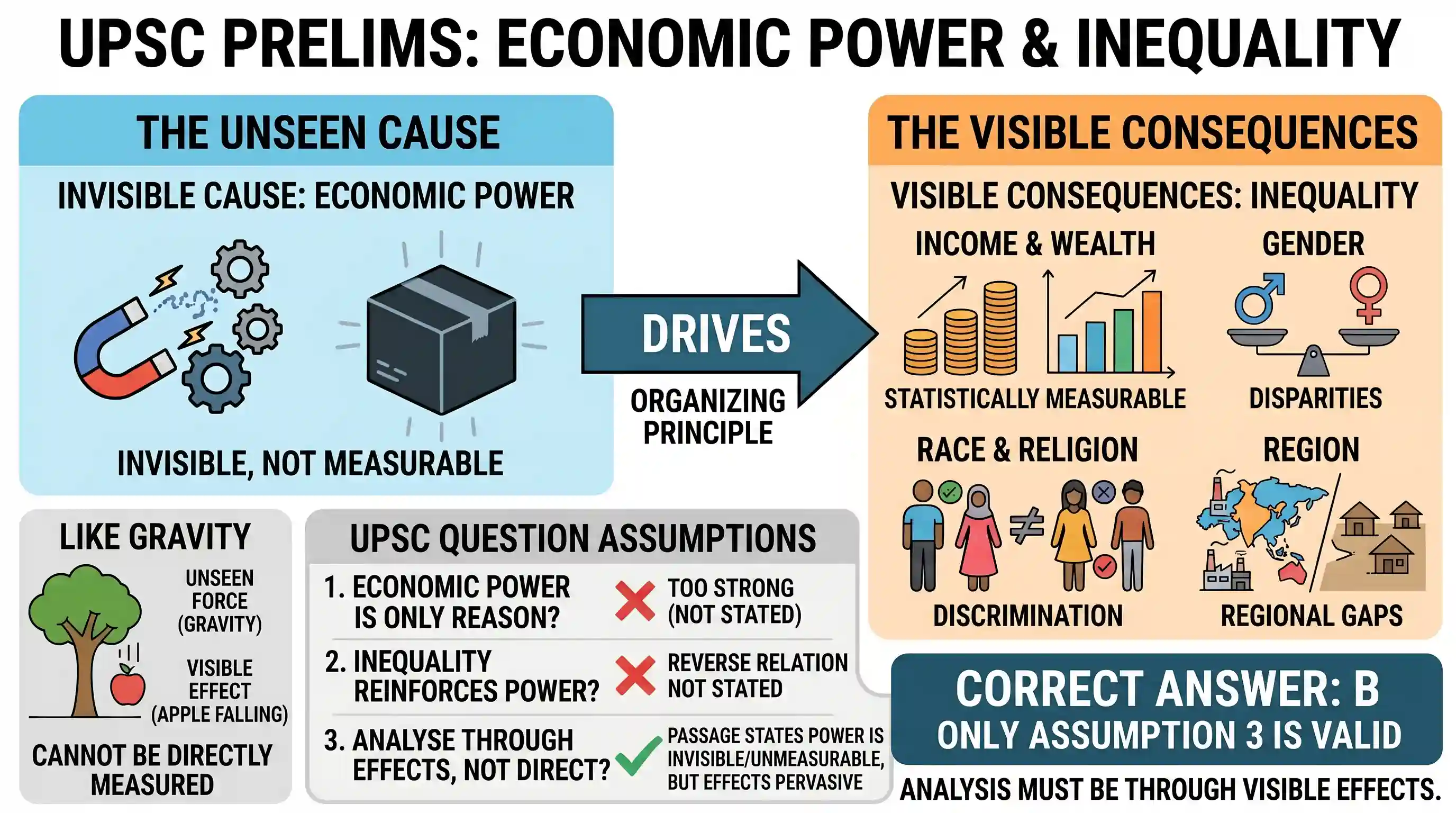
Inequality is visible, even statistically measurable in many instances, but the economic power that drives it is invisible and not measurable... Like the force of gravity, power is the organising principle of inequality, be it of income, or wealth, gender, race, religion and region. Its effects are seen in a pervasive manner in all spheres, but the ways in which economic power pulls and tilts visible economic variables remain invisibly obscure, On the basis of the above passage, the following assumptions have been made: 1. Economic power is the only reason for the existence of inequality in a society. 2. Inequality of different kinds, income, wealth, etc, reinforces power. 3. Economic power can be analysed more through its effects than by direct empirical methods. Which of thy above assumptions is/are valid?

- A1 and 2 only
- B3 onlyCorrect
- C1 and 3 only
- D1, 2 and 3
Explanation
Statement 1: "Economic power is the only reason for the existence of inequality in a society." The passage states that "power is the organising principle of inequality, be it of income, or wealth, gender, race, religion and region." While it highlights economic power as an invisible driver, it does not explicitly state that it is the only reason. The mention of various types of inequality (gender, race, religion, region) suggests that other forms of power or factors might also contribute, even if economic power is presented as a fundamental underlying force. The word "only" makes this assumption too strong and not directly supported by the passage.
Statement 2: "Inequality of different kinds, income, wealth, etc, reinforces power." The passage describes power as the "organising principle of inequality." This establishes a causal link where power drives or creates inequality. It does not mention a reverse relationship where inequality, in turn, reinforces power. The passage focuses on power as the cause, not inequality as a cause or reinforcer of power.
Statement 3: "Economic power can be analysed more through its effects than by direct empirical methods." The passage explicitly states that economic power "is invisible and not measurable" and that "Its effects are seen in a pervasive manner in all spheres." It also notes that "the ways in which economic power pulls and tilts visible economic variables remain invisibly obscure." This directly implies that since economic power itself is invisible and not measurable (i.e., not amenable to direct empirical methods), understanding or analyzing it must be done by observing its visible and pervasive effects. This statement is directly supported by the text.
Therefore, only assumption 3 is valid based on the provided passage.
The final answer is B.
Related questions
More UPSC Prelims practice from the same subject and topic.
- Prelims 2019CSATReading Comprehension
What stands in the way of the widespread and careful adoption of 'Genetic Modification (GM)' technology is an 'Intellectual Property Rights' regime that seeks to create private monopolies for such tec…
- Prelims 2019CSATReading Comprehension
Passage-1 What stands in the way of the widespread and careful adoption of 'Genetic Modification (GM)' technology is an 'Intellectual Property Rights' regime that seeks to create private monopolies fo…
- Prelims 2019CSATReading Comprehension
Most invasive species are neither terribly successful nor very harmful. Britain's invasive plants are not widespread, not spreading especially quickly, and often less of a nuisance than vigorous nativ…
- Prelims 2019CSATReading Comprehension
Diarrhoeal deaths among Indian children are mostly due to food and water contamination. Use of contaminated groundwater and unsafe chemicals in agriculture, poor hygiene in storage and handling of foo…
- Prelims 2019CSATReading Comprehension
The interests of working and poor people have historically been neglected in the planning of our cities. Our cities are increasingly intolerant, unsafe and unlivable places for large numbers of citize…
- Prelims 2019CSATReading Comprehension
A vast majority of Indians are poor, with barely 10 percent employed in the organised sector. We are being convinced that vigorous economic growth is generating substantial employment. But this is not…