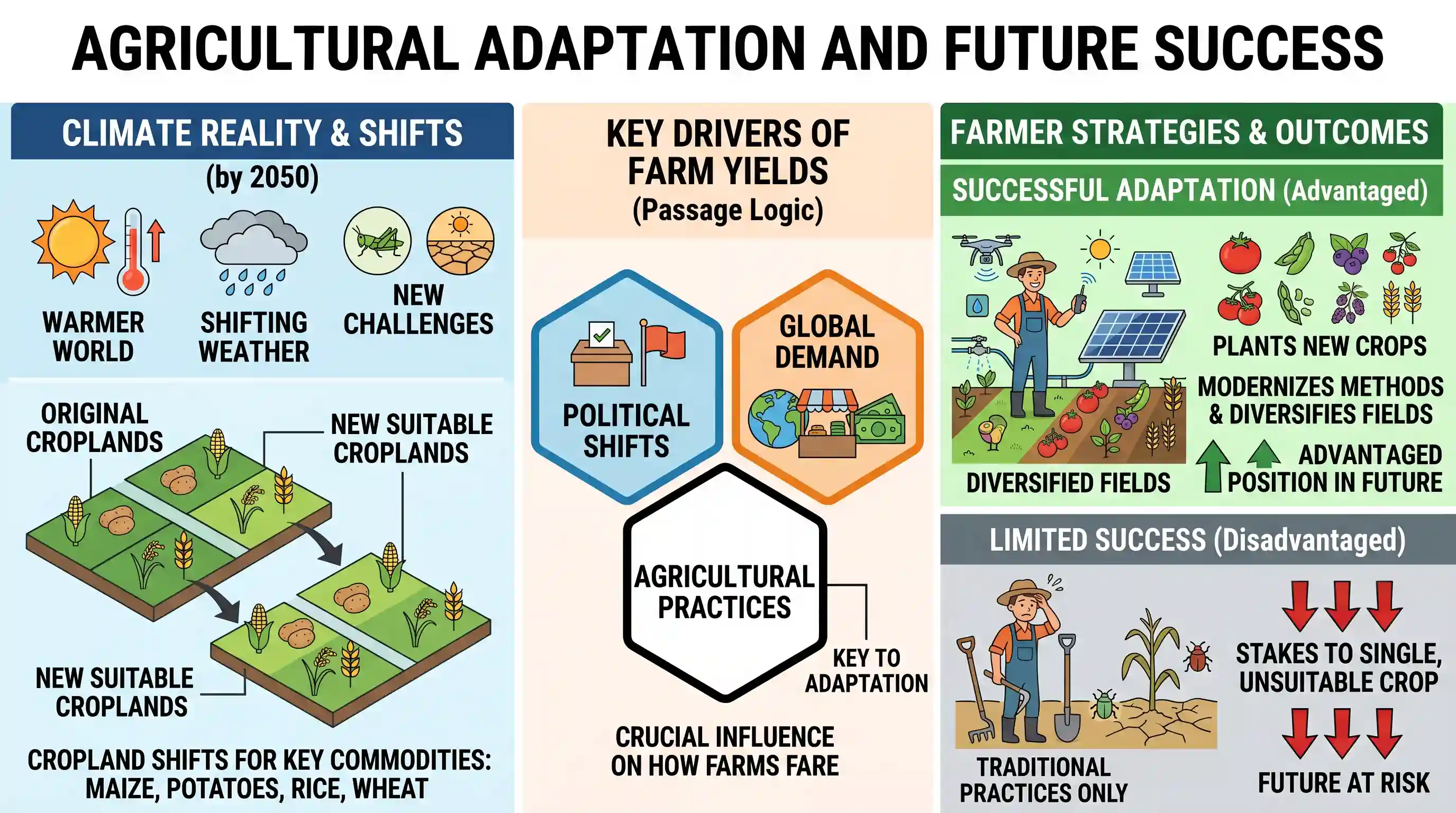
Climate change may actually benefit some plants by lengthening growing seasons and increasing carbon dioxide. Yet other effects of a warmer world, such as more pests, droughts, and flooding, will be less benign. How will the world adapt ? Researchers project that by 2050, suitable croplands for four commodities — maize, potatoes, rice and wheat — will shift, in some cases pushing farmers to plant new crops. Some farmlands may benefit from warming, but others won't. Climate alone does not dictate yields; political shifts, global "demand, and agricultural practices will influence how farms fare in the future. Which one of the following is the most logical and rational inference that can be made from) the above passage?

- AFarmers who modernize their methods and diversify their fields will be. in an advantageous position in futureCorrect
- BClimate change will adversely affect the crop diversity
- CShifting ma'r crops to new croplands will lead to a gr t increase in the total area under culti tion and thus an increase in overall agricultural production
- DClimate change is the most important factor affecting the agricultural economy in the future.
Explanation
The passage highlights that climate change will cause shifts in suitable croplands, forcing farmers to plant new crops. It also states that "agricultural practices will influence how farms fare in the future."
A) Farmers who modernize their methods and diversify their fields will be in an advantageous position in future. This aligns with the passage's mention of farmers needing to plant new crops (diversification) and that agricultural practices (modernization) will be crucial for future success in a changing climate. It represents a logical adaptation strategy.
B) Climate change will adversely affect the crop diversity. The passage states farmers will be "pushing farmers to plant new crops," which implies a shift in crops grown, potentially leading to different forms of diversity or new crops being adopted, rather than a clear adverse effect on overall crop diversity.
C) Shifting major crops to new croplands will lead to a great increase in the total area under cultivation and thus an increase in overall agricultural production. The passage only mentions a "shift" in suitable croplands and that some farmlands may benefit while others won't. There is no information to suggest a "great increase" in total cultivated area or overall production.
D) Climate change is the most important factor affecting the agricultural economy in the future. The passage explicitly states, "Climate alone does not dictate yields; political shifts, global demand, and agricultural practices will influence how farms fare in the future." This directly contradicts the idea that climate change is the most important factor.
Therefore, option A is the most logical and rational inference as it directly addresses the need for adaptation, diversification, and improved practices in response to the challenges and shifts described.
Related questions
More UPSC Prelims practice from the same subject and topic.
- Prelims 2019CSATReading Comprehension
What stands in the way of the widespread and careful adoption of 'Genetic Modification (GM)' technology is an 'Intellectual Property Rights' regime that seeks to create private monopolies for such tec…
- Prelims 2019CSATReading Comprehension
Passage-1 What stands in the way of the widespread and careful adoption of 'Genetic Modification (GM)' technology is an 'Intellectual Property Rights' regime that seeks to create private monopolies fo…
- Prelims 2019CSATReading Comprehension
Most invasive species are neither terribly successful nor very harmful. Britain's invasive plants are not widespread, not spreading especially quickly, and often less of a nuisance than vigorous nativ…
- Prelims 2019CSATReading Comprehension
Diarrhoeal deaths among Indian children are mostly due to food and water contamination. Use of contaminated groundwater and unsafe chemicals in agriculture, poor hygiene in storage and handling of foo…
- Prelims 2019CSATReading Comprehension
The interests of working and poor people have historically been neglected in the planning of our cities. Our cities are increasingly intolerant, unsafe and unlivable places for large numbers of citize…
- Prelims 2019CSATReading Comprehension
A vast majority of Indians are poor, with barely 10 percent employed in the organised sector. We are being convinced that vigorous economic growth is generating substantial employment. But this is not…