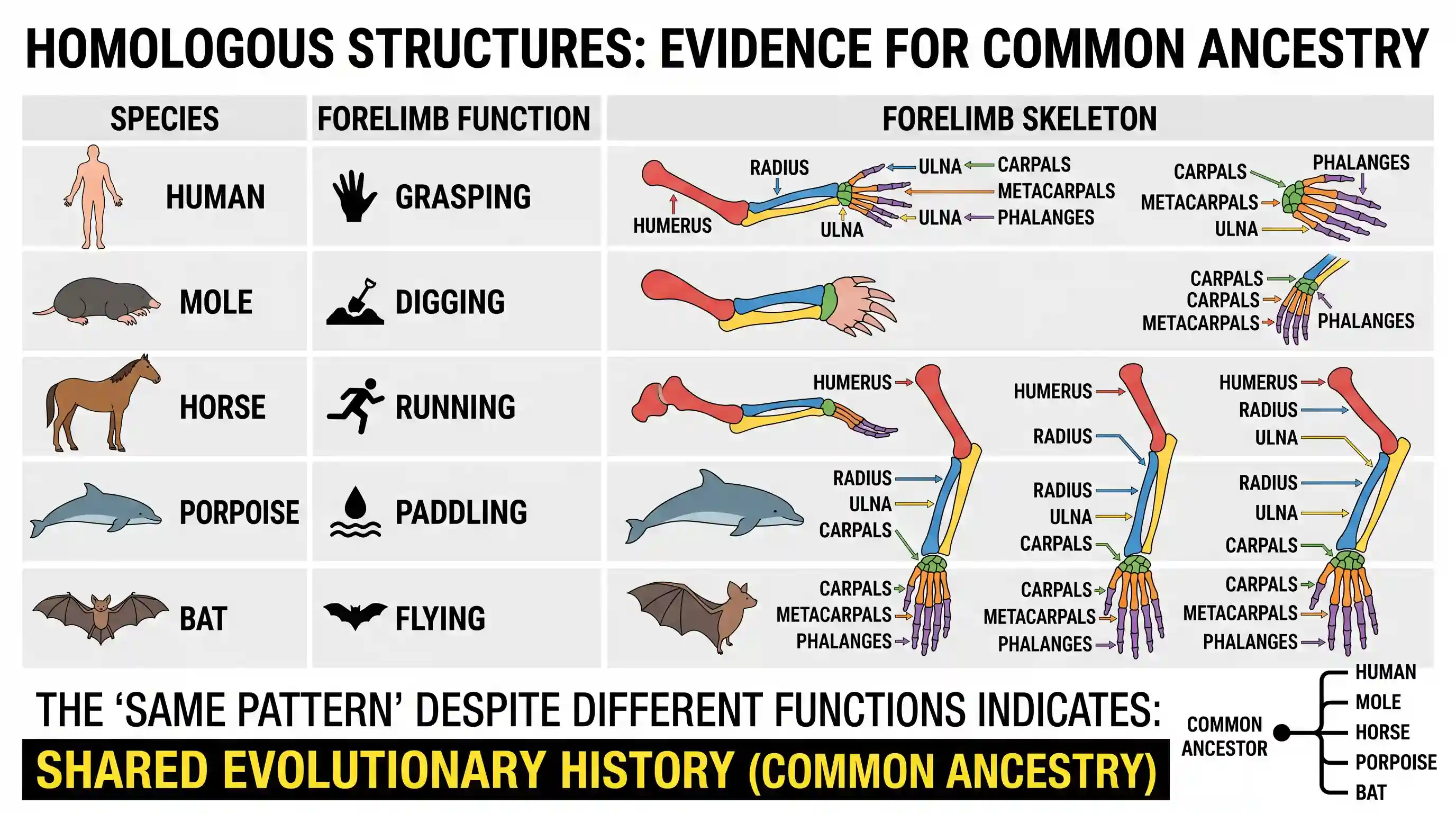
A bat's .wings may look like sheets of skin. But underneath, a bat has the same five fingers as an orangutan or a human, as well as a wrist connected to the same cluster of wrist bones connected to the same long bones of the arm. What can be more curious than that the hand of a man, formed for grasping, that of a mole for digging, the leg of the horse, the-paddle of the porpoise, and the wing of the bat, should all be constructed on the some pattern ? Which one of the following is the most logical, scientific and rational inference that can be made from the above passage?

- ADifferent species having similar structure of hands is an example of biodiversity
- BLimbs being used by different species for different kinds of work is an example of biodiversity
- CMan and the aforementioned animals having similar structure of limbs is an example of coincidence in evolution
- DMan and the aforementioned animals have a shared evolutionary history.Correct
Explanation
The passage describes homologous structures: the limbs of humans, moles, horses, porpoises, and bats, despite being adapted for different functions (grasping, digging, running, paddling, flying), share a fundamental underlying skeletal pattern (same five fingers, wrist bones, long arm bones).
A) Different species having similar structure of hands is an example of biodiversity. Biodiversity refers to the variety of life. While these are different species, the similarity in structure points to a specific evolutionary relationship, not just the general concept of variety.
B) Limbs being used by different species for different kinds of work is an example of biodiversity. This describes functional diversity, which is true, but the passage's core curiosity is about the underlying structural similarity despite these functional differences, not just the differences in work.
C) Man and the aforementioned animals having similar structure of limbs is an example of coincidence in evolution. In biology, such widespread and fundamental structural similarities across diverse species are considered strong evidence of common ancestry, not mere coincidence. Coincidence is not a scientific explanation for such a consistent pattern.
D) Man and the aforementioned animals have a shared evolutionary history. This is the most logical, scientific, and rational inference. The presence of homologous structures (similar underlying anatomy adapted for different functions) is a key piece of evidence for common descent. The "same pattern" suggests a common blueprint inherited from a shared ancestor, which was then modified over time through natural selection to suit different environments and lifestyles.
Related questions
More UPSC Prelims practice from the same subject and topic.
- Prelims 2019CSATReading Comprehension
What stands in the way of the widespread and careful adoption of 'Genetic Modification (GM)' technology is an 'Intellectual Property Rights' regime that seeks to create private monopolies for such tec…
- Prelims 2019CSATReading Comprehension
Passage-1 What stands in the way of the widespread and careful adoption of 'Genetic Modification (GM)' technology is an 'Intellectual Property Rights' regime that seeks to create private monopolies fo…
- Prelims 2019CSATReading Comprehension
Most invasive species are neither terribly successful nor very harmful. Britain's invasive plants are not widespread, not spreading especially quickly, and often less of a nuisance than vigorous nativ…
- Prelims 2019CSATReading Comprehension
Diarrhoeal deaths among Indian children are mostly due to food and water contamination. Use of contaminated groundwater and unsafe chemicals in agriculture, poor hygiene in storage and handling of foo…
- Prelims 2019CSATReading Comprehension
The interests of working and poor people have historically been neglected in the planning of our cities. Our cities are increasingly intolerant, unsafe and unlivable places for large numbers of citize…
- Prelims 2019CSATReading Comprehension
A vast majority of Indians are poor, with barely 10 percent employed in the organised sector. We are being convinced that vigorous economic growth is generating substantial employment. But this is not…