Around 56 million years ago, the Atlantic Ocean had not fully opened and animals, perhaps including our primate ancestors, could walk from Asia to North America through Europe and across Greenland. Earth was warmer than it is today, but as the Palaeocene epoch gave way to Eocene, it was about to get much warmer still – rapidly and radically. The cause was a massive geologically sudden release of carbon. During this period called Palaeocene – Eocene Thermal Maximum or PETM, the carbon injected into the atmosphere was roughly the amount that Would be injected today if humans burned all the Earth's reserves of coal, oil and natural gas. The PETM lasted for about 1,50,000 years, until the excess carbon was reabsorbed. It brought on drought, floods, insect plagues and a few extinctions. Life on Earth survived – indeed, it prospered – but it was drastically different. Based on the above passage, the following assumptions have been made: 1. Global warming has a bearing on the planet's biological evolution. 2. Separation of land masses causes the release of huge quantities of carbon into the atmosphere. 3. Increased warming of Earth's atmosphere can change the composition of its flora and fauna. 4. The present man-made global warming will finally lead to conditions similar to those which happened 56 million years ago. Which of the assumptions given above are valid?

- A1 and 2
- B3 and 4
- C1 and 3Correct
- D2 and 4
Explanation
The explanation for why C is correct is as follows:
Analyze each assumption:
-
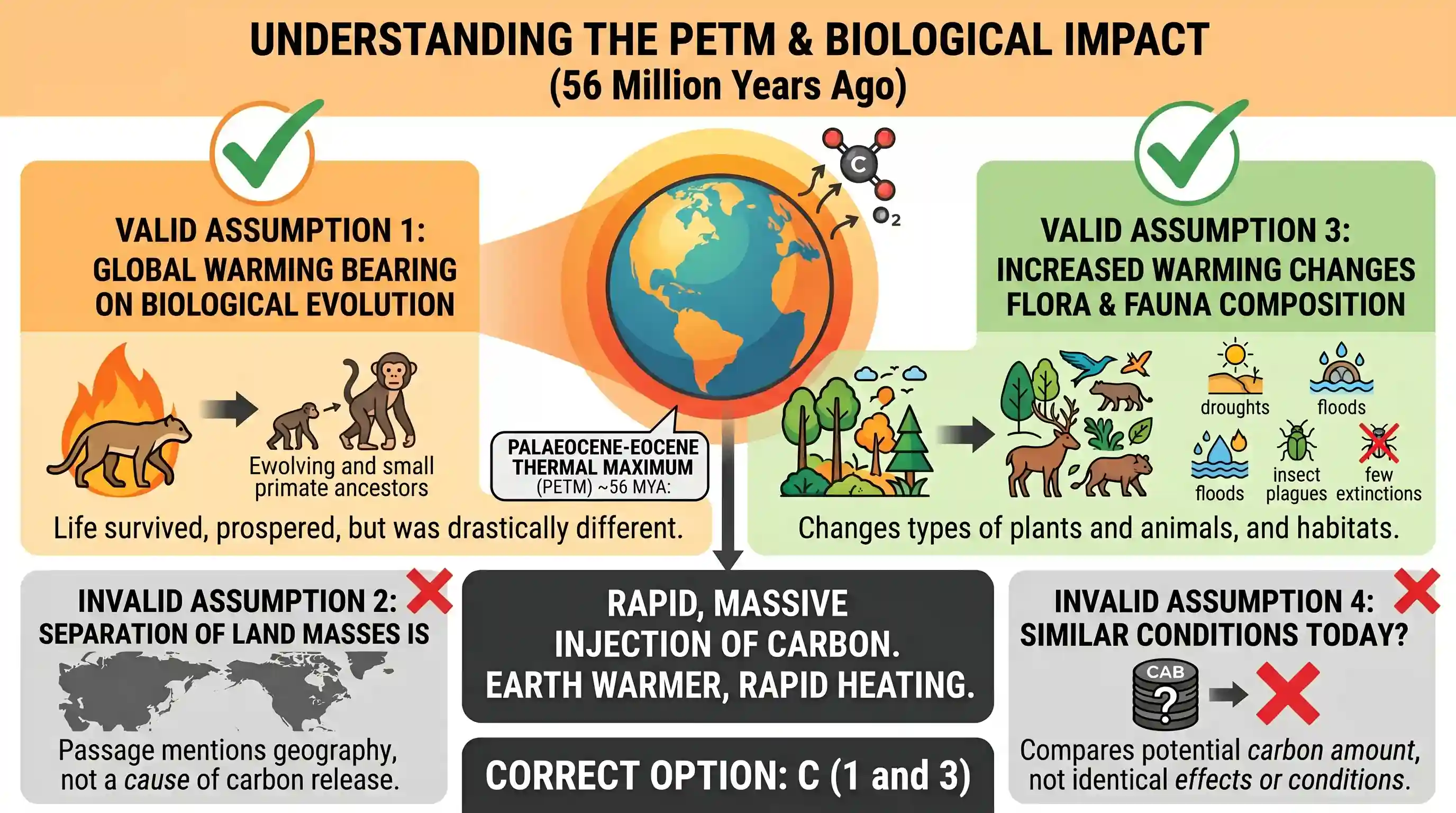
Global warming has a bearing on the planet's biological evolution. The passage states that during the PETM, Earth got much warmer, and "Life on Earth survived – indeed, it prospered – but it was drastically different." This "drastically different" outcome for life, following a period of rapid warming, directly supports the idea that global warming can influence biological evolution or significant changes in life forms. So, this assumption is valid.
-
Separation of land masses causes the release of huge quantities of carbon into the atmosphere. The passage mentions that "the Atlantic Ocean had not fully opened" around 56 million years ago and then states that the "cause was a massive geologically sudden release of carbon." However, it does not link the separation of land masses (opening of the Atlantic) as the cause of the carbon release. It merely describes the geographical context before the carbon release event. Therefore, this assumption is not supported by the passage.
-
Increased warming of Earth's atmosphere can change the composition of its flora and fauna. The passage describes the PETM as a period of rapid warming, which "brought on drought, floods, insect plagues and a few extinctions. Life on Earth survived – indeed, it prospered – but it was drastically different." A "drastically different" life implies a change in the types and distribution of plants (flora) and animals (fauna). This directly supports the assumption that increased warming can change the composition of flora and fauna. So, this assumption is valid.
-
The present man-made global warming will finally lead to conditions similar to those which happened 56 million years ago. The passage makes a comparison regarding the amount of carbon released: "the carbon injected into the atmosphere was roughly the amount that Would be injected today if humans burned all the Earth's reserves of coal, oil and natural gas." This is a comparison of the potential cause (carbon amount), not a definitive statement that the effects or conditions will be identical or similar. While the carbon amount might be similar, the passage does not guarantee that all resulting conditions (drought, floods, insect plagues, extinctions, and how life adapts) will be similar. It's an overreach to assume exact similarity of conditions. Therefore, this assumption is not directly supported.
Based on the analysis, only assumptions 1 and 3 are valid according to the passage. Hence, option C is the correct answer.
Related questions
More UPSC Prelims practice from the same subject and topic.
- Prelims 2019CSATReading Comprehension
What stands in the way of the widespread and careful adoption of 'Genetic Modification (GM)' technology is an 'Intellectual Property Rights' regime that seeks to create private monopolies for such tec…
- Prelims 2019CSATReading Comprehension
Passage-1 What stands in the way of the widespread and careful adoption of 'Genetic Modification (GM)' technology is an 'Intellectual Property Rights' regime that seeks to create private monopolies fo…
- Prelims 2019CSATReading Comprehension
Most invasive species are neither terribly successful nor very harmful. Britain's invasive plants are not widespread, not spreading especially quickly, and often less of a nuisance than vigorous nativ…
- Prelims 2019CSATReading Comprehension
Diarrhoeal deaths among Indian children are mostly due to food and water contamination. Use of contaminated groundwater and unsafe chemicals in agriculture, poor hygiene in storage and handling of foo…
- Prelims 2019CSATReading Comprehension
The interests of working and poor people have historically been neglected in the planning of our cities. Our cities are increasingly intolerant, unsafe and unlivable places for large numbers of citize…
- Prelims 2019CSATReading Comprehension
A vast majority of Indians are poor, with barely 10 percent employed in the organised sector. We are being convinced that vigorous economic growth is generating substantial employment. But this is not…