With reference to different Committees in India, consider the following details : | Sl. No. | Committee | Objective | Organization under which it was formed | | :--- | :--- | :--- | :--- | | 1. | R.N. Malhotra Committee | Comprehensive reforms of Insurance sector in India | Insurance Regulatory and Development Authority of India | | 2. | L.C. Gupta Committee | Preparing a roadmap for the introduction of derivatives trading in India | Securities and Exchange Board of India | | 3. | Urjit R. Patel Committee | Preparing a roadmap for reforming bank lending to the Housing sector | Reserve Bank of India | | 4. | Y.H. Malegam Committee | Preparing a roadmap for reforms in Microfinance sector in India | Reserve Bank of India | In which of the above rows are all the details correctly matched ?

- A2 only
- B2 and 3
- C1, 3 and 4
- D2 and 4Correct
Explanation
The correct answer is Option D (2 and 4).
Here is a detailed analysis of each committee:
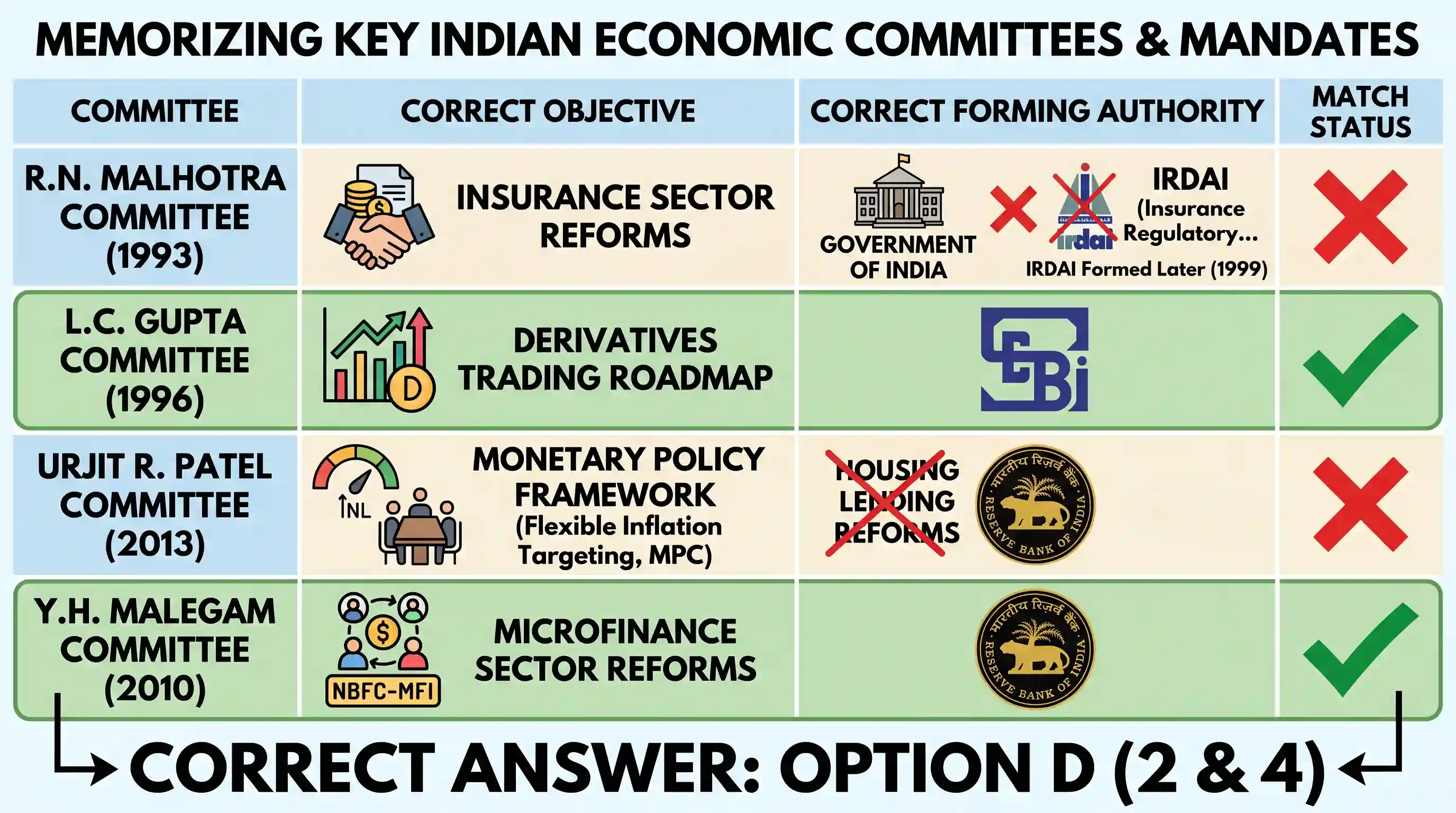
- Row 2 is correctly matched: The L.C. Gupta Committee was appointed by the Securities and Exchange Board of India (SEBI) in 1996. Its primary objective was to develop a regulatory framework and prepare a roadmap for the introduction of derivatives trading in India's capital markets.
- Row 4 is correctly matched: The Y.H. Malegam Committee was constituted by the Reserve Bank of India (RBI) in 2010. Following the Andhra Pradesh microfinance crisis, this sub-committee was tasked with studying issues and concerns in the microfinance sector, eventually leading to the creation of a separate regulatory framework for NBFC-MFIs.
- Row 1 is incorrectly matched: The R.N. Malhotra Committee was indeed formed in 1993 to recommend comprehensive reforms in the Indian insurance sector. However, it was constituted by the Government of India, not the Insurance Regulatory and Development Authority of India (IRDAI). In fact, the IRDAI itself was established in 1999 as a direct statutory result of this committee's recommendations.
- Row 3 is incorrectly matched: While the Urjit R. Patel Committee was constituted by the RBI in 2013, its objective was to revise and strengthen the Monetary Policy Framework, not housing sector lending. The committee is historically significant for recommending the adoption of a flexible inflation-targeting framework (using CPI as the nominal anchor) and the establishment of the Monetary Policy Committee (MPC).
Takeaway: Remember these key associations: Malhotra = Insurance Reforms (GoI), Gupta = Derivatives Framework (SEBI), Patel = Monetary Policy/Inflation Targeting (RBI), and Malegam = Microfinance Regulations (RBI).
Related questions
More UPSC Prelims practice from the same subject and topic.
- Prelims 2026GS1economy
Consider the following statements with reference to the Sagarmala Programme of the Government of India : I. The Sagarmala Programme seeks to achieve port-led economic growth through cost-effective and…
- Prelims 2026GS1economy
In what way(s) does the Vizhinjam International Seaport represent a structural shift in India's maritime trade and logistics policy? 1. By functioning exclusively as a domestic cargo hub to reduce rel…
- Prelims 2026GS1economy
An e-commerce revenue model where the seller has control over pricing but doesn't keep products in stock and instead transfers customer orders and shipment details to a third-party supplier, who then …
- Prelims 2026GS1economy
Which one of the following correctly represents the three key sub-indices of the Financial Inclusion Index (FI-Index) of the Reserve Bank of India (RBI) ?
- Prelims 2026GS1economy
Which one of the following best describes the key objective of India's 'Open Network for Digital Commerce' (ONDC) initiative ?
- Prelims 2026GS1economy
Which one of the following statements about Unified Payments Interface (UPI) and Central Bank Digital Currency (Digital Rupee) is not correct ?